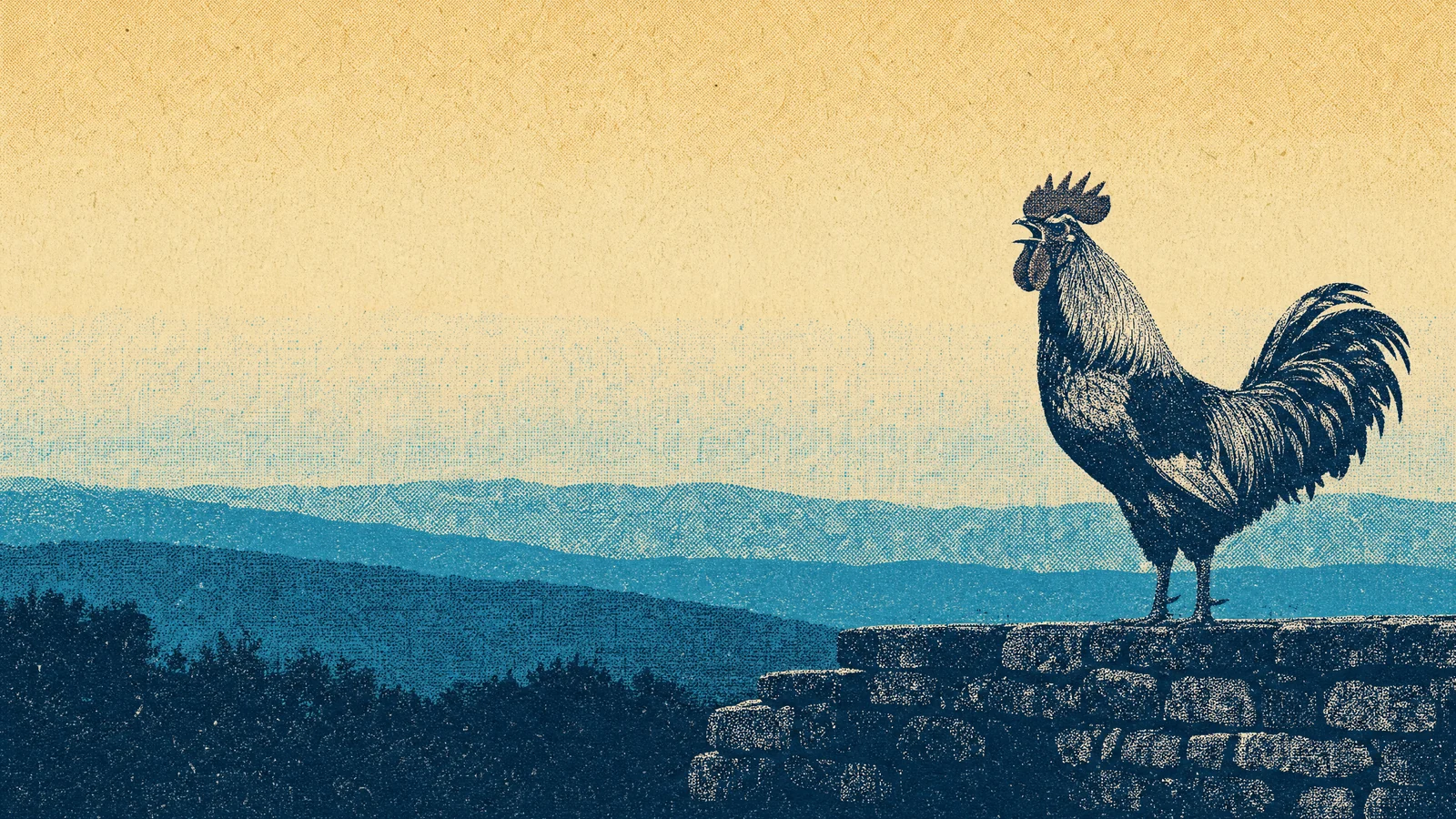
A chicken dream tends to linger as sound rather than image.
Many people can't recall what the chicken looked like, yet the crowing stays vivid — and there was something strange about it. Too loud, too close, or somehow at the wrong time.
That instinct is correct. In chicken dreams, sound is the fork in the road. And it lines up precisely with the grammar of old dream interpretation.
Lumi
"That rooster — when did it crow?
At dawn? Or in the middle of the night?
That's where it splits. It's the detail people in the past cared about most."
Table of contents
The Chicken's Hour: YusiIn Old Dream Manuals, Every Bird Entry Hinged on Crying OutNo Sewing on the First Rooster Day of the New YearThe Chicken's Five VirtuesWhen Did It Crow?A Dream of Seeing or Laying an EggA Dream of Slaughtering a ChickenChicks, a Flock, and Fighting ChickensThe Most Honest AnswerFrequently Asked QuestionsThe Chicken's Hour: Yusi
Our separate guide to monkey dreams (not yet available in English) covers how the Hour of the Monkey (sinsi) is classified as yang and assigned to Metal in the Five Elements system. The chicken comes next, occupying the Hour of the Rooster (yusi) — roughly 5 to 7 p.m.
According to the "Thirty-Six Beasts" entry in the Encyclopedia of Korean Culture (a major reference work on Korean history and culture compiled by the Academy of Korean Studies) — a system that further subdivides each of the twelve zodiac hours into three finer categories — the Rooster hour is yin, sharing the Metal element with the Monkey hour before it. Since the previous hour was yang, this marks a swing back to yin.
Something here is a little puzzling. The chicken is known as the bird that announces dawn, yet the hour assigned to it is dusk.
The twelve zodiac hours (sipyiji, the traditional system dividing the day into twelve two-hour blocks, each paired with an animal) appear to have marked not when the chicken crows, but when it climbs onto its roost — the moment it settles in as the day closes. For a chicken, that's where the day ends.
Subdivided into thirty-six beasts, the Rooster hour breaks down further still: an unnamed "bird" at the start, the chicken in the middle, and the pheasant at the end. A generic, unnamed bird comes first and the pheasant trails behind — which also means the chicken was placed as the representative of birds in general.
In Old Dream Manuals, Every Bird Entry Hinged on Crying Out
This is the heart of this piece.
Looking at the animal entries in the folk dream-interpretation list in the "Dreams" entry of the Encyclopedia of Korean Culture, three birds appear: the crane, the parrot, and the swallow.
Look closely at the conditions, though, and a pattern emerges.
- If a crane cries clearly, you will win renown.
- If a parrot cries, your wife will become the subject of gossip.
- If a swallow flies into your bosom, you will bear a son.
Two of the three hinge on crying out. The tiger, in the same list, follows the same rule: opening its mouth wide and roaring is said to bring a government post. We cover this in more detail in our separate guide to tiger dreams, not yet available in English.
In old dream interpretation, sound itself was the condition. Hearing carried more weight than seeing. It makes sense once you consider what it meant to hear an animal call at night, in the mountains or the yard — knowing something was there without being able to see it.
The chicken doesn't appear in this list. Like the ox and the horse, discussed in our separate guides to cow dreams and horse dreams (also not yet available in English), it may simply have been too common to need symbolism. It was always right there in the yard.
But that grammar fits the chicken better than almost any other bird. Crying out is, quite literally, its job.
No Sewing on the First Rooster Day of the New Year
The chicken also survives in Korea's traditional seasonal customs.
The "Sangyu-il" entry in the Encyclopedia of Korean Culture — Sangyu-il being the set of taboo days tied to each of the twelve zodiac animals at the start of the lunar new year — lists the taboos observed on the first Rooster Day of the first lunar month.
- Women were forbidden from sewing. Tradition held that sewing or weaving on this day would leave your hands shaped like a chicken's ugly feet.
- On Jeju Island, people avoided gathering on this day, believing it would lead to a fight.
- Chickens were not slaughtered and roofs were not rethatched, out of a belief that a chicken would climb up and tear the roof apart.
- In South Jeolla Province, grain was not spread out in the yard, since a chicken scattering it was believed to bring a poor harvest or scatter one's fortune.
Our monkey dream guide mentions that people avoided using knives on the first Monkey Day of the new year. The Rooster Day taboo is sewing. Both cases forbid work done with the hands.
The reasoning is entertaining. Most of the Rooster Day taboos trace back to what chickens actually do — scratching, digging, scattering. These are rules made by people who knew exactly what a chicken would do to grain left out in the yard.
The Chicken's Five Virtues
People in the past believed the chicken possessed five virtues.
| Civility (mun) | its comb resembles a crown |
| Martial prowess (mu) | its spurs are sharp |
| Courage (yong) | it does not retreat when it meets an enemy |
| Benevolence (in) | it calls the flock when it finds food |
| Trustworthiness (sin) | it crows without fail, on time |
The last one is the key to this whole piece.
The chicken's virtue isn't in crowing itself — it's in crowing at the right time. A chicken is only truly a chicken when it crows at dawn. That's why folk tradition took a dim view of crowing at the wrong hour. It's also why stories of a chicken crowing in the early evening or the dead of night are generally passed down as ill omens.
This is why the first question about a chicken dream is always the time.
When Did It Crow?

It Crowed at Dawn
In traditional interpretation, this is the chicken right where it belongs. In the Silla-era (one of ancient Korea's Three Kingdoms) legend of Kim Al-ji, founding ancestor of the Gyeongju Kim clan, a chicken's crow is said to have revealed where a child was found. A rooster's crow was a signal that darkness was ending and something was beginning.
From a modern psychological perspective, it's not unusual for a dawn sound to work its way into a dream — sounds heard during sleep really do get woven into dream content. Yi Ik, a late-Joseon-era silhak (practical-learning) scholar, made the same observation in his essay "Monggamnon" ("On the Causes of Dreams"), writing that hearing a drum while asleep produces dreams about the military.
If you heard a rooster crow just before your alarm went off, that may not be a matter of dream interpretation at all — it may just be your alarm.
It Crowed at Midnight or in the Early Evening
In folk tradition, a chicken crowing at the wrong hour was generally treated as an ill omen. This is less a documented entry from a dream-interpretation text than a widely circulated folk belief, so we'll keep the claim scoped to that.
From a modern psychological perspective, this scene is an image of misalignment — the right thing occurring at the wrong time. Some interpretations describe it as the kind of image that surfaces when you feel a sequence has been reversed or a moment has been missed.
If the dream felt strange rather than frightening, that reading is more likely.
Lumi
"Some people say the chicken opened its beak to crow but nothing came out.
Mouth open, no sound at all.
That's a fairly common scene — and it's a slightly different story."
A dream where no sound comes out may not really be about the chicken at all. It's worth looking at alongside our separate guide to voiceless dreams, not yet available in English.
A Dream of Seeing or Laying an Egg
In traditional interpretation, the egg was often treated as an image of beginnings. In Silla's founding myth, the dynasty's progenitor is born from an egg. That said, there is no separate egg entry in the dream-interpretation list itself.
From a modern psychological perspective, an egg is an image of something not yet opened — a matter whose outcome hasn't arrived, something started but not yet shaped.
What matters here is the egg's condition.
- Whether it was intact, cracked, or broken
- Whether it was warm or cold
- How many there were
Whether you felt upset seeing a broken egg, or felt nothing at all, also makes a difference.
An egg appearing does not mean you're pregnant. We cover why a taemong (a conception dream, believed in Korean folk tradition to foretell a pregnancy) cannot reveal whether someone is pregnant or the baby's sex in our separate guide to conception dreams, not yet available in English.
A Dream of Slaughtering a Chicken
In traditional interpretation, slaughtering livestock was generally depicted as a scene tied to receiving a guest or marking a special occasion. Chicken was the meat that appeared at feasts and on a guest's table.
That said, records note the taboo against slaughtering chickens on the first Rooster Day of the new year. In other words, it depended on the occasion.
From a modern psychological perspective, some interpretations read this scene through guilt, similar to rabbit dreams or sheep dreams (both covered in separate guides, not yet available in English). Because chicken is livestock people actually eat, though, the sensation is a little different.
If you woke up feeling unsettled, that feeling is the information. If you felt nothing, that's information too.
Chicks, a Flock, and Fighting Chickens
Chicks
A young chick feels completely different from an adult chicken. It isn't a threat, and it doesn't sound like one. The scene shifts toward care.
How many there were, whether a mother hen was present, and whether they scattered are all worth noting.
A Flock of Chickens
From a modern psychological perspective, a flock of chickens is different from a flock of sheep in our separate sheep dream guide. Where sheep tend to appear as a still image, chickens appear as a chaotic one — they swarm the moment feed is thrown and scatter just as fast.
This scene sometimes carries over the exact sensation of having been in a chaotic environment.
Fighting Chickens
Cockfighting is an old pastime, so this scene may be less symbolic and more a case of a familiar image simply resurfacing.
From a modern psychological perspective, what matters is your position — whether you were part of the fight, watching it, or the one setting it up. Dreams about conflict in general are covered in our separate guide to fighting dreams, not yet available in English.
The Most Honest Answer
Lumi
"Search for chicken dreams and you'll find talk of wealth or gossip.
There's no chicken entry in the dream-interpretation list. I couldn't find one either.
What I can tell you for certain is that the 'crying out' condition is real."
Traditional dream interpretation and modern psychology rely on different kinds of evidence.
Even the encyclopedia, after listing out its dream-interpretation entries, notes directly that these readings formed naturally out of many people's experiences rather than from any consistent theoretical basis. A case where the same dream was interpreted in opposite ways depending on who read it survives in the Samguk Yusa (Memorabilia of the Three Kingdoms, a 13th-century compilation of early Korean history and legend) as well.
The chicken has a clear presence in seasonal customs and myth, but it is not confirmed as a dream-interpretation entry.
So the chicken-dream interpretations you find online, the ones attaching words like wealth, gossip, or news, may simply have borrowed the grammar of other bird entries. The crane-crying-brings-renown and parrot-crying-brings-gossip entries genuinely exist, and that logic may well have migrated onto the chicken.
There is no confirmed connection between chicken dreams and lottery numbers. Money-related dreams in general are covered in our separate guide to finding-money dreams, not yet available in English.
The old saying that "a crowing hen brings ruin to the household" isn't dream interpretation at all — it's an old expression rooted in looking down on women. It isn't a valid basis for interpreting a dream.
Frequently Asked Questions
Is a chicken dream an auspicious dream? There's no chicken entry in the dream-interpretation list, so nothing can be stated with certainty. But since every bird entry in that same list hinges on crying out, it's practical to focus on whether it crowed, and when.
The chicken crows at dawn, so why is its zodiac hour in the evening? There's no exact reason on record. One explanation holds that the hour marks when the chicken climbs onto its roost rather than when it crows.
A chicken pecked at me. Being harmed by a small animal reads more like being caught off guard than being truly threatened. Whether it hurt, startled you, or made you angry is what matters.
I can't tell if it was a chicken or a pheasant. That confusion isn't strange. Even the old classification grouped bird, chicken, and pheasant together within the Rooster hour. It's more useful to record the sound and the time than the exact species.
I keep forgetting my dreams. Dreams start fading about 90 seconds after waking. Instead of getting up right away, stay still for a moment — more fragments tend to surface.
It's fine to just go about today as usual.
If you want to do one thing, take a moment to notice whether anything lately has felt out of sync — especially if a crow at the wrong hour stuck with you. Most of the time it isn't that you're late; it's that the order got tangled, and that can usually be sorted out again.
And if you woke up at dawn, try to turn in a little early tonight.
Even the same chicken dream leaves a different color for every person.
Dream Talisman looks at the dream scene you record together with your day stem (ilgan) in the Five Elements system to create a color and wallpaper for the day. It's less an app that interprets your dream for you than one that lets you carry today's dream with you through the day.
If you're curious what color the chicken you just read about would come out as.
Record today’s dream in Dream Talisman
References
- "Dreams" — Encyclopedia of Korean Culture · Folk dream-interpretation list, Yi Ik's "Monggamnon," the King Wonseong dream-interpretation episode in the Samguk Yusa
- "Sangyu-il" — Encyclopedia of Korean Culture · Taboos of the first Rooster Day of the lunar new year
- "Thirty-Six Beasts" — Encyclopedia of Korean Culture · The logic behind the twelve zodiac assignments and their subdivision into thirty-six beasts
- National Folk Museum of Korea materials on chicken-related folklore · The legend of Kim Al-ji and the chicken
- Traditional accounts of the chicken's five virtues (odeok)
- General research in modern sleep and dream psychology