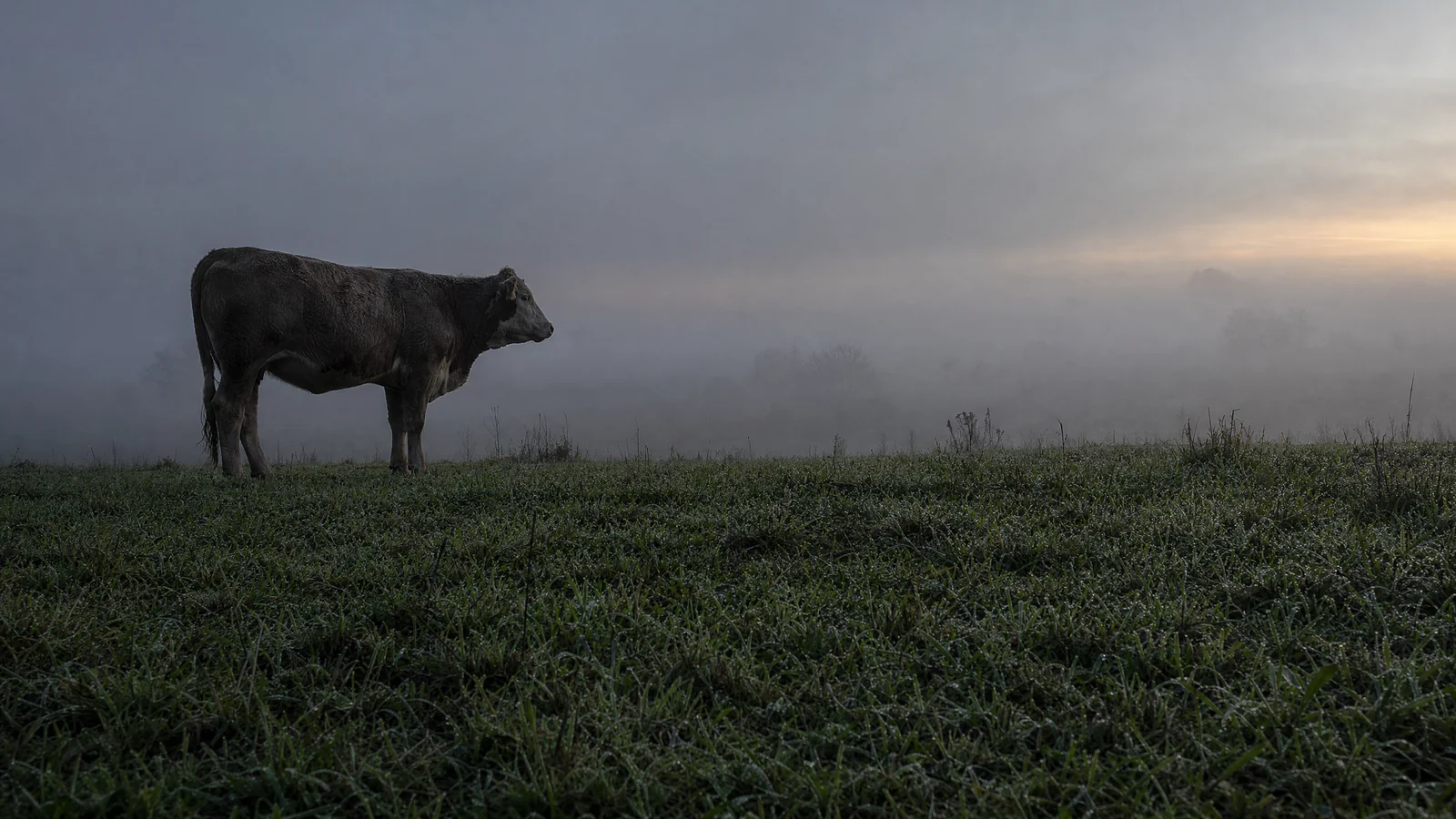
Cow dreams get searched differently from most.
A snake or a rat leaves you unsettled the moment you wake, so you look it up right away. A cow isn't like that. Nothing frightening happened, nothing particularly bad occurred — and yet it stays with you in a strange way. The image of that large animal standing still, watching you, follows you around all day.
Then, a few days later, you search: cow dream meaning.
Lumi
"What was the cow doing?
Standing still, walking, or was someone leading it?
One more thing. That rope — who was holding it?"
Table of contents
Why the Cow Comes SecondWhy the Cow Is Missing From the RecordDid You Lead the Cow, or Did It Lead YouThe Cow That Came Into the HouseRuminationThe Cow That Chased You, the Cow That Gored YouBulls, White Cows, Black Cows, Thin CowsCalves, Several Cows, a Dead CowTold HonestlyFrequently Asked QuestionsWhy the Cow Comes Second
Our article on rat dreams covered why the rat holds first place in the zodiac: ja-si (子時), the first two-hour period of the day, is half the day just ending and half the day about to begin, so a creature carrying both yin and yang had to occupy it.
So why does the cow come next?
The entry on the thirty-six beasts in the Encyclopedia of Korean Culture (a major reference work on Korean history and culture) has the answer: the cow's cloven hoof classifies it as pure yin. That's why it was placed directly after the rat, which carries both yin and yang. For comparison, the horse's hoof is a single, unsplit form, which classified it as pure yang — placed at o-si (午時), the middle of the day.
The animals' positions, in other words, were assigned by the shape of their hooves.
One thing worth clarifying: pure yin doesn't mean bad. Yin isn't an ill omen — it's simply a quality. Dark, heavy, inward-gathering, slow. These words describe the cow almost exactly.
This is likely why cow dreams are rarely read negatively. The cow was always assigned to this category. Being slow isn't a flaw here — it's where the cow belongs.
Why the Cow Is Missing From the Record
Here's something a little strange.
The folk-belief dream-interpretation list in the dream entry of the Encyclopedia of Korean Culture is organized into the body, human affairs, natural objects, houses, tools, animals, and plants. The animal category includes the dragon, the snake, the crane, the parrot, the tiger, the swallow, the rat, and the pig.
The cow isn't there.
Second in the zodiac and the central livestock animal of an agrarian society, and yet it has no place in the dream-interpretation list. This likely isn't because the cow didn't matter — if anything, it's probably the opposite reason.
The cow wasn't a symbol. It was property.
A dragon becomes a symbol because no one has ever seen one; a snake becomes a symbol because it startles you by appearing suddenly. A cow, by contrast, was seen every single day. It stood in the yard, in the rice paddy, in a stable attached to the house itself. It was too familiar to serve as a symbol.
Instead, the cow represented value. A single cow was worth several plots of rice paddy, and the practice of selling a cow to send a child to university became common enough to give rise to the term "cow-bone tower" (ugoltap, 牛骨塔) — a tuition system funded, quite literally, by cattle. This was a real practice from the 1950s through the 1970s.
So a cow appearing in a dream, for people of that era, was likely never a matter for symbolic interpretation — it was simply a statement about property. A cow arriving meant an increase; a cow leaving meant a decrease. It was too obvious to need its own entry in a dream manual.
The modern habit of linking cows to wealth in casual dream interpretation traces back to this background. One caution is worth adding, though: the era when a cow represented wealth has ended. Claiming that the same symbolism still applies today would require separate evidence, and none exists.
Did You Lead the Cow, or Did It Lead You
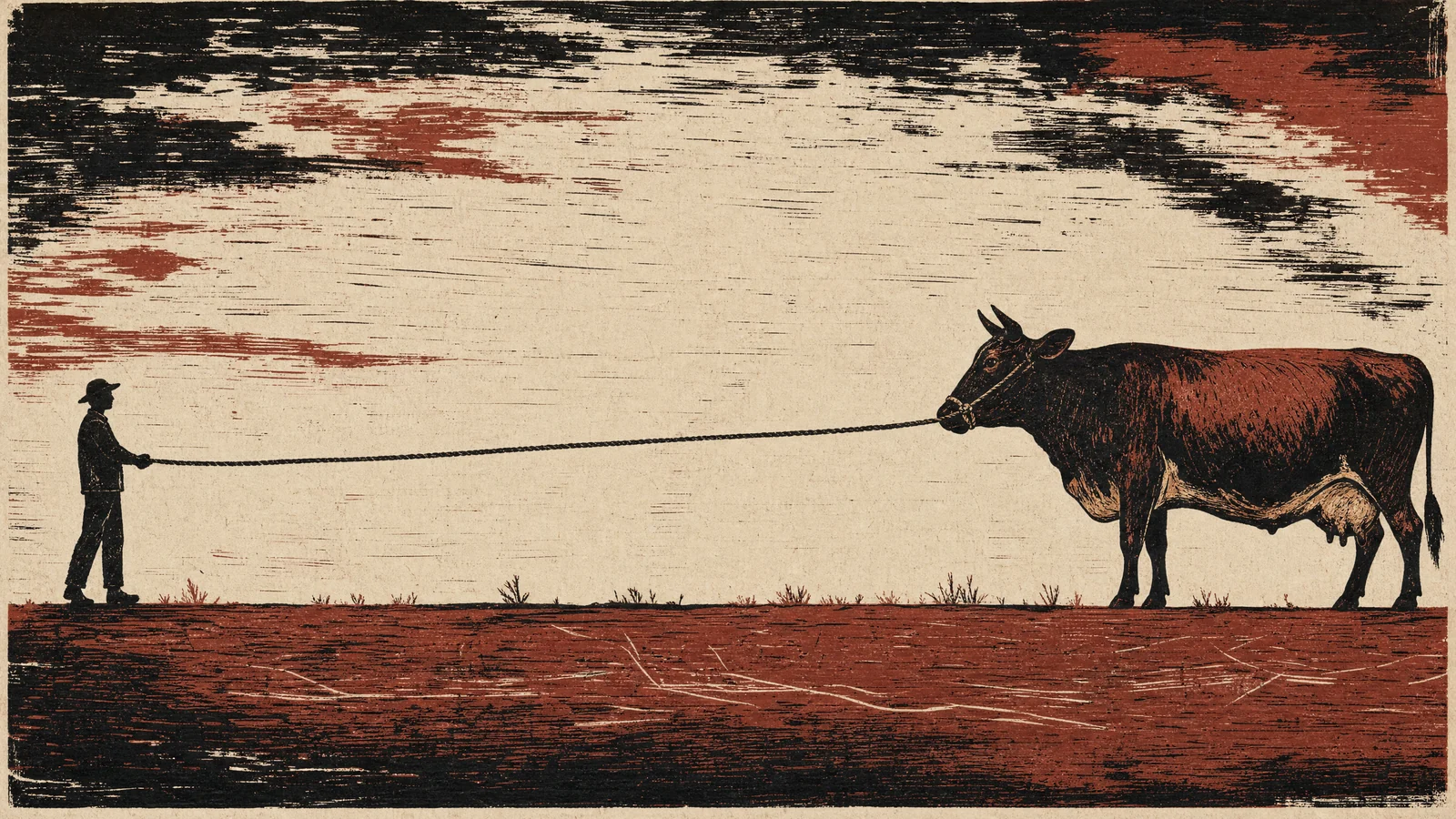
This is the single most informative scene in a cow dream. Even size and color come second to it.
You led the cow
In traditional interpretation, an image of leading livestock home was generally read as acquisition — the same grammar carried over from the era when a cow meant wealth. Whether you led it toward home mattered in particular.
From a modern psychological perspective, this reads as an image of control — the sensation of leading something much larger and stronger than you. There's a reading that this scene surfaces when you've taken on a large project or something that feels like more than you can handle.
Whether it was hard or easy to lead the cow matters, too. If it followed obediently, that suggests you're in control; if it dug in and wouldn't move, the opposite.
The cow led you
This is the reversed version.
In traditional interpretation, there's no clearly documented entry for this specific scene, and this article won't invent one.
From a modern psychological perspective, though, this is a fairly vivid image: being pulled in a direction you didn't choose. You can't overpower it, and you can't quite let go, either. You're technically holding the rope, but the cow is the one making the decisions.
There's a reading that this scene surfaces when you've been putting off a decision for a long time — whether to change jobs, whether to end a relationship.
Someone else led the cow away
In traditional interpretation, a scene of livestock leaving the house was generally read unfavorably — unsurprising, given that it's an image of property leaving.
From a modern psychological perspective, this feels closer to deprivation than loss — something that was yours leaving your hands, with you unable to intervene in the process. Whether you simply watched or chased after it is the fork here.
The Cow That Came Into the House
A large animal entering the home is treated as a powerful image across many cultures.
In traditional interpretation, an animal entering the house was read as an arrival — the same grammar that repeats in our guide to pig dreams. With a cow, though, whether it was in the yard or inside a room matters. The yard or a stable is where a cow belongs; a room is not.
From a modern psychological perspective, a large animal indoors generally represents something too big to fully handle. That doesn't mean bad — it means large. Even good things become a burden once they're big enough. There are reports of this dream occurring around a promotion, a move, a marriage, or the birth of a child.
If a cow was in the room and it didn't feel frightening, that may be a sign you've already come to accept the size of whatever it represents.
Lumi
"That cow — was it chewing something the whole time?
Not actually eating anything, just moving its jaw?
If you remember that detail, read the section below. It's a good one."
Rumination
A cow standing still, jaw moving slowly. Many people say this scene stays with them longer than expected.
The traditional record has no clear entry interpreting this scene specifically. But in modern psychology, this exact word became a technical term.
Rumination. It describes the act of a cow regurgitating and re-chewing what it's eaten, and in psychology, the same word describes the state of going over the same thought again and again. The English word "rumination" shares the same origin — it comes straight from a cow's digestive habit and became a psychological term as-is.
It fits together well for something that started as a coincidence. Pulling up something already finished, chewing on it, swallowing, and pulling it back up again — that's the exact sensation of replaying a conversation from three years ago in bed at night.
So if a ruminating cow stuck in your memory, it's worth asking whether you've been chewing over something lately. The cow isn't telling you anything — it's more that the image caught your eye because you were already doing the chewing.
The Cow That Chased You, the Cow That Gored You
Cows have a gentle reputation, but they're actually capable of hurting people. Frightening cow dreams are common too.
Being chased
In traditional interpretation, being chased by an animal was generally read as a warning sign. Whether you looked back is covered separately in our guide to being-chased dreams.
From a modern psychological perspective, being chased by a cow feels different from being chased by a tiger or a dog. A cow isn't fast. If you still couldn't get away, that's not because the pursuer was quick — it means your own feet wouldn't move. The problem in this dream isn't the threat's speed; it's your own state of being frozen.
Being gored
In traditional interpretation, there was some reading of injury scenes that varied by body part, but no clear record has been confirmed specifically for cows.
From a modern psychological perspective, being gored feels different from being bitten. A bite is something burrowing in; being gored is being pushed back. Whether you were knocked down, held your ground, or sent flying is itself the information.
There's a reading that this dream surfaces during friction with someone close to you — a cow, after all, is rarely a stranger's animal. It's usually your own.
Bulls, White Cows, Black Cows, Thin Cows
Color and size come third. Still worth covering.
The Bull
In Korea, "cow" defaults to the ordinary bull in most people's minds. If you didn't consciously register a color, this is likely the default.
From a modern psychological perspective, not remembering a color usually means color wasn't the important part of the scene. It's better not to force a color onto the memory.
The White Cow
In casual folk interpretation, white animals are frequently mentioned favorably, and white cows get the same treatment. This isn't confirmed as a separate entry in the old dream manuals, though — it's closer to a phrase in common circulation today. We'll limit the claim to exactly that.
The Black Cow
Black on its own wasn't read as an ill omen. The cow is classified as pure yin to begin with, so a dark, quiet register is, if anything, where it belongs.
From a modern psychological perspective, the issue isn't the color but the emotion. The same black cow is a completely different dream depending on whether it felt heavy or steady.
A Thin or Sickly Cow
In traditional interpretation, the condition of livestock was read as a direct reflection of a household's condition. A thin cow wasn't read favorably.
From a modern psychological perspective, there's a reading of this as an image of exhaustion. Something known for being large and strong appearing gaunt connects to the sense that something meant to be dependable is no longer holding up — whether that's work, a person, or yourself.
Calves, Several Cows, a Dead Cow
The Calf
In traditional interpretation, livestock giving birth was read as an image of increase — a growing fortune.
Some also mention this as a taemong (conception dream), and a line needs to be drawn here: dreaming of a cow doesn't mean you're pregnant. The encyclopedia's examples of taemong material are things like peppers, strawberries, and pumpkins, or household items — not livestock. Taemong stories, more often than not, get attached after the fact. We cover this in more depth in our separate guide to taemong.
A Herd of Cows
In traditional interpretation, several head of livestock at once was read by scale — the more, the better.
From a modern psychological perspective, it's a little different. A herd generally reads as an image of something beyond your control. Still, a herd of cows feels different from a swarm of rats. Where rats swarm from every direction, a herd of cows tends to move in a single direction. Whether you were swept along with it or watching from the side is the fork.
A Dead Cow
In traditional interpretation, a piece of livestock — which is to say, property — dying was read as loss.
From a modern psychological perspective, this reads as an image of something ending. We cover in more depth, in our separate guide to dreams about the deceased, how death was generally treated in the old record as closure or transition rather than loss alone. Here too, the fork is emotion: if you felt relief, something has been resolved; if you felt sad, something is still unfinished.
Told Honestly
Lumi
"You've probably noticed by now.
I've said 'no record exists' a few times in this article.
That's not laziness.
It's much easier to write something invented as if it were documented. That's exactly why I don't."
Traditional dream interpretation and modern psychology rely on different kinds of evidence.
This isn't just this article's own position — the encyclopedia states it directly. After listing out its dream-interpretation methods, it notes plainly that these readings emerged naturally from many people's experiences rather than from any consistent theoretical foundation. It also describes two stances within dream interpretation: reading dreams symbolically, and reading a dream as the opposite of reality.
A case survives in the Samguk Yusa (Memorabilia of the Three Kingdoms) where the very same dream was read in opposite directions depending on who interpreted it. A dream King Wonseong had before taking the throne was first read as a sign of dismissal and imprisonment — until a second interpreter reversed the reading entirely, calling it an omen that he would become king.
A few things should be made clear.
No verified connection exists between cow dreams and lottery numbers. Nothing in the traditional record or in psychological research mentions numbers. Dreams involving money are covered separately in our guide to dreams about finding money.
The claim that a cow represents an ancestor is also difficult to verify. It circulates in casual folk interpretation, but no documented source confirms it. If you dreamed of someone who has passed and it's been weighing on you, that isn't really a matter of the cow's symbolism — it's closer to a matter of missing someone, and that's the more honest explanation.
Frequently Asked Questions
Is a cow dream auspicious? It depends on direction. A cow moving toward the house was read favorably in the old interpretation; a cow moving away was read the opposite way. That comes before color or size.
Why is there no dream-interpretation record for cows specifically? More precisely, none appears in the encyclopedia's dream-interpretation list. It seems likely the cow was too familiar to need to become a symbol — it was property in its own right, not something to interpret.
I can't tell if it was a regular cow or a bull. Then don't worry about the color. Not being sure means color wasn't the important part of the scene. It's far more useful to note what the cow was doing and who was holding the rope.
I keep having the same cow dream over and over. With a recurring dream, the repetition itself is often more informative than the content. Noting the interval between occurrences, and what happened in between, tends to reveal something later.
I keep forgetting my dreams. Dreams start fading about 90 seconds after waking. Instead of getting up right away, lying still for a moment often brings back more fragments. Changing position tends to make a lot of it disappear.
Today, there's nothing you need to do differently.
If you want one thing to try, think about whether there's something you've been chewing over lately — especially if a ruminating cow is what stayed with you.
And if there's a message you've been putting off for a while, maybe send it today. That will do more for you than any dream interpretation.
The same cow dream leaves a different color for everyone.
Dream Talisman looks at the dream scene you record together with your day stem (ilgan) in the Five Elements system, and turns it into a color and phone wallpaper for the day. It is less an app that interprets your dream for you than one that lets you carry today's dream with you for the rest of the day.
Curious what color that cow will come out as?
Record today’s dream in Dream Talisman
References
- "The Thirty-Six Beasts" — Encyclopedia of Korean Culture · The logic of zodiac-hour assignment, the cow's classification as pure yin
- "Dreams" — Encyclopedia of Korean Culture · The folk-belief dream-interpretation list, the dream-interpretation case in the Samguk Yusa's account of King Wonseong
- "The Twelve Zodiac Spirits" — Encyclopedia of Korean Culture
- General research on the psychological concept of rumination
- General research in modern sleep and dream psychology