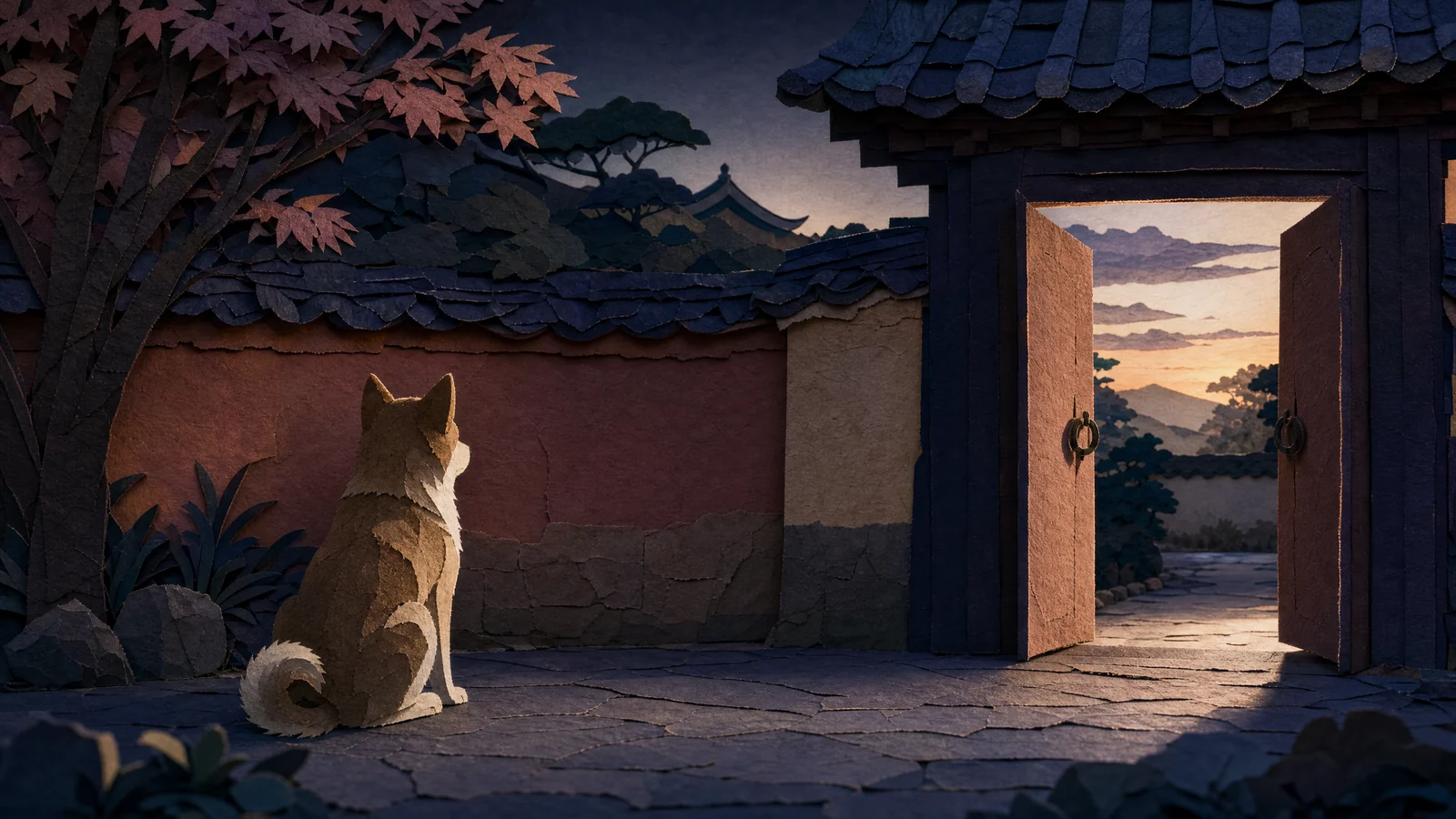
After a strange dream, people often say it without thinking: "Ah, that must have been a gaekkum."
But people say the same thing after dreaming about an actual dog — gae, in Korean. Does a dog showing up make it a gaekkum? Or does the word mean something else entirely?
Let's clear this up first. Gaekkum is an actual dictionary entry. And its meaning has nothing to do with a dream that features a dog.
Lumi
"You said gaekkum, right? Do you know where that word actually comes from?
It has a counterpart. You might be surprised by what sits on the other end of the scale."
Table of contents
Gaekkum and the Dragon Dream Are a PairThe Dog's HourDog Days Meant Opposite Things Depending on the RegionThe Dog Is Missing From the Traditional Dream ListThe Dream of Being BittenThe Dog That Barked, the Dog That FollowedThe Dead Dog, the Lost DogBlack Dogs, White Dogs, and Packs of DogsThe Dream of Your Own DogTold HonestlyFrequently Asked QuestionsGaekkum and the Dragon Dream Are a Pair
The entry on dreams in the Encyclopedia of Korean Culture (a major reference work on Korean history and culture) collects Korean expressions related to dreams — words for a dreamlike daze, the quality of a night's sleep, and a small mishap that is said to "pay off" a bad dream.
One passage stands out. Among the terms used to interpret dreams are the dragon dream and gaekkum: a dragon dream refers to luck beyond what anyone expected, while gaekkum (a "worthless" or meaningless dream) points to a dream so groundless that nothing real can be hoped from it.
The two words sit side by side.
At one end is the dragon, a creature our separate guide to dragon dreams covers in more depth; at the other end is the dog. Of the twelve zodiac animals, the fifth and the eleventh — dragon and dog — end up holding the highest and lowest rank in the Korean vocabulary of dreams.
There is something a little unfair about that arrangement. No one has ever actually seen a dragon, while everyone sees a dog every day. The thing nobody has seen became the best omen, and the thing everybody sees every day became the empty one.
One thing should be made clear here: the fact that gaekkum means a meaningless dream does not mean that a dream featuring an actual dog carries no meaning. That is a quirk of the word, not a rule of dream interpretation. The two ideas appear to have blended together over time, which is likely how the notion that dog dreams aren't worth examining spread in the first place.
The Dog's Hour
Our article on rooster dreams noted that the rooster's two-hour period, yu-si, is a yin hour and corresponds to metal in the Five Elements (Korea's traditional wood-fire-earth-metal-water system). The dog comes next: sul-si (술時), the two-hour period from 7 to 9 in the evening.
According to the entry on the thirty-six beasts in the Encyclopedia of Korean Culture, sul is a yang hour and corresponds to earth in the Five Elements. Together with chuk, jin, and mi, it holds one of the four "corner" positions in the traditional zodiac clock.
It is the hour when the sun sets and darkness gathers — also the time when a dog in a yard grows most alert.
When the twelve two-hour periods are further divided into thirty-six finer segments, the dog's hour breaks down into dog at its start, wolf in its middle, and jackal at its end.
That's a little unsettling. Right beside the animal closest to humans sit the wolf and the jackal. Within the very same time slot, a domestic animal shifts into a wild predator.
Darkness falling, and a slot that slides from dog to wolf — the reason dog dreams can feel either warm or frightening may already be built into this arrangement.
Dog Days Meant Opposite Things Depending on the Region
Within the seasonal folk calendar, the "dog day" is an unusual case.
According to the entry on lucky and unlucky days in the Encyclopedia of Korean Culture, people traditionally rested from work on the first dog day of the new lunar year. Working that day was believed to bring harm to the vegetable garden from a dog getting into it. In South Jeolla Province, people avoided cooking paste for fear that a dog would vomit up whatever it had eaten.
Jeju Island, however, took the opposite view entirely.
According to the same record, Jeju Island regarded the dog day as an especially good day. It was considered a good day for a haenyeo (traditional female diver) to prepare her tools, for an interesting reason: since dogs are skilled at retrieving things, it was believed she would bring back plenty of seafood. It was also considered a good day for making soybean paste blocks.
Same day, same animal — one region treats it with caution, the other treats it as auspicious.
Compared with how fairly consistent the taboos were for monkey days or rooster days in our other guides, the dog day stands out for splitting this way. Perhaps it's because the dog lives too close to people. The closer something is to us, the more our judgments of it diverge.
The Dog Is Missing From the Traditional Dream List
In the folk-belief dream-interpretation list from the dream entry of the Encyclopedia of Korean Culture, the animal category includes the dragon, the snake, the crane, the parrot, the tiger, the swallow, the rat, and the pig.
The dog is not there.
It's likely the same reason cattle and horses are missing too: they were too familiar to need a symbolic entry. There was no need to interpret something that was always right there in the yard.
So most of the dog-dream interpretations that turn up in a search — claims about wealth, betrayal, and the like — are hard to trace to any real source.
There is one traditional role dogs did occupy in Korean culture, though. Some research on shamanic material describes dogs as beings that bridge this world and the next — guarding doorways, standing at boundaries, sensing what comes from the other side before anyone else does.
That is as far as the documented record goes.
The Dream of Being Bitten

This is the most-searched scene among dog dreams.
In traditional interpretation, the grammar of reading an animal bite as "something entering the body" shows up in our guide to snake dreams. There is no separate entry confirmed for dogs specifically, though, and we won't invent one.
From a modern psychological perspective, a dream about being bitten by a dog is decisively different from other animals for one reason: a dog is, by nature, an animal that doesn't bite you.
A tiger biting is simply what tigers do. A dog biting reads closer to betrayal — the image of something close suddenly turning on you.
So what tends to matter most in this dream is whether it was a dog you knew.
- An unfamiliar dog points toward an unfamiliar threat
- A dog you knew — especially one you raised yourself — is an entirely different story
Whether you felt anger, fear, or hurt afterward also matters. If hurt is what you felt, that emotion may be the most honest piece of information the dream offers.
Lumi
"Was it a dog you knew, by any chance?
...Then there's a good chance this dream isn't really about the dog.
It's probably about a person."
The Dog That Barked, the Dog That Followed
It Barked
Our guide to rooster dreams noted that every bird entry in the old dream lists is conditioned on the sound the bird makes. Sound has always been an old and reliable marker.
A barking dog is a special case even within that pattern. A dog barks because something is there. So a dream of a barking dog tends to point attention less toward the dog itself and more toward whatever the dog saw.
From a modern psychological perspective, this scene reads as an image of warning. What exactly is being warned about, though, is something the dream doesn't say. Whether you could see what the dog was barking at is the fork in the road — and if you couldn't, that absence is itself information.
It Followed
From a modern psychological perspective, a dog following you has a different feel from being chased in a dream. Being chased is an image of running away; being followed is an image of something simply sticking close.
Whether that felt burdensome, reassuring, or annoying is the fork here. The three are entirely different dreams.
The Dead Dog, the Lost Dog
This is among the worst dreams to wake up from — and all the more so for anyone who has ever kept a dog, or keeps one now.
In traditional interpretation, the death of a domestic animal was read as loss. No separate entry for dogs specifically has been confirmed, however.
From a modern psychological perspective, this dream is often better understood through the lens of grief than symbolic interpretation — especially if you have actually lost a dog.
A dream like that isn't a premonition. It's a scene built out of missing someone. And that is neither strange nor a bad thing. We cover dreams about the deceased in general in our separate guide on that topic.
If the dream was about losing and searching for a dog, there is one fork: did you find it, or were you still searching when you woke?
Black Dogs, White Dogs, and Packs of Dogs
The Black Dog
In folk belief, a black dog was sometimes thought of as an animal that warded off misfortune. This isn't confirmed as an entry in any dream-interpretation text, though — it belongs to folklore tradition rather than the dream-book record. We'll limit our claim to exactly that.
From a modern psychological perspective, the fork here isn't color but emotion. There's no basis in the old records for treating a dark color, on its own, as an ill omen.
The White Dog
In folk dream interpretation, white animals are often mentioned in a favorable light. Here too, this isn't confirmed as a separate dream-book entry.
A Pack of Dogs
From a modern psychological perspective, a pack of dogs has an entirely different character from a single dog. If one dog is an image of relationship, a pack is closer to an image of threat. This calls back to the wolf and jackal sitting in the latter half of the dog's traditional hour.
Whether you were surrounded or the pack simply passed you by is the fork.
The Dream of Your Own Dog
Of the twelve zodiac animals, the dog is still the only one most people actually live close to today.
The dragon doesn't exist; sheep and monkeys were never native to the Korean peninsula. Cattle and horses are things city dwellers rarely encounter anymore. Only the dog remains.
So a large share of dog dreams aren't symbolic at all — they're about an actual relationship.
A dream where your own dog is sick, has gone missing, or doesn't recognize you — this isn't something to look up in a dream-interpretation book. It's closer to something you were worrying about during the day resurfacing at night. Yi Ik, a late-Joseon-era scholar of the Silhak (Practical Learning) school, wrote in his essay "Monggamnon" (On the Sensations Behind Dreams) that hearing drumming while asleep produces dreams about soldiers. People understood this three hundred years ago.
If you had a dream like that, the first thing to check isn't a dream dictionary. It's the food bowl.
Told Honestly
Lumi
"A lot of dreams end up shortchanged because of the word gaekkum.
It doesn't mean a dream with a dog in it isn't worth looking at.
The word just means 'a dream that's nothing much' — and the dog got its name borrowed for no fault of its own."
Traditional dream interpretation and modern psychology rely on different kinds of evidence.
The encyclopedia itself notes, after listing out its dream-interpretation methods, that these readings emerged naturally from many people's experiences rather than from any consistent theoretical foundation. Even the Samguk Yusa (Memorabilia of the Three Kingdoms) preserves a case where the very same dream was read in opposite directions depending on who was interpreting it.
The dog is a special case even among all this. It has no entry in the dream-interpretation list, yet its name is baked into the vocabulary of dreams itself.
Most of the bite-sized dog-dream interpretations that come up in a search — the ones tagged with wealth, betrayal, or gossip — are difficult to trace to any real source.
No verified connection exists between dog dreams and lottery numbers, either. Dreams involving money are covered separately in our guide to dreams about finding money.
There's also no basis for the claim that a dog dream is a taemong (conception dream). The idea that a taemong can reveal a baby's sex is addressed in our separate guide to taemong.
Frequently Asked Questions
Is any dream with a dog in it a gaekkum? No. Gaekkum refers to a meaningless dream and has nothing to do with whether a dog appears in it. The encyclopedia lists it as the direct counterpart to the dragon dream.
Is a dog dream auspicious or inauspicious? There's no dog entry in the dream-interpretation list, so no firm answer exists. It's more useful to consider whether the dog was familiar or a stranger, and how you felt at the time.
A dog bit me but it didn't hurt. Pain is rarely remembered clearly in dreams. If it didn't hurt, the scene may have been more about contact than attack. What you felt afterward matters more than the bite itself.
My deceased pet keeps appearing. It isn't a premonition or an omen. It's closer to a scene built out of missing them. If it keeps recurring, note the intervals — they tend to lengthen over time.
I keep forgetting my dreams. Dreams start fading about 90 seconds after waking. Instead of getting up right away, lying still for a moment often brings back more fragments.
Today, there's nothing you need to do differently.
If you want one thing to try, and a familiar dog appeared in the dream, think about the person connected to that dog rather than the dog itself. Dog dreams are, more often than you'd think, really about people.
And if you have a dog of your own, maybe take it on a longer walk today. That will do more for you than any dream interpretation.

The same dog dream leaves a different color for everyone.
Dream Talisman looks at the dream scene you record together with your day stem (ilgan) in the Five Elements system, and turns it into a color and phone wallpaper for the day. It is less an app that interprets your dream for you than one that lets you carry today's dream with you for the rest of the day.
Curious what color that dog will come out as?
Record today’s dream in Dream Talisman
References
- "Dreams" — Encyclopedia of Korean Culture · Meanings of gaekkum and the dragon dream, the folk-belief dream-interpretation list, Yi Ik's "Monggamnon"
- "Lucky and Unlucky Days" — Encyclopedia of Korean Culture · Customs of the first dog day of the lunar year and regional differences
- "The Thirty-Six Beasts" — Encyclopedia of Korean Culture · The logic of zodiac-hour assignment and its finer thirty-six-part division
- General research on zodiac-animal symbolism in shamanic and folk-art traditions
- General research in modern sleep and dream psychology