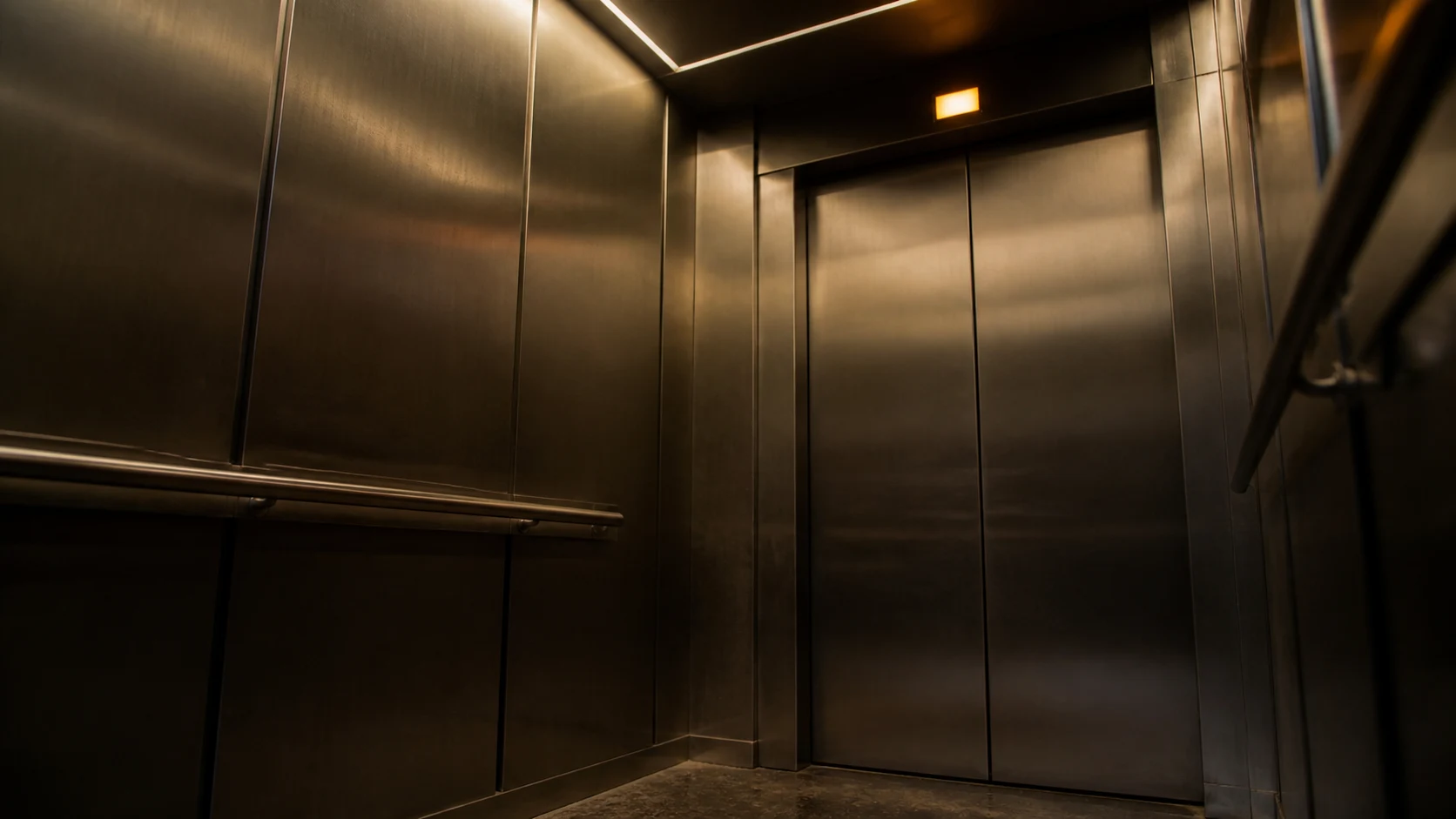
Your body probably felt like it lifted off the ground.
The sensation of the floor disappearing, reaching for a handrail that isn't there. Or maybe it was the opposite — nothing happened at all, and it just stopped. The doors wouldn't open, and the floor indicator just kept blinking.
Sometimes both scenes show up in the same dream. So when people search for it, they lump it all together as an elevator dream.
But looked at through the old record, these are two completely different entries. And they sit on opposite sides of the ledger.
Lumi
"Did it fall, or did it stop?
There's a reason to separate those.
In the old dream manual, falling is inauspicious, but being trapped is auspicious.
A little unexpected, right?"
Table of contents
Of Course There's No 'Elevator' EntryFalling Was Recorded as InauspiciousBut Being Trapped Was Recorded as AuspiciousModern Research Counts These Two SeparatelyIf It Was a Falling Sensation Right as You Fell AsleepIf You Remember Which Floor It Stopped OnThe Dream Where You Pressed a Button and Nothing HappenedTold HonestlyFrequently Asked QuestionsOf Course There's No 'Elevator' Entry
Let's establish this first. There's no elevator entry in the old dream manuals.
It isn't in the eight branches of the folk-belief dream-interpretation list in the entry on dreams in the Encyclopedia of Korean Culture (a major reference work on Korean history and culture), and it isn't in the old Chinese dream manuals either. It couldn't be — people have only been riding boxes up and down for a bit over a century.
So the fate of an elevator dream can't be found in the old record. Modern dream-interpretation sites toss around all sorts of claims about it, but none of them are backed by traditional texts.
What the old lists do have, separately, are the two scenes that make up this dream: falling, and being trapped.
Falling Was Recorded as Inauspicious
The classical Chinese dream manual known as the Zhougong Jie Meng (Duke of Zhou's Dream Interpretation — a dream-divination text with a long circulation history in China, distinct in lineage from Korean folk tradition) has entries on falling, and a commonly circulated edition preserved on Chinese Wikisource points in a single direction.
- If you climb a mountain and then fall to the ground, you will lose your position.
- If your body falls into a well, illness will follow — it is inauspicious.
Both lines carry weight. The first one especially stands out — climbing and falling are placed in the same sentence, and the conclusion is written as losing your position.
The same list has a related entry about trees: if you climb a tree and a branch snaps, you will be hurt. It's the same entry covered in our separate guide to tree dreams.
The old lists viewed climbing favorably, and climbing followed by falling unfavorably. The issue wasn't height itself — it was whether that height held.
A falling elevator fits that grammar precisely. It's a device meant to go up, failing to hold.
We've covered the sensation of falling in more depth in our separate guide to falling dreams.
But Being Trapped Was Recorded as Auspicious

Here's where it flips.
The same text's entries on confinement read like this:
- If you sit in prison, you will certainly be pardoned.
- If the prison collapses, there will be a pardon — it is auspicious.
Being trapped, and the conclusion is a pardon. Not inauspicious at all.
That doesn't match today's intuition, but the encyclopedia lays out the logic behind it. There were two traditional attitudes toward dream interpretation — one reading dreams as symbols, and one reading dreams as the reverse of reality. An entry where confinement flips into release belongs to the second category.
It's the same grammar we found in our separate guide to death dreams — a coffin being brought into the house was read as things going well.
Put together, it comes out like this:
| Falling | Inauspicious |
|---|---|
| Trapped | Auspicious |
Two scenes that could happen in the same elevator, and the old list places them in opposite categories.
Neither one has ever been shown to actually predict anything, if that's the real question. But it's clear enough that this dream shouldn't be lumped into a single category.
Modern Research Counts These Two Separately
There's a standard scale used to survey typical dream themes — the TDQ, with 55 items — and a study of 1,181 Canadian university students measured how often each scene was reported.
There's no elevator item here either. But the pieces that make up this dream do appear separately.
- Falling — 73.8%
- Being trapped — 24.0%
- Loss-of-control category — 57.8%
A falling dream is something seven out of ten people have experienced. It ranks near the top even among typical dream themes.
Korean research points the same direction. A study of 500 Korean adults found falling and being chased among the most commonly experienced dreams.
So this dream isn't a sign of anything unusual just for happening. It's an extremely common scene.
That said, we won't push this further than the data allows. The TDQ's loss-of-control category groups together losing control of a vehicle, discovering a new room, and teeth falling out. Elevators aren't on that list. "A malfunctioning elevator means a loss of control" isn't a verified conclusion — it's an interpretation borrowed from a similar-sounding category.
If It Was a Falling Sensation Right as You Fell Asleep
This deserves its own explanation.
There's an experience where the body suddenly jerks right as you're about to fall asleep, accompanied by a sensation of falling. In medicine, this is called a hypnic jerk.
It happens during the transition between sleep and wakefulness, when muscles suddenly contract — and a sense of falling, brief flashes of imagery, or flashes of light or sound are sometimes reported along with it. There's nothing unusual about it on its own.
Fatigue, stress, and sleep deprivation have been reported as factors that increase it, though individual variation is significant.
One thing worth being careful about: a widely circulated explanation claims "the brain mistakes muscle relaxation for falling and tries to catch itself." That's one possible explanation, not a confirmed mechanism. And a falling scene inside a dream and this sensation at the edge of sleep may actually be different phenomena.
So it can't be said for certain that a falling-elevator dream happened because of a hypnic jerk.
That said, if it keeps recurring right as you're falling asleep, and it's starting to make you afraid to go to sleep, or you're exhausted beyond what a normal day should leave you, that isn't something to interpret through dream reading — it's worth getting a sleep consultation.
If You Remember Which Floor It Stopped On
Lumi
"What floor was it?
Write it down if you remember. Most people don't — so if you do, that's information.
But it doesn't mean 'floor number X means Y.' That part's made up."
It stopped and wouldn't move, or the doors wouldn't open.
Traditional interpretation has an entry about doors. In the Zhougong Jie Meng tradition, a blocked door means things won't go through. There's a matching line in the other direction, too — a door standing wide open is greatly auspicious.
The reading turned on whether passage happened. Open, and things proceed; blocked, and they don't.
The old lists consistently cared about entering and exiting when it came to spaces — the same pattern we found in our separate guide to house dreams.
Read in modern terms, a stalled scene is often connected to a sense of things not progressing. But that's a symbolic reading, not something the old record ever said about elevators specifically.
Let's be clear about the floor number itself, though. There's no evidence anywhere that a specific floor number means anything. Not in the old texts, not in research. Still, remembering the number at all is worth noting — it's rare for a number to stay clear and specific in a dream.
The Dream Where You Pressed a Button and Nothing Happened
The floor you pressed didn't respond, or it went to the wrong floor, or the door-close button didn't work.
Traditional interpretation has no entry for this. We won't manufacture one where none exists.
Read in modern terms, this is slightly different from simply being stalled. Being stopped is a state of not moving; a button that doesn't respond is a state where your own action doesn't work.
A similar sensation shows up in other dreams — trying to speak and no sound coming out, trying to run and your legs not moving, hitting the brakes and the car not stopping.
The voice version is covered in our separate guide to dreams of losing your voice, and the driving version is covered in our separate guide to car accident dreams. These three often turn out to belong to the same family.
If this kind of scene keeps recurring, it helps to note the interval between occurrences — more on that in our separate guide to recurring dreams.
Told Honestly
Lumi
"'A falling elevator dream means failure is coming' — search for it and you'll find it everywhere.
There's no evidence for that.
The old texts don't have elevators, and the research has falling but not elevators.
I'll only tell you what's actually there."
Traditional dream interpretation and modern research rely on different kinds of evidence — and on this particular topic, neither side has much direct evidence to offer.
What's confirmed. The old lists have separate entries for falling and being trapped, and they point in opposite directions. Falling dreams are reported at a high rate in surveys of typical dream themes. There's a recognized phenomenon called a hypnic jerk that explains the falling sensation right at the edge of sleep.
What isn't confirmed. There's no elevator entry in either the old texts or the standard dream-theme scale. There's no evidence that a specific floor number carries any meaning.
The encyclopedia itself notes, after laying out its dream-interpretation list, that these readings emerged naturally from many people's experience rather than from any consistent theoretical foundation.
A few things are worth stating plainly.
A falling-elevator dream doesn't predict a real accident. It isn't a reason to avoid elevators today.
"A malfunctioning elevator means a loss of control" isn't a verified interpretation. It's borrowed from a similar-sounding category.
There's no evidence that the specific floor it stopped on means anything.
No verified connection exists between elevator dreams and lottery numbers, either.
Frequently Asked Questions
Is a falling-elevator dream inauspicious? There's no elevator entry in the old record at all. That said, falling from a height was recorded as inauspicious, and falling dreams are reported by around seven in ten people surveyed on typical dream themes.
I was trapped in an elevator. The old lists actually read being trapped favorably — there's a line about sitting in prison and being granted a pardon.
I jerked awake right as I felt myself falling. If that was right as you were falling asleep, it may have been a hypnic jerk. If it keeps recurring and your sleep is suffering, a sleep consultation is worth it.
I remember exactly which floor it stopped on. There's no evidence the floor number itself means anything. But remembering a number at all is unusual for a dream, and worth writing down.
I pressed a button and nothing happened. No traditional entry covers this. It's in the same family as scenes where your voice won't come out or the brakes won't respond.
Can I still ride elevators today? Yes. There's no evidence this dream predicts an accident.
What makes an elevator dream particularly stifling is that there's nowhere to run. Other dreams at least let you try to escape by running — here, you're inside a box.
So this dream usually ends with you unable to do anything at all, whether you fell or got stuck. That's usually the feeling that lingers after waking, too.
Today, there are three things worth writing down.
- Did it fall, or did it stop — these are two different dreams
- What were you trying to do — pressing a button, trying to open the door, or just standing there
- What was your mood when you woke up
The distinction starts right at the first line. Lump it together and it won't make sense later.

A short, intense dream tends to fade the fastest.
By about 90 seconds after waking, it's already starting to blur. One line noting whether it fell or stopped is enough to keep it intact.
Dream Talisman looks at the dream scene you record together with your day stem (ilgan) in the Five Elements system, and turns it into a color and phone wallpaper for the day. It is less an app that interprets your dream for you than one that lets you write it down before it fades.
Record today’s dream in Dream Talisman
References
- Nielsen, T. A., et al. (2003), "The Typical Dreams of Canadian University Students," Dreaming 13(4) · Survey of 55 dream themes among 1,181 university students, including reported rates for falling, being trapped, and loss-of-control factors. Elevator is not included as an independent item
- Study on typical dream experiences among Koreans · Reported frequency of falling and being-chased dreams among 500 adults
- General literature review on hypnic jerks · A physiological phenomenon of the sleep-wake transition and its contributing factors. Not a confirmed mechanism behind falling dreams
- Zhougong Jie Meng (Duke of Zhou's Dream Interpretation), commonly circulated edition — Chinese Wikisource · Passages on falling, imprisonment, and doors. A classical Chinese dream-interpretation text, distinct in lineage from Korean folk records. No elevator entry
- "Dreams" — Encyclopedia of Korean Culture · The eight-branch folk-belief dream-interpretation list, the two traditional attitudes toward dream interpretation
- General research in modern sleep and dream psychology