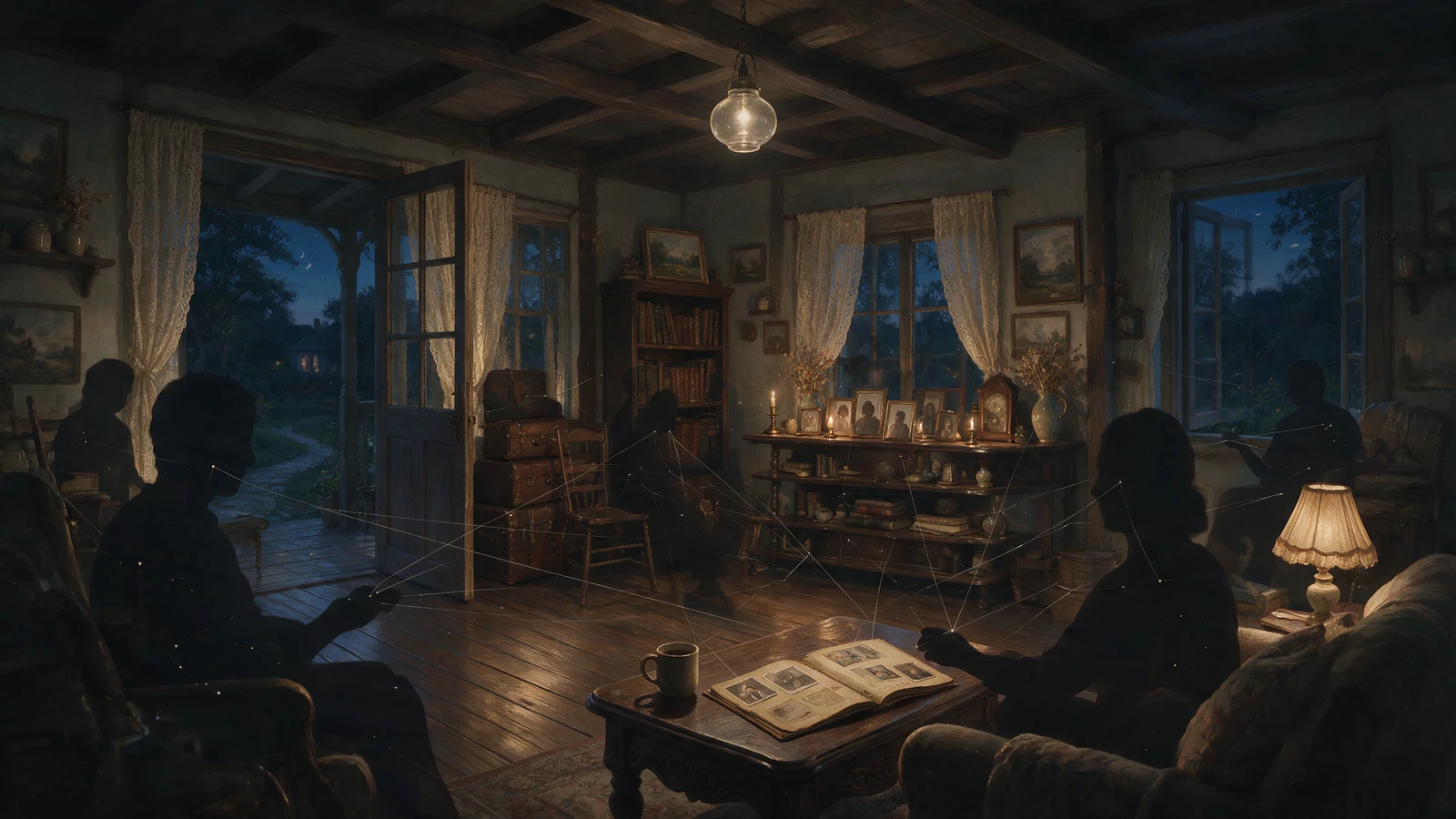
Your mother appeared, but something was off.
Maybe she didn't talk the way she usually does, or her face was subtly wrong, or you were somewhere that wasn't your house. In the dream, she was unmistakably your mother — but recalling it after waking, something doesn't line up.
And it nags at you all day. You start to wonder whether you should call and check in.
Lumi
"You were about to tell me who showed up, weren't you?
The old records split that very finely — ancestor, sibling, spouse, each its own category.
But modern readings go the opposite way. They don't treat who it was as the information.
This is one topic where the two perspectives collide head-on."
Table of contents
The Old Records Split People Into Very Fine CategoriesBrothers Fighting Was Highly Auspicious; Relatives Quarreling Meant ScatteringBut the People in Your Dream Are Assembled From MemoryA Dream Where a Family Member's Attitude Toward You Was StrangeA Dream of a Family Member Being Hurt or SickA Dream Featuring a Family Member Who Has Passed AwayA Dream Where It Was Family, But the Face Was WrongTo Put It HonestlyFrequently Asked QuestionsThe Old Records Split People Into Very Fine Categories
In the list of folk dream-reading methods under the "Dreams" entry of the Encyclopedia of Korean Culture (a major reference work on Korean history and culture), the entries involving people are organized tightly by who exactly appears.
- If an ancestor appears and offers food or speaks, something good will happen.
- If a married couple sits together at a feast, they will divorce.
- If a wife wears silk clothing, she will bear a distinguished son.
- Inviting a guest to drink together means a long life.
- If a tooth falls out, misfortune will befall an elder in the family.
Ancestor, married couple, wife, guest, family elder — each one its own separate entry.
The second entry stands out. A couple sitting together happily at a feast, and the verdict is divorce. It's the classic reversal grammar of dream interpretation, where a scene that looks pleasant flips into its opposite, and the encyclopedia notes this pattern directly: traditional interpretation held two competing attitudes, one that read dreams as symbols and one that read dreams as the mirror opposite of reality.
Brothers Fighting Was Highly Auspicious; Relatives Quarreling Meant Scattering

A dream of family members fighting is one of the most searched scenes in this territory, and most people search for it assuming it means something bad.
Commonly circulated versions of the Zhougong Jie Meng (The Duke of Zhou's Dream Manual, a family of traditional Chinese dream interpretation texts) — as preserved in a Wikisource transcription — contain several fighting scenes, and their verdicts go in every direction.
- If brothers strike each other, it is highly auspicious.
- If members of a household quarrel, they will scatter.
- Striking a wife or concubine means a loss of power.
- Being struck by a wife or concubine is inauspicious.
- Trading insults with a stranger is auspicious.
Read them together and no consistent rule emerges. Brothers fighting is highly auspicious; a household quarreling means scattering. The same act of conflict points in opposite directions depending on who's involved.
In traditional dream interpretation, family was never a single category. Brothers, spouses, and ancestors were entirely separate entries, sometimes carrying opposite verdicts.
That makes it hard to find one clean answer for a search like "a dream of family fighting." The old lists simply weren't organized at that level.
But the People in Your Dream Are Assembled From Memory
Lumi
"Their face was a little off, wasn't it?
That's very common. And it's actually the most important thing in this article."
The encyclopedia explains how dream images are built. Dream representations relate to waking experience, but arrive through fusion, displacement, symbolization, and figuration — two or more elements combine, or swap places and attach to something else entirely.
Modern psychology lands in roughly the same place. The person in your dream is not actually them — it is your own stored image of that person, assembled by the brain from raw material pulled out of memory.
This is why the family members in your dreams tend to show certain features.
- They say or do things they never would in real life.
- Their face is subtly wrong.
- Their age doesn't match — young when they should be old now, or the reverse.
- Multiple people are blended into one.
Once you know this, the question changes. It's not why did that person show up, but why did that particular memory surface right now.
We won't push this further, though. The claim that "the family in your dream represents a different part of yourself" circulates widely, but that belongs to a specific theoretical framework, not a verified fact.
We cover the same idea, applied to unfamiliar faces, in our guide to dreams about strangers.
A Dream Where a Family Member's Attitude Toward You Was Strange
They were angry, or pretended not to see you, or treated you like a stranger. This is the type that leaves you feeling worst after waking.
Traditional dream interpretation does not appear to contain a separate entry for this scene. The old lists recorded fighting and sitting together, but not a shift in someone's manner toward you.
Modern psychological readings generally connect this to the current state of the relationship. But one caution applies: whatever that person said in the dream was not said by them — you made it up.
So it's best not to conclude "my mother said that in the dream, so that must be what she really thinks." That is not information.
If you want to read something into it, this is the better angle: how the words made you feel, and whether that feeling overlaps with how you've actually been feeling around that person lately.
A Dream of a Family Member Being Hurt or Sick
This is the scene people search for with the most anxiety, so it gets its own section.
There is no evidence that this dream means something is going to happen to that person. It is not a prophetic dream. Neither the old dream manuals nor psychological research support that idea.
From a modern psychological perspective, a dream of someone close being hurt or sick is generally read as a scene created by the fear of losing them — an emotion, not real information.
It is said to appear more often during certain periods:
- When you're genuinely worried about that person's health
- When you've become separated from them
- When the relationship is changing — a child becoming independent, a parent growing older
- When you've recently heard of someone else's death
If you feel like calling after waking, go ahead. But it's better not to mention the dream. It will only make the other person anxious.
If the scene involved a family member passing away, our guide to dreams about dying covers that in more detail.
A Dream Featuring a Family Member Who Has Passed Away
This one belongs to a different category.
Traditional dream interpretation is favorable here. The records say that if an ancestor appears and offers food or speaks, something good will happen. The appearance of an ancestor itself was never treated as bad.
For people of that era, ancestors weren't gone — the relationship simply continued. That framing follows naturally.
Modern psychological readings generally connect this to the grieving process. Research on dreams following bereavement has observed that recurring dreams may play a role in working through emotion.
We cover this in more depth in our guides to dreams about deceased parents and dreams featuring people who have died.
A Dream Where It Was Family, But the Face Was Wrong
In the dream, it was unmistakably that person — but recalling it afterward, the face doesn't add up.
From a modern psychological perspective, this is extremely common. As noted above, the people in dreams are assembled from multiple memories, so the sense of identity is strong even while the details are wrong. It's the same phenomenon as a familiar house having the wrong layout in a dream — we cover that side of it in our guide to house dreams.
So there's no need to search for special meaning in a mismatched face. The more informative question is on the identity side: why were you so certain it was them?
It might have been the voice, or the clothing, or just a feeling. That tells you what you actually remember that person by.
To Put It Honestly
Lumi
"Search for family dreams and you'll find plenty of claims that they mean bad news.
The old entries say that brothers fighting is highly auspicious.
Of course, that's not a prophecy either. It's just a record of how people at the time read it."
Traditional dream interpretation and modern psychology rely on different kinds of evidence, and on this topic they point in genuinely opposite directions.
Tradition split people into fine categories. Ancestors, brothers, and spouses were each separate entries, sometimes with opposite verdicts.
Modern psychology doesn't treat the identity of the person as information at all. The person in the dream is understood as an image assembled from memory.
The two perspectives shouldn't be mixed. Mix them, and you end up with conclusions like "my brother appeared in the dream, so something must really be going on."
The encyclopedia itself notes, after listing these dream-reading entries, that such interpretations emerged naturally from many people's experiences rather than from any consistent theoretical basis.
A few points should be made clearly.
A family dream is not information about that person. That applies to scenes of injury or illness as well.
It's best not to take words heard in a dream as that person's real feelings. You made those words up.
It's better not to transfer your worry onto them because of a dream. Checking in is fine, but leave the dream out of it.
There is also no verified connection between family dreams and lottery numbers.
Frequently Asked Questions
I dreamed my family was fighting. The old entries didn't treat this as one thing. Brothers fighting is recorded as highly auspicious, while a household quarreling is recorded as leading to scattering.
I dreamed a family member was hurt. Will they be okay? It's not a prophetic dream. It's natural to read it as a scene shaped by the fear of losing them.
My mother was angry with me in the dream. Words spoken in a dream weren't said by that person — you made them up. It's best not to take them as her real feelings.
The face was a little different. Very common. The people in dreams are assembled from multiple memories, so identity feels strong even when the details don't match.
Someone who has passed away appeared. The old entries treated the appearance of an ancestor favorably. This belongs to a different category, and we cover it in a separate guide.
Should I call them? If you want to, go ahead. Just don't mention that it was because of a dream.
Family dreams linger because they're verifiable. Most dreams have nothing to check against, but this one is just a phone call away.
That's exactly what makes it more unsettling — you want to check.
For today, write down just three things.
- What did that person do?
- How did you feel?
- Has anything changed in your relationship with them lately?
The third one is usually closest to the answer. Family dreams tend to cluster around times when a relationship is shifting.
Writing down a heavy-hearted dream helps.
In your mind, it keeps expanding. On the page, it's short. And a few months of notes will show you that these dreams cluster around specific periods.
Dream Talisman combines the dream scene you record with your day stem (ilgan) in the Five Elements system to create a color and phone wallpaper for the day. It is less an app that claims to interpret dreams for you than one that helps you record them before they fade.
Record today’s dream in Dream Talisman
References
- "Dreams" — Encyclopedia of Korean Culture · Folk dream-reading entries on people and the body, the encyclopedia's explanation of fusion, displacement, symbolization, and figuration in dream imagery, and the two traditional attitudes toward interpretation
- The Wikisource transcription of the Zhougong Jie Meng tradition · Passages concerning conflict among family members. These are commonly quoted source lines; the wording has not been checked against a specific original edition. This is a Chinese dream-interpretation tradition with a different textual lineage from Korean folk records.
- General research on dreams following bereavement and relationship change
- General research in modern sleep and dream psychology