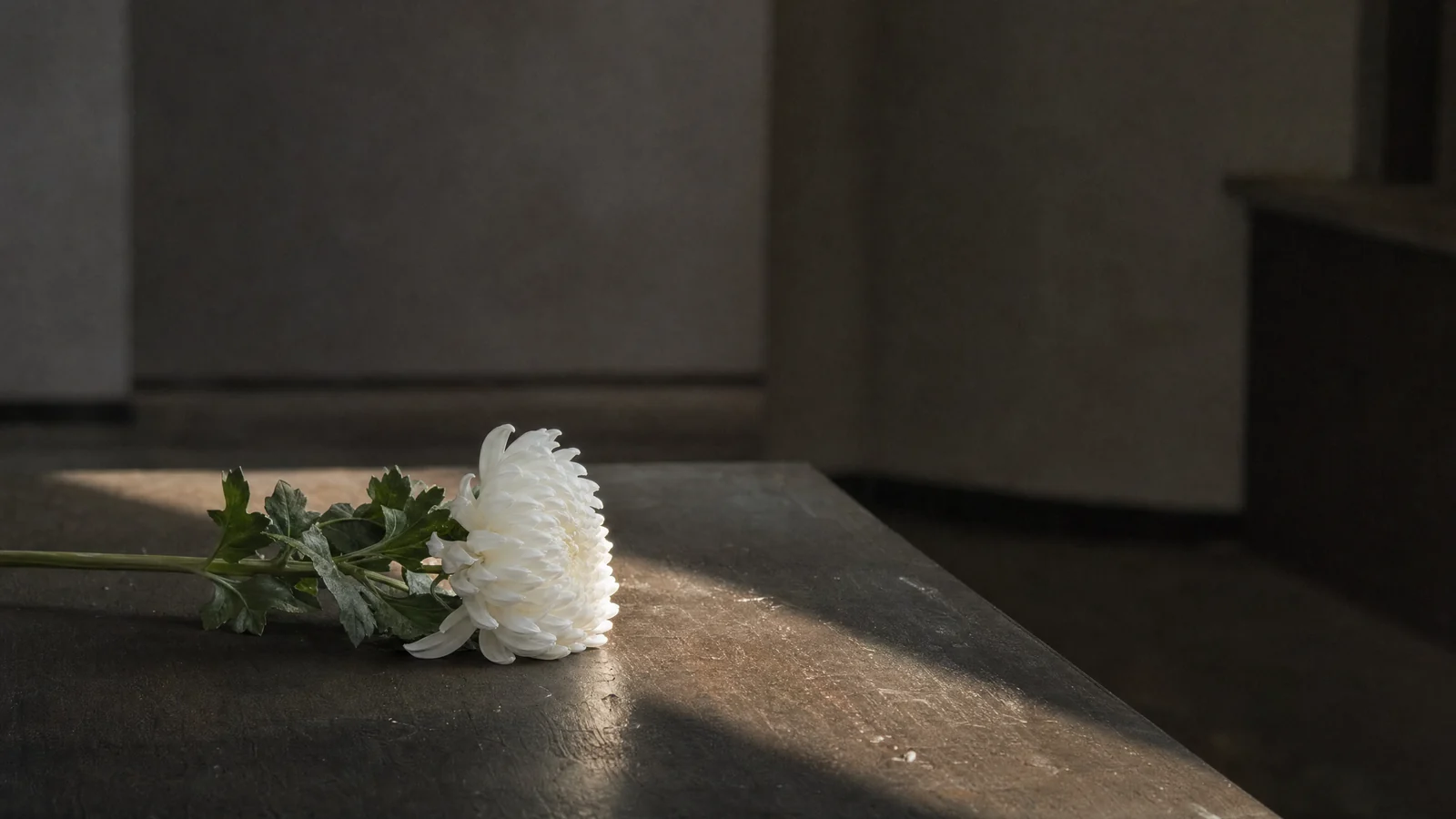
You tend to wake from a funeral dream feeling heavy.
No one had actually died, yet you felt sad. There were people, and somewhere was quiet. Then the worry sets in: is something wrong with someone?
Let's say this up front: old records read this dream favorably. And they said so in fairly clear terms.
Lumi
"Whose funeral was it?
And one more thing—what were you doing there?
Whether you were paying respects, serving as chief mourner, or just present changes everything."
Table of contents
Old Records Viewed Mourning Visits FavorablyWhy Were Funerals Viewed FavorablyA Dream of Attending Someone Else's FuneralA Dream of Watching Your Own FuneralA Dream of Wearing Mourning Clothes, or Being the Chief MournerIf It Was the Funeral of Someone You KnowA Dream Where a Funeral You Actually Attended ReappearsThe Coffin, the Bier, and the Memorial PhotographThe Most Honest AnswerFrequently Asked QuestionsOld Records Viewed Mourning Visits Favorably
Gather the funeral-related entries from the folk dream-reading list in the "Dreams" entry of the Encyclopedia of Korean Culture (a major reference work on Korean history and culture), and they all point the same way.
- Paying a mourning visit to a house of grief brings the birth of a son
- Seeing a funeral bier brings wealth
- A coffin entering the house means everything will go well
All three are favorable.
Mourning visits, biers, coffins—by today's instincts, every one of these feels unsettling, yet the old interpretations read them all as auspicious.
The encyclopedia notes that one traditional attitude toward dream interpretation held that dreams mean the opposite of reality, and these entries are an example of that. The same rule appears in our guide to dreams of dying, which is not yet available in English.
So there is no basis in the old records for reading a funeral dream badly just because a funeral appeared.
Why Were Funerals Viewed Favorably
The records don't spell out the reasoning, so what follows is a reasonable guess.
A funeral is not death—it is a procedure.
A person dying and a funeral being held are two different things. A funeral is where something that has already happened gets put in order. People gather, steps are followed, and things reach a close.
Old-fashioned funerals were also far larger events than they are now. The whole village would gather, and the proceedings could stretch on for days. Attending one meant you were part of the community.
That it was over, and that people had gathered. These two things are likely why the dream was read favorably.
A Dream of Attending Someone Else's Funeral

This is the most commonly reported type, and it is exactly the case the old mourning-visit entry describes.
From a modern psychological perspective, being a mourner is an unusual position—you are both observer and participant. It isn't your own affair, yet you are there.
A few details tend to matter.
- Whose funeral it was
- Whether you felt sad or simply calm
- Whether many people you knew were present
If the funeral was for someone unidentifiable, that's a common pattern. Dreams don't fill in every detail, and in those cases the situation of a funeral itself is the content.
If it was the funeral of someone you know, we'll cover that separately below.
A Dream of Watching Your Own Funeral
You had died, and you were watching it happen. This isn't rare, and it tends to stick with you.
From a modern psychological perspective, this is a variation on a dream of dying, but with one difference: there is an aftermath.
The moment of dying is usually forgotten, but a funeral can be seen. Unlike death, which you've never experienced, a funeral is something you have witnessed before, so the dream has material to build from.
What matters here is who came, and how they behaved.
- Did they grieve?
- Did they seem unaffected?
- Did no one come at all?
One reading treats this scene largely as a dream about relationships—a way of picturing how people would respond if you were gone.
If no one showed up, the dream may not be about death at all, but about loneliness.
A Dream of Wearing Mourning Clothes, or Being the Chief Mourner
Lumi
"Were you wearing mourning clothes?
That's a completely different position from paying a visit.
It means you weren't a guest—you were the host."
Wearing Mourning Clothes
Traditional interpretation has entries about clothing. Wearing someone else's clothes was read as a sign of coming worry, and worn-out clothing was viewed unfavorably. No entry specifically addressing mourning clothes has been confirmed, however.
From a modern psychological perspective, mourning clothes carry the image of a role. What you wear decides who you are in that setting.
Being the Chief Mourner
This is the case where you weren't a visitor but the one receiving visitors.
From a modern psychological perspective, this is a position of responsibility—greeting people and managing the proceedings without room to grieve.
If you've actually been in that position before, that memory may have supplied the material. And if you're currently shouldering something alone, that feeling may have taken this shape.
If It Was the Funeral of Someone You Know
Many people search specifically worried about this case, so it gets its own section.
There is no evidence that dreaming of a living person's funeral means something will happen to them. It is not a prophetic dream.
From a modern psychological perspective, this scene is usually read in terms of your relationship with that person.
- Are you worried about them right now?
- Is the relationship changing?
- Have you grown distant recently?
Sometimes a relationship coming to an end is pictured in the form of death. This is discussed in our guide to dreams of dying as well—it isn't a literal death, but the ending of the relationship as it has existed until now.
If you feel like checking in after waking, go ahead. But it's better not to mention the dream. It will only make the other person anxious.
A Dream Where a Funeral You Actually Attended Reappears
This is the case where a real funeral you went through comes back in a dream.
This isn't really in the realm of symbolic dream interpretation.
After a bereavement, scenes from that period recurring is common. Research on the bereaved has reported this pattern—memories from around the time of death or the funeral resurfacing in dreams.
And the intervals often widen as time passes.
Related material appears in our guides to dreams of a deceased parent and dreams featuring someone who has died, neither of which is yet available in English.
If these dreams increase around an anniversary or a holiday, that isn't strange—the season itself is calling up the memory.
The Coffin, the Bier, and the Memorial Photograph
The Coffin
Traditional interpretation reads the coffin favorably. A coffin entering the house was read as a sign that everything would go well.
The fact that the direction of entry mattered stands out—it's the same "coming in" grammar seen in our guides to rat dreams and pig dreams, which are not yet available in English.
The Bier
Traditional interpretation held that seeing a funeral bier brings wealth.
It's an object rarely seen today, so if you dreamed of one, a period drama or old footage may well have supplied the material.
The Memorial Photograph
This isn't a subject the old records cover.
From a modern psychological perspective, a memorial photograph is a face, and faces carry a lot of information: who it was, what expression they wore, whether you could recognize them.
If the face was blurry, that's common. Dreams don't render faces with much detail.
The Most Honest Answer
Lumi
"You'll find a lot of claims online that funeral dreams are bad omens.
The old records say a mourning visit brings the birth of a son.
That's not a prophecy either, of course—just a record of how people once read it."
Traditional dream interpretation and modern psychology draw on different kinds of evidence.
What the old records confirm is limited to this: mourning visits, biers, and coffins were all read favorably. That wasn't prophecy—it was how people of that era made sense of their world.
The encyclopedia itself states, after listing these interpretations, that they arose naturally out of many people's experiences rather than from any consistent theoretical basis.
A few points should be made clearly.
A funeral dream is not a prophetic dream.
Seeing a living person's funeral does not mean something will happen to them.
It's best not to pass your worry on to someone based on this dream. Checking in is fine, but leave the dream itself out of it.
This article will not suggest that you need a talisman or a ritual. There's no evidence for that, and telling a worried person to spend money is a different matter entirely.
There is also no verified connection between funeral dreams and lottery numbers.
Frequently Asked Questions
Is a funeral dream an inauspicious dream? Old records read it the opposite way. The entries for mourning visits, biers, and coffins are all favorable.
It was the funeral of someone I know. It isn't a prophetic dream. It's more natural to read it as a scene shaped by worry for that person or a shift in the relationship.
I watched my own funeral. This isn't rare. Who came and how they behaved is often the informative part, and one reading treats it as a dream about relationships.
A funeral I actually went through keeps reappearing. This is common after a bereavement. The intervals often widen over time. If it increased around an anniversary or holiday, that season is what called it up.
I was the chief mourner. That's a different position from being a visitor. One reading treats it as an image of responsibility.
I keep forgetting my dreams. They start fading around 90 seconds after waking. If you stay still for a moment instead of getting up right away, more fragments tend to surface.
It was probably a heavy dream. Let's accept that as it is.
But even the old records didn't read this dream badly. A funeral was seen not as death, but as a place where things get put in order.
There's nothing you need to do today. If you want one small thing to check, see whether there's something you've been putting off that needs sorting out.
And if someone has been on your mind, just check in on them. Leave the dream out of it.
Writing down a heavy dream can make it feel smaller.
In your mind, it keeps growing. On the page, it turns out to be shorter than expected. And after a few days of notes, you'll usually see it clustering around a particular period.
Dream Talisman has a record feature for logging that day's dream and how you felt. It is less an app that interprets your dreams for you than one that helps you write them down before they fade.
Record today’s dream in Dream Talisman
References
- "Dreams" — Encyclopedia of Korean Culture · Folk dream-reading entries (the human body, objects, and other categories), and the two traditional attitudes toward interpretation
- General research on dreams following bereavement
- General research in modern sleep and dream psychology