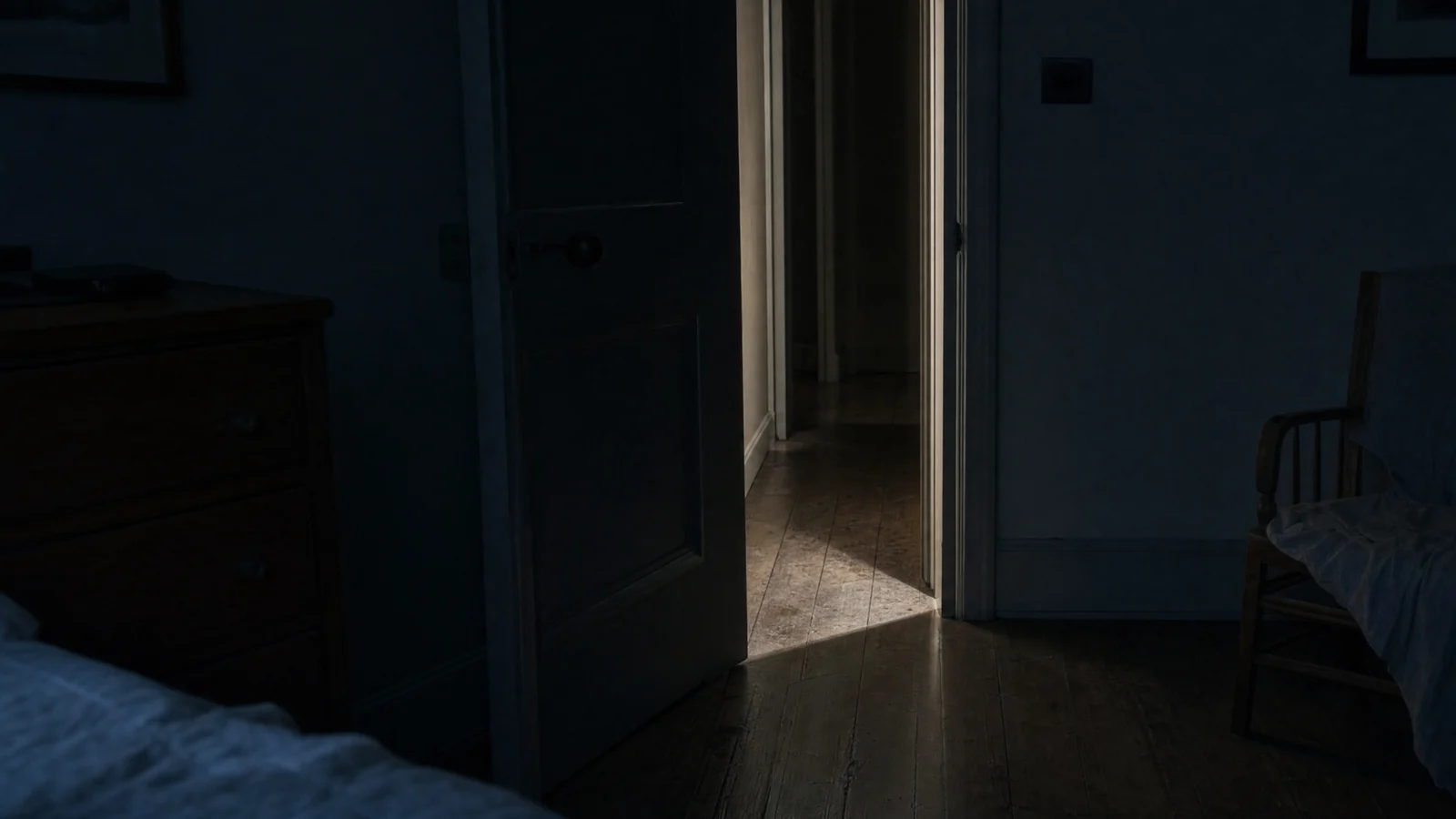
Someone who searches after a ghost dream is usually asking two things.
Is this a bad dream? And, was something actually there?
Let's answer the first one first. Being frightened and having a bad-omen dream are two different claims. And looking at old records, the truth runs closer to the opposite direction.
We'll get to the second question shortly. But there's something to check first.
Lumi
"Did your body stop moving at some point?
Eyes open, but you couldn't move a finger, and no sound would come out.
If so, that might not have been a dream at all. Read the section below first."
Table of contents
If Your Body Wouldn't Move, That's a Different StoryOld Interpretations Mostly Read Death-Related Entries FavorablyAncestors Were Also "Ghosts"How Yi Ik Explained Ghost DreamsNo Face, or a Face You Can't RememberSomeone You Know Appeared StrangeBeing Chased, Being Pressed Down, a Door OpeningWhen You Watched Something Scary Before BedWhen It Keeps RecurringThe Most Honest AnswerFrequently Asked QuestionsIf Your Body Wouldn't Move, That's a Different Story
A large share of the experiences people search for under "ghost dream" are actually sleep paralysis.
The symptoms overlap in fairly specific ways.
- Your eyes were open, but your body wouldn't move
- You tried to scream, but no voice came out
- Something felt like it was pressing on your chest
- You sensed—maybe even saw—someone else in the room
This happens when the muscle paralysis of REM sleep persists after consciousness has returned. It's quite common, and its causes are fairly well understood.
Here's the important part. What you saw during it really did appear to you. Because the brain generates dream imagery while partly awake, it can look extremely vivid. There's no reason to doubt someone who says they saw something. It just wasn't actually there in the room.
A detailed explanation and coping methods are covered in our guide to sleep paralysis, which is not yet available in English. If you remember your body being unable to move, read that first.
From here on, this article covers cases where your body could move—a straightforward dream.
Old Interpretations Mostly Read Death-Related Entries Favorably
This is likely the most surprising part of the article.
The "Dreams" entry of the Encyclopedia of Korean Culture organizes folk dream-reading methods by category. Gathering the entries related to death or funerals produces this list.
- A coffin entering the house means everything will go well
- Seeing a funeral bier brings wealth
- Paying a mourning visit to a house of grief brings the birth of a son
- If an ancestor appears offering food or speaking to you, something good will happen
All four are favorable.
Coffins, biers, mourning visits, ancestors—by today's instincts, all of these feel unsettling, yet the old interpretations read every one of them as auspicious.
The encyclopedia describes two traditional attitudes toward dream reading: one treats dreams as symbols, and the other holds that dreams mean the opposite of reality. The death-related entries lean toward the latter.
So there's no basis in the record for calling this a bad-omen dream just because something frightening appeared. If anything, people in the past tended to read it the other way around.
Ancestors Were Also "Ghosts"
The image that comes to mind now when you hear "ghost" is mostly a frightening one. But the traditional usage was far broader.
An ancestral spirit was a gwisin (ghost/spirit). A being guarding the house was a gwisin. A wandering spirit carrying a grudge was also a gwisin. It wasn't a matter of scary or not scary—the term referred more broadly to anything without a body.
That's why the entry mentioned above makes sense. If an ancestor appearing and speaking meant something good was coming, that means the being wasn't viewed as a threat.
This is useful for reading dreams today, too. What the figure in your dream tried to do to you carries more information than whether it counts as a "ghost."
- Did it try to hurt you?
- Did it seem to be trying to tell you something?
- Did it just stand there?
- Did it seem not to notice you?
That last one comes up surprisingly often, and it isn't a threatening scene at all.
Dreams featuring someone who has actually died belong to a different category, covered in our guide to dreams of the deceased, which is not yet available in English.
How Yi Ik Explained Ghost Dreams
Lumi
"Someone asked this same question 300 years ago.
He was a Joseon-era Silhak scholar, and his answer is a bit surprising.
He didn't say ghosts don't exist. He also didn't say they do."
Yi Ik (이익, a late-Joseon Silhak—Practical Learning—scholar) discussed the omens that appear in dreams in his essay "Mongjoron" (몽조론, "On the Signs of Dreams").
There, he wrote that the claim "ghosts create dreams" sometimes made sense to him. But what follows matters more: he explained that a ghost is the working of qi (氣), and that another person's qi can come into contact with the dreamer's mind and produce countless illusions.
In short, his explanation wasn't that a supernatural being visited the room, but that some energy met the mind and produced an image.
In the same essay, Yi Ik made another observation: sleeping to the sound of drums produces dreams about soldiers, and sleeping to the sound of someone reading produces dreams about writing. It's an observation that what enters from outside becomes the dream.
What someone reached 300 years ago lands remarkably close to what sleep research says today. Only the vocabulary is different.
No Face, or a Face You Can't Remember
This is the most common description in ghost dreams, and it's what makes the fear so much bigger.
From a modern psychological perspective, this isn't unusual at all. Blurry faces in dreams are extremely common.
Most dreams featuring a stranger work this way. The brain has to construct a face, but without a real person to draw from, there's no material to fill in the details. So you're left with an outline and no features.
You've never seen a face like that while awake, so it feels frightening. But that's not because there's no face—it's because it was never filled in.
Dreams of unfamiliar people in general are covered in our guide to dreams of strangers, which is not yet available in English.
Someone You Know Appeared Strange
A living person you know appeared, but their expression or mood felt off. Many people say this type lingers even longer.
From a modern psychological perspective, this scene is better read in terms of your relationship with that person than as a ghost story. An awkward conversation from earlier in the day, unresolved feelings, an unaddressed misunderstanding—these are the kind of material this scene tends to draw on.
One thing tends to matter here: how that person treated you.
If it felt frightening, that may be less about the other person being scary and more a sign that you're feeling tense in that relationship right now.
Being Chased, Being Pressed Down, a Door Opening
Being Chased
From a modern psychological perspective, a chase dream turns less on who's chasing you than on your own response—whether you looked back, hid, or stood your ground. Details are covered in our guide to being chased in a dream, which is not yet available in English.
That the pursuer was a ghost is a matter of the type of threat, not its scale.
Being Pressed Down
This is likely the sleep paralysis mentioned earlier. It's better to check our guide to sleep paralysis, which is not yet available in English.
A Door Opening, Something Coming In
Traditional interpretation generally read something entering the house as an inflow. As noted above, a coffin entering the house was among the entries read as a sign that things would go well.
From a modern psychological perspective, a door is an image of a boundary. An open door signals a sense that the boundary has disappeared, which could feel either welcome or unsettling.
When You Watched Something Scary Before Bed
This has to be mentioned.
Having a ghost dream after watching a horror movie or a scary video before sleep is common. It isn't a symbol or an omen—it was simply the material you fed it.
Yi Ik's observation, quoted above, applies directly here: what you heard or saw becomes the dream.
If ghost dreams have increased recently, take a look at what you've been watching before bed. What fills the thirty minutes before sleep tends to decide that night's material.
When It Keeps Recurring
From a modern psychological perspective, with a recurring dream, the repetition itself is often more informative than the content.
If ghost dreams are recurring and any of these are also present, it's worth paying attention.
- You're going to bed later and later because falling asleep feels scary
- You're waking up frequently during the night
- You're severely drowsy during the day
At that point, the issue has shifted from the dream to sleep itself. Less sleep tends to bring more frightening dreams—a cycle worth interrupting before it sets in.
If it continues, it's worth consulting a sleep clinic or a mental health professional. Not sleeping is the bigger problem here, not the scary dream itself.
The Most Honest Answer
Lumi
"Search for ghost dreams and you'll find claims that an ancestor is trying to tell you something, or that bad luck has attached to you.
I couldn't find anything about bad luck.
There really is an entry saying it's good when an ancestor appears. Those are two completely different things."
Traditional dream interpretation and modern psychology draw on different kinds of evidence.
The encyclopedia itself states, after listing these interpretations, that they arose naturally out of many people's experiences rather than from any consistent theoretical basis. There's even a case in the Samguk Yusa (the Samguk Yusa, or Memorabilia of the Three Kingdoms, a 13th-century Korean historical text) where the same dream was read in opposite ways depending on who was interpreting it.
A few points should be made clearly.
There is no evidence in the records that a ghost dream is a bad-omen dream. There's no dedicated "ghost" entry in the dream-reading list at all, and the death- and funeral-related entries were, if anything, read favorably.
There's also no evidence that a ghost dream forecasts something bad. It is not a prophetic dream.
This article will not suggest buying a talisman or holding a ritual. There's no evidence for that, and telling someone who's frightened to spend money is a different matter entirely.
There is also no verified connection between ghost dreams and lottery numbers.
Frequently Asked Questions
Is a ghost dream an inauspicious dream? There's no ghost entry in the dream-reading list, so there's no basis to say so definitively. If anything, death-related entries like coffins, biers, and mourning visits were mostly read favorably.
I couldn't move, and I saw a ghost. This is likely sleep paralysis, caused by REM muscle paralysis lingering after waking. What you see during it can be extremely vivid. Our guide to sleep paralysis, not yet available in English, covers how to cope.
There was no face. Blurry faces in dreams are common. Without a familiar person to draw from, the brain has no material to fill in the details, leaving only an outline.
Is my ancestor trying to tell me something? There is an old entry reading an ancestor appearing and speaking as a good sign. But that reflects how people of that era read it, not evidence that a message was actually delivered.
I keep having the same ghost dream. Note the interval between occurrences and what happened in between—patterns tend to become clearer later. This often overlaps with periods of insufficient sleep.
I'm too scared to sleep. That's the most important issue here. Less sleep brings more frightening dreams. If it continues for more than a few days, it's worth getting some counseling.
It really was frightening. Let's accept that as it is.
But being frightened doesn't mean something bad is coming. Old records didn't read it that way either.
There isn't much to do today. Skip scary videos before bed, lie down a little earlier, and maybe leave a small light on rather than making the room pitch dark.
That alone tends to make tonight quiet.

Writing down a scary dream can make it feel smaller.
In your mind, it keeps growing. On the page, it turns out to be shorter than expected. And after a few days of notes, you'll usually see it clustering around a particular period.
Dream Talisman has a record feature for logging that day's dream and how you felt. It is less an app that interprets your dreams for you than one that helps you write them down before they fade.
Record today’s dream in Dream Talisman
References
- "Dreams" — Encyclopedia of Korean Culture · Folk dream-reading entries (human affairs and other categories), Yi Ik's "Mongjoron" and "Monggamnon," and a Samguk Yusa dream-interpretation case from the reign of King Wonseong
- "Ghost" — Encyclopedia of Korean Culture
- General sleep-medicine material on REM atonia and hallucinations during sleep paralysis
- General research in modern sleep and dream psychology