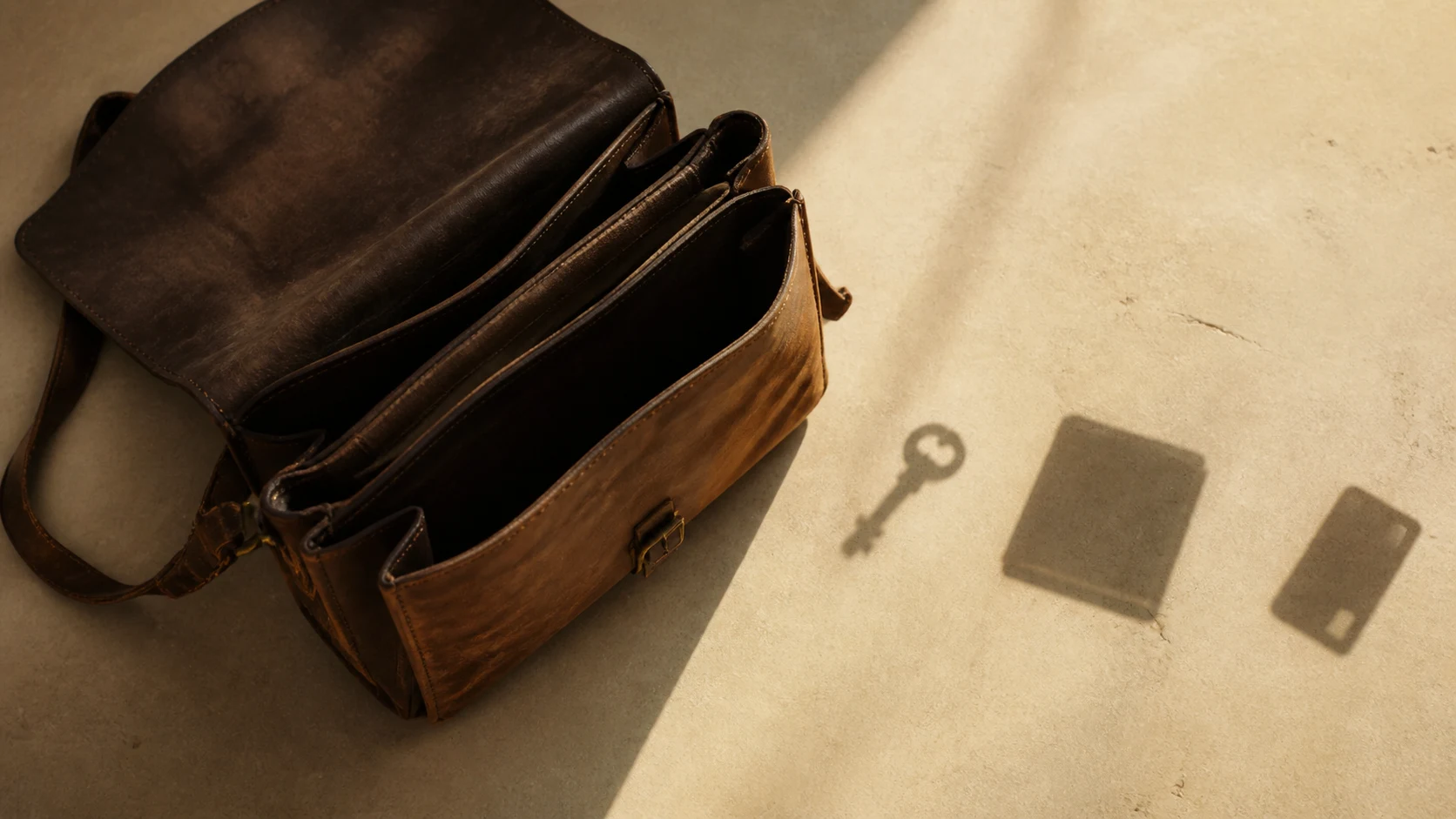
You probably went through your pockets first.
You were sure you had put it there, but it was gone. You searched again, opened your bag, retraced your steps. Then you woke up still searching. Most people never find it.
Some of you checked your actual wallet or phone the moment you opened your eyes.
When people search for this dream, they usually type something like "dream about losing things." But measured against the old lists, that search term is too broad. Each object had its own entry, and the conclusions rarely matched.
Lumi
"What did you lose?
A wallet, a set of keys, a shoe — the old books treated every one of those as a different entry.
You won't find an answer by lumping them together."
Table of contents
The Old Lists Are Organized by ObjectSo Here Is the Order to Work ThroughDreams of Losing a Wallet or MoneyDreams of Losing Your Keys, or Being Unable to Open a DoorDreams of Losing a BagDreams of Losing ShoesDreams of Losing an ID or DocumentsDid You Find It, or Not?Being Honest About ThisFrequently Asked QuestionsThe Old Lists Are Organized by Object
Commonly circulated versions of the Zhougong Jie Meng (The Duke of Zhou's Dream Manual, a family of traditional Chinese dream interpretation texts) contain a whole cluster of entries about losing things, and they do not point in one direction.
- Losing an official's cap means stepping down from a post
- Picking up an official's sash means a title is on its way
- Losing a mirror means a couple will separate
- Losing a sword means losing rank and authority
- Losing control of one's bodily functions means losing wealth
Most of these lean unlucky, but not all of them. And losing something sits right next to finding something in the same list.
The "Dreams" entry of the Encyclopedia of Korean Culture (a major reference work on Korean history and culture) shows a similar pattern in its section on objects. Seeing scissors is said to bring wealth; a shattered mirror means a couple will part; being struck dead by a sword is read as a great blessing. Each object gets its own verdict.
One rule stands out. The conclusion depended on what job the lost object had been doing.
An official's cap represented a position, so losing it meant losing that position. A sword represented authority, so losing it meant losing authority. A mirror reflected a pair, so a broken one meant the pair split.
What mattered was not the fact of loss itself, but what the object had been standing in for.
So Here Is the Order to Work Through
There are three things worth checking when you retrace this dream.
- What did you lose?
- What can you no longer do without it?
- Did you find it in the dream?
The second question is the important one. It is also the exact place the old lists were looking.
Without a wallet, you cannot buy anything. Without a key, you cannot get in. Without an ID, you cannot prove who you are. Every lost object closes off something different.
Read in modern terms, that closed-off thing is what is actually worth examining. This is a symbolic reading, though, not a verified prediction.
Dreams of Losing a Wallet or Money
This is the most commonly searched version.
Traditional interpretation offers several entries about wealth, but they do not point in a single direction. The Zhougong Jie Meng tradition includes a line that treats loss as financial loss, alongside many entries that flip an apparently bad scene into a reading about wealth.
The encyclopedia notes that dream interpretation carried two different attitudes: one that read dreams as symbols, and one that treated dreams as the opposite of reality. Both attitudes show up mixed together in the entries about money.
We cover dreams that feature money itself in a separate guide.
Read in modern terms, a wallet is unusual because it concentrates several functions in one object. Cash, cards, and identification all live in one place. So losing a wallet in a dream tends to look less like losing one thing and more like losing several things at once.
If you woke up feeling unusually empty, that may be why.
Dreams of Losing Your Keys, or Being Unable to Open a Door
Traditional interpretation puts the entry on the door rather than the key itself. A door swinging wide open is read as a strongly good sign; a blocked door means a matter will not go through.
The old lists judged whether the door could be passed through. The key was simply the tool that opened that passage.
Read in modern terms, losing a key is one of the clearest versions of the "closed-off thing" described above. You cannot get in. And there is usually somewhere you need to be.
What matters here is which door it was.
- Was it your own home?
- Was it work or school?
- Was it somewhere you had never been?
The first points toward a place you want to return to; the third points toward somewhere you have not yet entered.
A dream where the door will not lock runs in the opposite direction — that scenario belongs to a different guide about doors that won't stay locked.
Dreams of Losing a Bag
Lumi
"What was inside the bag?
If you remember, that's the closest thing to an answer.
You didn't lose the bag — you lost what was in it."
A bag is not really an object in the same way — it is a container, and that makes it a bit different.
Traditional interpretation rarely addresses bags directly. Clothing, shoes, and official caps each get several entries, but bags are uncommon in the old lists — likely in part because a bag in today's shape was not an everyday object at the time these texts took form.
Read in modern terms, the thing worth examining when a bag goes missing is not the bag but its contents.
If you remember what was inside, write that down. And usually only one item comes back clearly. That one item is the most useful piece of information in this dream.
If you cannot remember, that is information too — a state of anxiety about a loss you cannot name.
Dreams of Losing Shoes
Traditional interpretation does have a separate entry for shoes. It sits alongside sashes and clothing; in the old lists, clothes and shoes were both things worn on the body and markers of status.
Entries about receiving new clothes or an official sash generally lean auspicious, while losing or burning them leans toward stepping down from a position.
Read in modern terms, shoes are different from other objects — they are tied to movement. Without shoes, you cannot walk.
So a dream of losing shoes may be less about the object and more about travel or movement. If it appeared alongside scenes on a road, it is worth reading alongside our guide to dreams of losing your way.
Dreams of Losing an ID or Documents
Traditional interpretation has a fairly clear entry here. The Zhougong Jie Meng tradition includes a line saying that stamping a seal on a document makes one's name known, and it belongs to the same family as the entry where losing an official's cap means stepping down.
In the old lists, documents, seals, and official caps were all objects that proved something. And losing them pointed toward losing a position.
Read in modern terms, losing an ID is different from the other objects above. It is not about being unable to buy or enter somewhere — it is about being unable to show that you are who you are.
We will not push this further, though. The claim that this "means you're losing your identity" is a popular explanation, but it is one specific reading, not a verified fact.
Did You Find It, or Not?
Traditional interpretation places losing and finding side by side. The line about an official's cap being lost while a sash is picked up is a good example.
So if you found the item, the old lists do not treat that as an unlucky sign.
And as with the dream of drowning discussed elsewhere on this site, this tradition cared less about going under than about coming back up. Watching whether something is recovered follows the same grammar as watching whether something is lost.
Read in modern terms, what matters here is how you felt at the time.
- Were you still searching until the end?
- Did you give up?
- Did you find it, only to discover it was a different item?
The third option comes up more often than you'd expect — finding something that turns out not to be yours, or shaped differently than you remembered. That reads less like recovery and more like something still unresolved.
If this dream keeps recurring, it helps to track the interval between occurrences — that pattern is covered in our guide to recurring dreams.
Being Honest About This
Lumi
"Search online and you'll find claims that losing something in a dream predicts a real loss.
The old entries wrote about each object differently — a cap meant a position, a sword meant authority, a mirror meant a partner.
What they were tracking was what the object had been standing in for."
Traditional dream interpretation and modern psychology rely on different kinds of evidence.
What the old records support is limited to this: each object had its own entry, the conclusion followed what the object represented, and losing and finding were recorded side by side. These were not prophecies — they were the way people of that era made sense of their world.
The encyclopedia itself, after listing its dream-interpretation entries, states plainly that these readings formed naturally out of many people's experiences rather than from any consistent underlying theory.
A few points should be made clearly.
This dream does not predict an actual loss. It is not a reason to leave your wallet at home today.
A blanket reading of "losing things means financial loss" is not how the old lists actually worked. Each object was recorded on its own.
There is no evidence that a lost object stands for a specific person or relationship.
There is also no verified connection between this dream and lottery numbers.
Frequently Asked Questions
Is losing something in a dream an inauspicious dream? It depends on the object. Losing an official's cap points toward losing a position, losing a sword toward losing authority — while finding something sits on the good side.
I lost my wallet. A wallet concentrates several functions in one place, so losing it tends to feel like losing several things at once. It does not, however, predict an actual loss.
I lost my keys and couldn't get in. The old lists focused on the door more than the key. A blocked door was read as a sign that a matter would not go through.
I can't remember what was in my bag. That's information too — a state of anxiety about not knowing what you lost.
I found it, but it turned out to be a different item. That reads less like recovery and more like something still unresolved.
This keeps happening. Write down the interval between occurrences and what happened in between — patterns tend to become clear over time. It also helps to note whether it's always the same object.
This dream wears you out because you're always searching. Other dreams let an event pass; this one keeps you digging.
But the old lists never treated the loss itself as the main event. What they tracked was what the object had been doing for you.
Today, write down just three lines.
- What did you lose?
- What can you no longer do without it?
- Did you find it?
The second line is the most useful one in this dream. It usually comes out in a single sentence.
A dream that ends mid-search doesn't leave you with a resolution to write down.
In that case, just write down the name of the object. Collect a few weeks of these and you'll start to see whether the same object keeps coming back.
Dream Talisman combines the dream scene you record with your day stem (ilgan) in the Five Elements system to create a color and phone wallpaper for the day. It is less an app that claims to interpret dreams for you than one that helps you record them before they fade.
Record today’s dream in Dream Talisman
References
- Original text of the Zhougong Jie Meng — Wikisource · Entries on losing and gaining sashes, clothing, objects, and doors. This is a Chinese dream-interpretation tradition with a different textual lineage from Korean folk records
- "Dreams" — Encyclopedia of Korean Culture · Folk dream-interpretation entries on objects, and the two attitudes toward dream reading
- General research in modern sleep and dream psychology