People who dream about a rat and reach for a search bar tend to feel the same odd discomfort.
It wasn't frightening, exactly, but it left a residue. Nothing as dramatic as a snake dream or as significant as a tiger dream — just a small, fast shape that moved at the edge of your vision. That sensation is what lingers.
So most people end up typing the same question: is a rat dream a bad omen?
Lumi
"I know that look. That lingering unease.
But wait a moment — where was the rat?
Was it in a granary, a kitchen, or on your blanket?
That's where rat dreams actually diverge. It's about place, not size."
Table of contents
Why the Rat Comes FirstGranary, Kitchen, Bedroom — Location Is Half the AnswerThe Gnawing RatBeing BittenCatching, Losing, and Killing the RatOnly One Rat Entry Survives in the RecordsWhite, Black, Large, and Baby RatsOne Rat and a Swarm Are Entirely Different DreamsA Dead Rat, a Rat That Got AwayThe Modern RatBeing Honest About ThisFrequently Asked QuestionsWhy the Rat Comes First
The rat leads all twelve animals of the Korean zodiac.
The most familiar folktale explains why: the animals raced to determine their order, and the rat secretly rode on the ox's back before leaping off just before the finish line to claim first place. It won through cleverness, not strength.
The recorded explanation is different, though. According to the "Thirty-Six Beasts" entry of the Encyclopedia of Korean Culture (a major reference work on Korean history and culture), the rat was assigned to the Hour of the Rat — roughly 11 p.m. to 1 a.m., the first hour of the day — for a specific reason. That hour straddles the old day and the new one, so it needed an animal carrying both yin and yang at once.
This detail matters. The rat comes first not because it's fast, but because it straddles two worlds: it moves at night, lives in the house without belonging to it, and sits beside stored wealth while gnawing at it. That contradiction is where rat-dream interpretation starts to split in opposite directions.
There's a more important connection here.
Rats live wherever grain is stored. A granary swarming with rats meant there was something worth eating inside. A house with no rats at all, conversely, had nothing left to take — the same logic behind the old saying that rats are the first to leave a sinking ship.
So in traditional dream interpretation, the rat was read as an indicator of wealth rather than its source. A rat's presence didn't mean wealth was being handed to you; it meant wealth was already there. That distinction shapes every interpretation below.
Even though pig dreams belong to the same wealth-symbol family, the logic differs. A pig represents wealth itself, while a rat only signals that wealth is nearby — which is why a rat dream's meaning can flip entirely depending on the situation.
Granary, Kitchen, Bedroom — Location Is Half the Answer
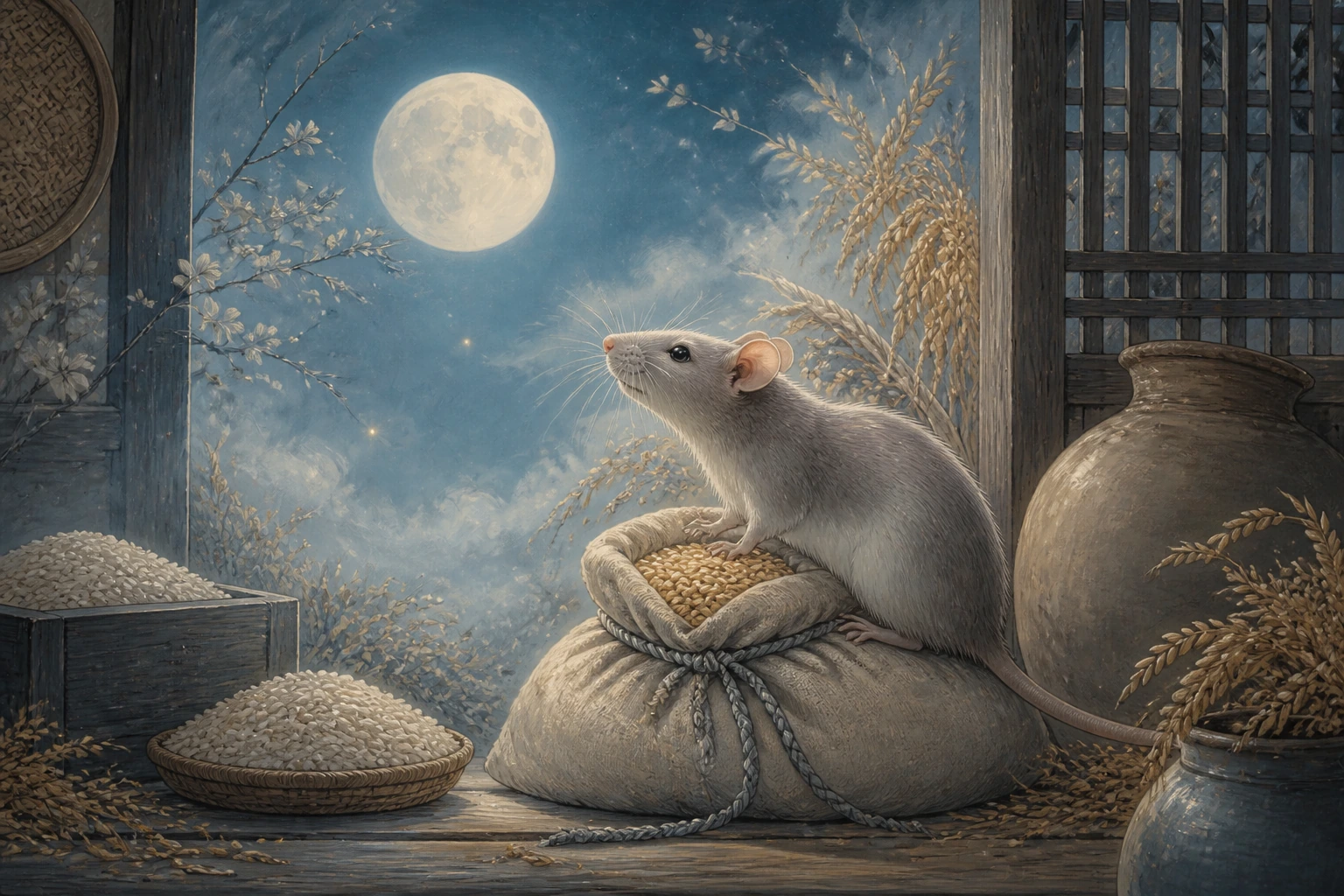
This is why place is the first question worth asking about a rat dream.
A Granary or Storehouse
Traditional interpretation reads this as the most favorable setting. A rat beside stored grain meant the granary was full, and most folk readings that link rats to wealth point back to this scene. The more rats, the more sacks of grain, the better the omen.
From a modern psychological perspective, this scene is sometimes read through the lens of storage and accumulation. A storehouse holds things you own but aren't currently using. Its appearance in a dream can suggest you're mentally taking stock of what you have — which is why storehouse dreams are said to increase around a job change or a period of checking your bank balance more often than usual.
A Kitchen
Traditional interpretation treats the kitchen as one step closer to daily life than the granary. Old dream readings connected a kitchen rat to immediate food supply — everyday household matters rather than long-term wealth. If the granary represents savings, the kitchen represents this month's living expenses.
From a modern psychological perspective, the kitchen is often described as a space tied to caregiving — the place where you feed people. An intruder appearing there can be read as the burden of caregiving, or the sense that this territory has been violated.
A Bedroom or Your Bed
This is the most unsettling version.
Traditional interpretation reads this scene differently from the previous two. A granary or a kitchen is a place a rat belongs; a bedroom is not. An animal appearing somewhere it shouldn't be was rarely read as favorable — the same grammar traditional dream interpretation applies whenever an animal strays from its expected place.
From a modern psychological perspective, the bedroom is the space where you're least defended: asleep, undressed, door closed. Something small and uncontrolled entering that space is often connected to a sense of privacy or personal territory being violated.
If you woke up feeling unusually uneasy, the setting is probably why.
The Gnawing Rat
This is the most commonly reported rat-dream scene — and the one where interpretations diverge the most.
Traditional interpretation splits depending on what was being gnawed. Gnawing at grain wasn't read as purely negative, following the same logic above: there has to be food present to gnaw on in the first place. Gnawing at clothing, blankets, or documents — things that aren't food — was more often read as loss. Modern dream-interpretation content that treats gnawed wires or appliances unfavorably follows the same pattern.
From a modern psychological perspective, what makes this scene interesting is its pace. Gnawing isn't destruction that happens all at once. It progresses slowly, almost invisibly, over a long stretch of time.
Some readings connect this image to a sense of gradual depletion — a stretch of time with no single crisis but constant tiredness. Small things that are nothing on their own but add up to something exhausting, like the quiet sound of automatic payments leaving your account one by one.
If a gnawing dream stays with you longer than a dream of sudden collapse, what's actually worrying you may be an ongoing condition rather than a single event.
Lumi
"Was there any actual gnawing sound while you were sleeping?
A refrigerator, a boiler running in the next room?
There's real research showing that sounds heard during sleep can work their way into dream content.
That's worth ruling out before reaching for an interpretation."
This observation isn't new. Yi Ik (이익), a late-Joseon Silhak scholar, made the same point in his essay Monggamnon (몽감론, "On the Causes of Dreams"): someone who falls asleep hearing drums dreams of soldiers, and someone who falls asleep hearing reading aloud dreams of books.
The idea that dreams absorb sounds from outside is at least 300 years old. Sometimes closing the window comes before consulting a dream dictionary.
Being Bitten
Perhaps because a rat is small, many people report being bitten without feeling pain.
Traditional interpretation generally reads being bitten as something entering the body — the same grammar that appears in our guide to snake dreams, not yet available in English. Contact and entry were treated as the same event. For rats specifically, the interpretation sometimes shifted with the location of the bite: a hand pointed toward wealth, a foot toward travel or movement.
From a modern psychological perspective, the story is different. Being bitten is the experience of a boundary breaking at an unexpected moment. Being bitten by a small animal, rather than signaling a major threat, connects more to the sense of being harmed by something you underestimated — a task you dismissed as minor, a person you didn't take seriously.
Whether you felt anger, shock, or nothing at all after the bite is often the most honest piece of information the dream offers.
Catching, Losing, and Killing the Rat
These three scenes are worth reading together, since they form a single thread.
You Caught It
Traditional interpretation reads this as gaining possession of something — especially if the dream involved a chase that ended in success. Catching an animal was generally read as acquisition in old dream interpretation.
From a modern psychological perspective, this can be read as regaining a sense of control over something that had been nagging at you. What you did after catching it matters more, though — did you release it, hold onto it, or freeze without knowing what to do next?
It Got Away
Traditional interpretation places this at the opposite end from catching — something almost within reach slipping away.
From a modern psychological perspective, this is often described as an image of an unresolved situation. If a dream of something almost-but-not-quite caught keeps recurring, there may be a real matter that hasn't reached a conclusion. These dreams tend to cluster in the same stretch of time, so recurrence a few days apart is information in itself.
You Killed It
Traditional interpretation most often reads this as an obstacle being cleared. There's a condition attached, though — old readings distinguished between feeling settled and feeling uneasy after the act.
From a modern psychological perspective, the reading is similar, but the deciding factor is emotion. Relief suggests the matter is genuinely resolved; sadness or lingering discomfort suggests it isn't finished yet.
Only One Rat Entry Survives in the Records
This next part is worth stating plainly, even though it complicates everything above.
The "Dreams" entry of the Encyclopedia of Korean Culture organizes folk dream-interpretation methods into categories: the body, human affairs, nature, houses, objects, animals, and plants. Within the animal category, the rat appears in exactly one line.
If a rat is caught and eaten by a cat, the dreamer will earn money.
That's the entire entry.
There's no mention of a rat in a granary meaning wealth, or of being bitten as an auspicious sign. That doesn't mean those readings are wrong — they've circulated widely and survive in regional oral traditions. But it's worth knowing that the country's leading encyclopedia recorded only this single line about rats.
And that one line is strange in its own right. It doesn't say the rat brings wealth; it says money comes once the rat is gone. That runs directly against the earlier logic that a rat in the granary signals grain in storage.
Within the same culture, then, two views of the rat sat side by side: a sign of wealth, and a drain on it. Choosing one as the correct reading means reading only half of what survives.
White, Black, Large, and Baby Rats
Color and size come third, after place and action. Still worth covering, since the curiosity is real.
A White Rat
Folk dream interpretation often mentions a white rat favorably — an extension of the broader belief that white animals are auspicious creatures. That said, this isn't a separate entry recorded in a traditional dream-interpretation text; it's closer to a claim that circulates in modern dream-interpretation content. The claim should be stated no more strongly than that.
From a modern psychological perspective, color functions more like an emotional temperature reading. If the same rat is remembered as white, the scene likely didn't register as threatening. Vivid color recall in dreams isn't especially common to begin with.
A Black Rat or Sewer Rat
Traditional interpretation didn't treat black itself as an ill omen — some readings even connected dark-colored animals to wealth. The deciding factor is condition, not color. A rat that looked dirty or diseased weighs more heavily on the interpretation than its color does.
From a modern psychological perspective, dreams that carried strong disgust are sometimes read as anxiety related to contamination or hygiene. Rats trigger an unusually strong instinctive aversion in people, so this kind of dream tends to leave a more intense emotional residue than dreams about other animals.
An Unusually Large Rat
Size translates directly to weight. Traditional interpretation held that a larger animal pointed to a larger matter behind it.
From a modern psychological perspective, size functions as a measure of how overwhelmed you feel. Something that should be small appearing unusually large can mean a matter you dismissed as minor is actually bigger than you can comfortably handle — a reading that tends to land accurately fairly often.
A Baby Rat
Rats give birth to large litters, which is why modern dream-interpretation content sometimes connects a baby rat to fertility or to a taemong (conception dream — a dream believed to foretell pregnancy).
The evidence behind that claim is thinner than it sounds, though. The material the encyclopedia actually lists for conception dreams is food — chili peppers, strawberries, pumpkins — or household items like brass bowls and vases. Rats don't appear on that list.
So a line is worth drawing here: a rat dream doesn't mean you're pregnant. Most conception dreams are stories attached after the fact. We cover this in more depth in our guide to conception dreams.
One Rat and a Swarm Are Entirely Different Dreams
The same animal, but the number of rats changes the interpretation completely.
A Single Rat
A single rat points to something specific — a person, or a particular matter. Traditional interpretation often read a lone animal as standing in for one concrete thing.
From a modern psychological perspective, a single rat is often described as one nagging problem — the sensation of something moving at the edge of your attention that you can never quite pin down.
Several Rats or a Swarm
Traditional interpretation splits sharply here. Rats swarming a granary followed the earlier logic and wasn't read unfavorably. Rats closing in from every direction or surrounding you, though, took on a different meaning — tangled relationships, or a pile of unfinished tasks.
From a modern psychological perspective, a swarm is almost always an image of losing control. One rat is manageable; many at once aren't. This is a classic scene for overlapping deadlines, too many people to respond to, or a to-do list that's grown too long to face.
If you woke up from a swarm dream feeling unusually exhausted, that may well be the answer.
A Dead Rat, a Rat That Got Away
Seeing a Dead Rat
This tends to be one of the least pleasant dreams to wake up from.
Traditional interpretation reads this scene as something reaching an end — a matter closing, for better or worse. Death was generally treated as closure or transition in old dream interpretation rather than as an omen in itself.
From a modern psychological perspective, the reading lands in a similar place, but emotion is what decides it. Relief suggests the matter is resolved; sadness or lingering discomfort suggests it isn't.
A Rat That Ran Away
Traditional interpretation reads this carefully, following the logic above: a rat leaving meant there was nothing left worth taking. But that only holds if the rat was in a granary to begin with — a rat leaving a bedroom means the opposite.
From a modern psychological perspective, this is sometimes read as an image of avoidance. Whether you chased it and lost it, simply watched it leave, or felt relieved that it left changes the meaning of the dream completely.
The Modern Rat
There's one version the old dream-interpretation texts have no answer for.
A pet rodent — a hamster or a guinea pig — showing up in a dream is a scene that simply didn't exist when the traditional texts were written, so no entry covers it. Forcing an old interpretation onto it would mean inventing one.
Here, only the modern psychological perspective applies. A pet dream carries a different emotional structure than a wild-animal dream — the center of gravity is caregiving, not threat. If the dream centered on losing the animal, forgetting to feed it, or it being sick, that's more naturally read as caregiving pressure or guilt than as a symbol tied to rats generally.
If you actually keep one of these animals, checking its water bowl comes before consulting a dream guide.
Being Honest About This
Lumi
"If you've read this far, you've probably noticed something.
I keep separating 'the old texts say this' from 'modern research says that.'
That's deliberate.
The moment you blend the two into something like 'scientifically proven fortune,' it stops being true."
Traditional dream interpretation and modern psychology rest on different kinds of evidence.
Traditional dream interpretation is a cultural symbol system built up over centuries. It reflects how people of the past read the world, and it's worth studying on those terms.
This isn't just an editorial position. The same encyclopedia cited above states directly, after listing its dream-interpretation entries, that these readings arose naturally from many people's experiences rather than from any consistent theoretical basis. It also describes two broad traditional approaches: reading dreams as symbols, and reading dreams as the opposite of reality.
The Samguk Yusa (Memorabilia of the Three Kingdoms) — a 13th-century compilation of Korean legends, folklore, and Buddhist history — preserves a case where the same dream was read in opposite ways by different interpreters. Before King Wonseong took the throne, a dream of his was first read as a sign of dismissal and imprisonment; asked again, the same dream was reinterpreted as an omen that he would become king.
Modern psychology treats dreams as activity of the brain and emotions. Freud's and Jung's interpretations hold an important place in the history of psychology, but they aren't theories used as-is in today's empirical research. Current sleep research tends to focus less on dream content and more on the dreamer's emotional state and memory processing.
So this article places the two side by side without blending them.
A few things are worth stating clearly.
There is no confirmed connection between rat dreams and lottery numbers. Neither traditional dream-interpretation texts nor psychological research mention numbers. Any "rat dream lottery numbers" you've seen online were invented by someone. Playing for fun is anyone's choice, but it isn't dream interpretation. Money-related dreams in general are covered separately in our guide to money dreams.
A dream cannot tell you about wealth or the future. Traditional interpretation connected rats to wealth because of the living conditions of the time — grain stored in a granary. Now that those conditions no longer apply, there's no reason the same reading would still hold.
Frequently Asked Questions
Is a rat dream auspicious or inauspicious? It depends on the setting. A place a rat would naturally occupy — a granary or storehouse — was read favorably in traditional interpretation, while a place it shouldn't be, like a bedroom, was read differently. That distinction comes before size or color.
I keep forgetting my dreams. Dreams tend to start fading about 90 seconds after waking. Instead of getting up right away, staying still for a moment often lets more fragments surface. Changing position tends to make them disappear fast.
Does writing dreams down change anything? After a few weeks, patterns emerge. Certain dreams cluster before deadlines, during shaky relationships, or while a decision is being put off. A dream can't predict the future, but it can tell you fairly precisely where you're standing right now.
I keep having the same rat dream. With a recurring dream, the repetition itself is often more informative than the content. Noting how many days apart it recurred, and what happened in between, tends to be far more useful than the dream's details alone.
Does a rat dream mean money is coming? No. Traditional interpretation connected rats to wealth because rats lived wherever grain was stored — a symbol drawn from the living conditions of the time. A symbol is a symbol, not a prediction.
This morning can be an ordinary one.
An unsettling dream usually fades within a few days. If you want to do something about it, try finishing one task you've been putting off — whether the dream involved gnawing or a swarm, crossing one thing off the list tends to make for a quieter night.
Or reach out to someone you haven't seen in a while and suggest coffee. That's a far more reliable fix than anything a rat dream can tell you.
Even the same rat dream leaves a different color for each person.
Dream Talisman looks at the dream scene you record together with your day stem (ilgan) in the Five Elements system to create a color and phone wallpaper for the day. It's less an app that interprets your dream for you than one that lets you carry today's dream with you for the rest of the day.
Curious what color that rat you just read about would become?
Record today’s dream in Dream Talisman
References
- "Dreams" — Encyclopedia of Korean Culture · List of folk dream-interpretation methods; Yi Ik's essay Monggamnon; the dream-reading example involving King Wonseong from the Samguk Yusa
- "Thirty-Six Beasts" — Encyclopedia of Korean Culture · The reasoning behind assigning the rat to the Hour of the Rat
- "The Twelve Zodiac Spirits" — Encyclopedia of Korean Culture
- "Zodiac Year Animals" — Encyclopedia of Korean Culture
- "Rat" — Encyclopedia of Korean Culture
- Sigmund Freud, The Interpretation of Dreams
- Carl Jung — symbol/archetype theory
- General research in modern sleep and dream psychology