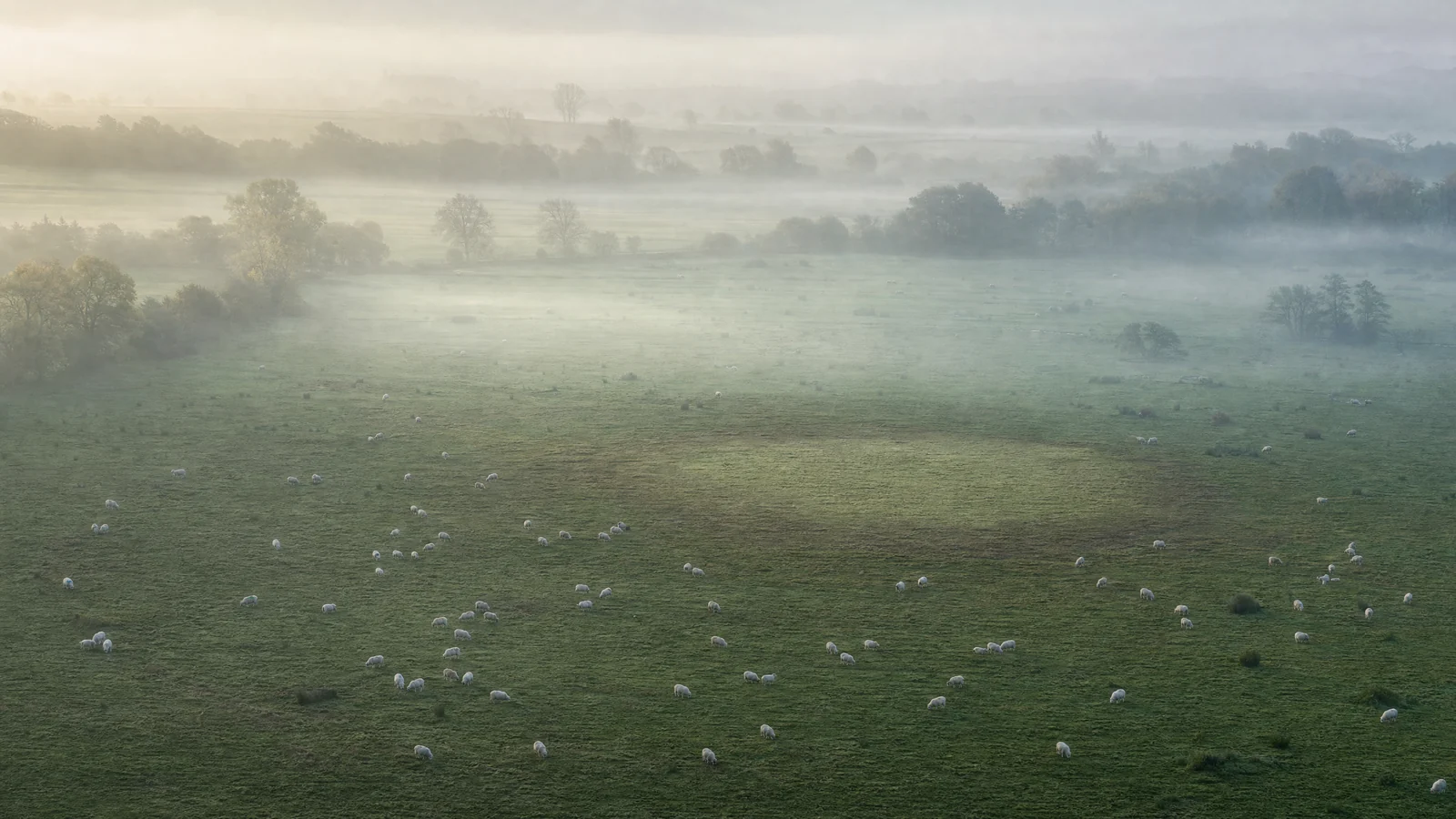
Sheep dreams are rare.
Many people dream of snakes or dogs, but far fewer dream of sheep. And when they do, the dream tends to follow the same pattern: there seemed to be several sheep, their shapes hazy, nothing frightening or good happened, and the whole scene was simply quiet.
So the reason people search is different too. They come not out of anxiety, but out of curiosity about why a sheep, of all things, appeared.
Let's say this upfront: the old records offer almost no answer to that question. And the reason is an unusual one.
Lumi
"Have you ever actually seen a sheep up close?
Not at a farm exhibit or a zoo—I mean really up close.
Most people haven't. And that turns out to be the key to this dream."
Table of contents
The Sheep's Hour: Mi (1–3 p.m.)Sheep Were Almost Never Seen in KoreaAbout the Yi Seong-gye Sheep Dream You'll Find OnlineA Dream of Seeing a Flock of SheepOne Sheep, Separated From the FlockWhite Sheep, Black SheepA Dream of Slaughtering a SheepA Dream of Counting SheepTo Be Honest About ItFrequently Asked QuestionsThe Sheep's Hour: Mi (1–3 p.m.)
In our guide to horse dreams, we noted that the horse—with its single, undivided hoof—was classified as pure yang and placed at high noon in the old records. The sheep comes right after, in the hour of Mi: between 1 and 3 p.m.
According to the entry on the Thirty-Six Beasts (Samsimnyuksu) in the Encyclopedia of Korean Culture (a major reference work on Korean history and culture), Mi is a yin hour and corresponds to earth in the Five Elements. Along with Chuk, Jin, and Sul, it holds one of the four corner positions. It also marks the point right after the horse's midday peak, when the day begins to tilt toward afternoon.
When the twelve hours are further divided into thirty-six beasts, Mi splits into three: a sheep at its start, a wild goose in the middle, and a hawk at its end. Two birds sit right after the sheep—an odd combination compared with earlier slots, which tended to group similar kinds of animals together.
That oddness connects to what comes next.
Sheep Were Almost Never Seen in Korea
This is the heart of the article.
The twelve zodiac animals are a system that came from China. Nine of the twelve were common on the Korean peninsula—the rat, ox, tiger, rabbit, snake, horse, rooster, dog, and pig. All of them could be seen in a yard or on a nearby hill.
The remaining three are the exceptions: the dragon (covered in our guide to dragon dreams), the monkey (in our guide to monkey dreams), and the sheep.
The dragon was imaginary to begin with, and the monkey never lived wild on the peninsula. The sheep is a real animal, but it was almost never raised in Korea. The climate and grassland conditions weren't suited to it, and cattle and goats filled the roles sheep might otherwise have played. In old documents, sheep mostly appear as sacrificial animals (huisaeng) used in ancestral rites—meaning they were seen only on special occasions, for a specific ritual purpose.
So people of that era likely almost never dreamed of sheep.
That appears to be why the sheep is absent from the list of folk dream-reading methods in the “Dreams” entry of the Encyclopedia of Korean Culture. The animal entries there include the dragon, snake, crane, parrot, tiger, swallow, rat, and pig—all creatures people actually saw often.
So the sheep we see in dreams today is less a traditional symbol than an image imported in more recent times—from farm photographs, picture books, stuffed animals, counting sheep to fall asleep, the biblical shepherd and his flock. The sources are all different, and all recent.
Once you know this, the direction of interpreting a sheep dream changes. Rather than digging through old records, it makes more sense to ask where you encountered the image of a sheep in the first place.
About the Yi Seong-gye Sheep Dream You'll Find Online
Search for sheep dreams and this story comes up often.
Before he became king, Yi Seong-gye (founder of the Joseon Dynasty) supposedly dreamed of trying to catch a sheep, and its horns and tail fell off. When he asked the monk Muhak to interpret it, the monk is said to have explained that removing the horns and tail from the Chinese character for sheep (羊) leaves the character for king (王)—a sign that Yi would become king.
The story is compelling, but it is not the dream that actually survives in the historical record.
According to the entry on the legends of the monk Muhak in the Encyclopedia of Korean Culture, the episode of Yi Seong-gye's dream interpretation is recorded in the Sunoji, the Jibongyuseol, and the Yeollyeosilgisul—three Joseon-era compilations. It is known as the origin story of Seokwangsa temple.
The content of that dream was this: roosters crowed in countless houses, the sound of laundry-beating could be heard, flowers fell, a mirror fell, and Yi carried three roof rafters on his back. Muhak interpreted each image in turn, and the final one is the key: a person carrying three rafters forms the shape of the character for king (王).
The method of reading a character's shape is the same. But the material in question is rafters, not a sheep.
The sheep version is most likely a later story built by borrowing the structure of this character-splitting method of interpretation. It is widely known and entertaining, but the version with documentary support is the one about the rafters.
This distinction may look minor, but it is worth making clear because many articles cite the Yi Seong-gye story as evidence for interpreting sheep dreams. That evidence does not check out.
A Dream of Seeing a Flock of Sheep
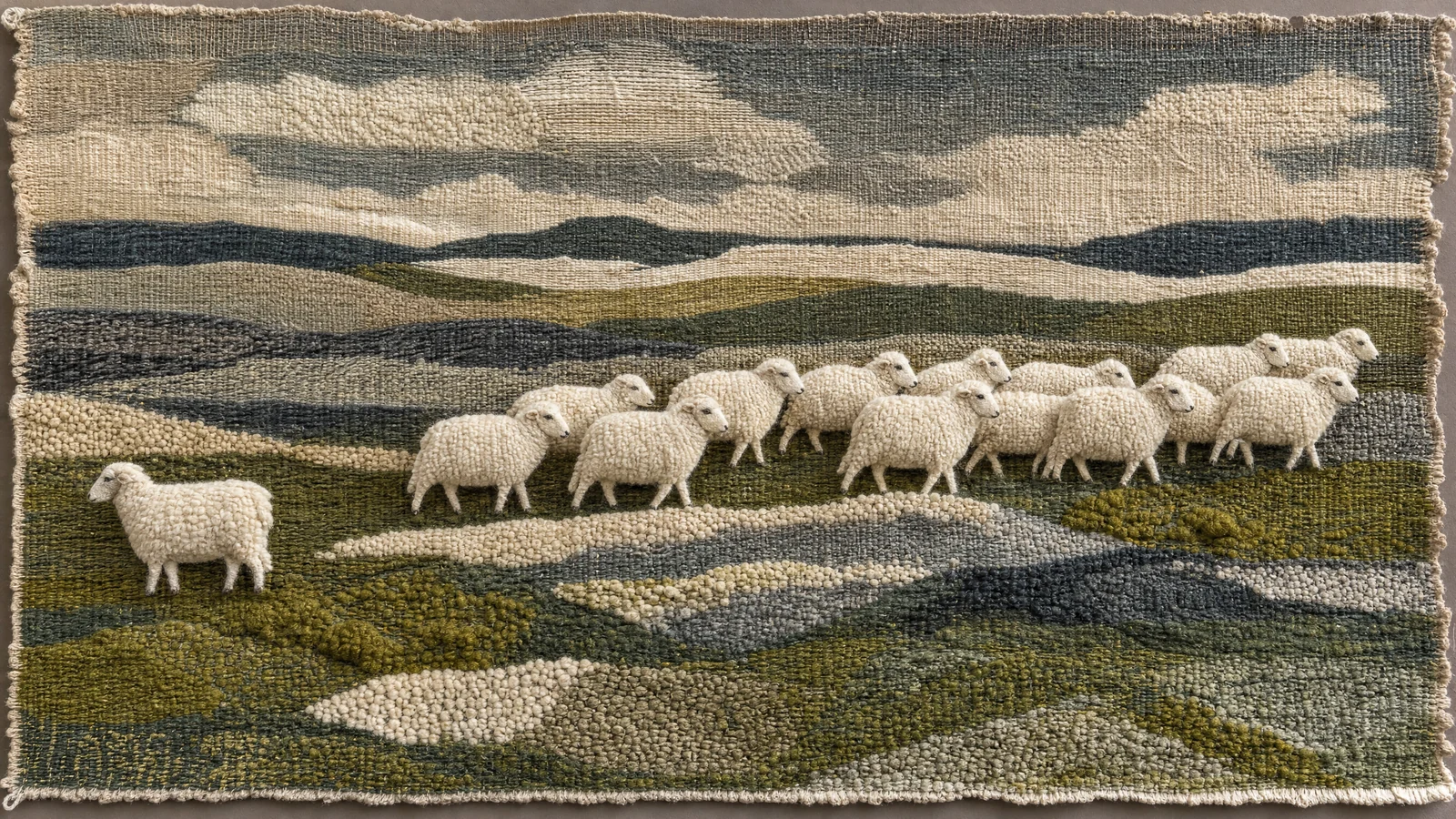
This is the most commonly reported scene in sheep dreams.
There is no traditional interpretation, for the reason already explained. We won't invent one here.
From a modern psychological perspective, this scene has a clearly different feel from other groups of animals. If a swarm of rats (as discussed in our guide to rat dreams) reads as something surging toward you, and a herd of horses (our guide to horse dreams) reads as something being swept along, a flock of sheep reads as something standing still.
Not threatening, not fast, and all looking much the same.
So this image is often read in terms of the group versus the individual—the sense of being somewhere everyone moves alike. Whether that felt comfortable or stifling is where the interpretation splits.
- If it felt comfortable, it leans toward a sense of belonging.
- If it felt stifling, it leans toward a sense of not being distinguished from everyone else.
It also matters whether you were inside the flock or watching from outside it. Watching from outside puts you in the position of observing belonging rather than experiencing it.
Lumi
"Was there one sheep looking somewhere different from the rest?
That detail comes up fairly often.
And if you remember it, that's the most important part of the dream."
One Sheep, Separated From the Flock
A single sheep, apart from the herd. Many people say this is the detail that stays with them.
From a modern psychological perspective, this scene sits opposite the flock dream. If the flock is an image of belonging, the separated sheep is an image of breaking away.
Here too, the feeling is the information. Did the sheep seem pitiful, enviable, or did it feel like nothing at all?
This image has another possible source. In Western religious culture, the lost sheep is an old parable—the well-known story of a shepherd who leaves ninety-nine sheep behind to search for the one that wandered off. If you're familiar with that story, it may well be where the material for the dream came from.
This has nothing to do with traditional Korean dream interpretation. But tracing where a dream borrows its material from is sometimes more accurate than trying to interpret it.
White Sheep, Black Sheep
White Sheep
Sheep, by default, are usually white. If you weren't consciously aware of the color, white is close to the default setting.
From a modern psychological perspective, not specifically remembering a color means color wasn't important to that scene. There's no need to force a memory of it.
Black Sheep
This one is different. The black sheep isn't an image from Korean tradition—it comes from the English expression, used to describe someone who stands out from the group, or the troublemaker of a family.
If you already know this expression, then seeing a black sheep in a dream comes with meaning already attached. So a black sheep dream is likely less a symbol drawn from sheep themselves than a scene produced inside the mind of someone who knows the phrase.
This has no connection to the old idea that black was an inauspicious color in traditional dream interpretation—there was no sheep entry to begin with.
A Dream of Slaughtering a Sheep
In old documents, sheep mostly appear in the context of ancestral rites—as sacrificial animals.
No record of this scene being interpreted as a dream has been confirmed in traditional sources.
From a modern psychological perspective, dreams of harming a harmless animal—as also discussed in our guide to rabbit dreams—are often read in terms of guilt. It doesn't mean you actually harmed someone; it's an image that tends to appear when you feel that some choice of yours caused someone else a loss.
With sheep, there's one more layer: the word "scapegoat" is still in use today. A sense that someone took the blame in another's place, or that you were the one standing in that spot. If something like that has been happening in your life, that may be the more accurate explanation.
A Dream of Counting Sheep
Naturally, this isn't in the old records. But for people today, sheep and sleep are linked.
The custom of counting sheep to fall asleep came from the West. It isn't clear exactly when it arrived, but it isn't an old Korean habit.
And there is research that casts doubt on whether counting sheep actually helps you fall asleep. One experiment found that vividly imagining a relaxing scene shortened the time it took to fall asleep more than counting sheep did. The explanation given is that monotonous counting is merely boring—it doesn't push worries out of the way.
If you were counting sheep in the dream itself, you may well have been genuinely struggling to fall asleep beforehand. That's a sleep issue, not a symbolic one.
To Be Honest About It
Lumi
"This article said 'there's no record' more than usual, didn't it?
But that's actually the most accurate piece of information here.
It would be much easier to pretend an answer exists when it doesn't. That's exactly why we didn't."
Traditional dream interpretation and modern psychology rely on different kinds of evidence.
After laying out its list of dream-reading methods, the Encyclopedia of Korean Culture itself notes that these interpretations arose naturally from many people's experiences rather than from any established theoretical basis. Even the Samguk Yusa (Memorabilia of the Three Kingdoms) contains a case where the same dream was read in opposite ways depending on who was interpreting it.
The sheep is a special case even among these. Korean traditional dream interpretation barely has an entry for it at all.
So the sheep-dream interpretations you find online—the ones attaching words like wealth, a helpful benefactor, or smooth sailing—mostly borrow the grammar of other animal entries or import Western symbolism.
There is also no confirmed connection between sheep dreams and lottery numbers. Dreams related to money are covered in our separate guide to dreams of finding money.
Claims about sheep as a taemong (conception dream, a dream believed to foretell a pregnancy) are also hard to verify. The fact that a taemong cannot reveal a baby's sex is discussed in our separate guide to conception dreams.
The absence of a record doesn't mean the dream is meaningless. It only means its meaning can't be found in an old book. A sheep dream is the kind of dream you're meant to trace inside your own head, right now.
Frequently Asked Questions
Is a sheep dream an auspicious dream? There is almost no verifiable traditional record to draw on, because sheep weren't common in Korea. Rather than sorting it into auspicious or inauspicious, it's more useful to look at whether you were inside the flock or outside it.
I can't tell if it was a sheep or a goat. That confusion is natural. Goats were the animal actually raised in Korea. Rather than pinning down the species, it's more useful to note how many there were and whether they were moving.
A sheep looked straight at me. One animal in the flock looking at you is the moment individuality entered the scene. Write down how you felt at that moment, and it will make more sense later.
I keep dreaming about a flock of sheep. For a recurring dream, the repetition itself is more informative than the content. Note how many days apart it happened and what went on in between.
I keep forgetting my dreams. Dreams start fading about ninety seconds after you wake. Instead of getting up right away, try staying still for a moment—more fragments tend to surface.
Today, it's fine to go about things as usual.
If you want to pick out just one thing, notice whether there's something in your life you've been going along with simply because everyone else does. If that feels fine, leave it. If it feels stifling, that's worth thinking about.
And if sleep has been difficult lately, that's the far more practical issue to deal with. Darkening the room helps more than counting sheep.
Even the same sheep dream leaves a different color for every person.
Dream Talisman looks at the dream scene you record together with your day stem (ilgan) in the Five Elements system to create a color and phone wallpaper for the day. It is less an app that claims to interpret dreams for you than one that lets you carry today's dream with you for the rest of the day.
If you're curious what color the sheep you just read about would come out as.
Record today’s dream in Dream Talisman
References
- “The Thirty-Six Beasts” — Encyclopedia of Korean Culture · The zodiac assignment system and its subdivision into thirty-six beasts
- “Dreams” — Encyclopedia of Korean Culture · List of folk dream-reading methods
- “Legends of the Monk Muhak” — Encyclopedia of Korean Culture · The origin story of Seokwangsa temple, recorded in the Sunoji, Jibongyuseol, and Yeollyeosilgisul
- “The Twelve Zodiac Spirits” — Encyclopedia of Korean Culture
- General experimental research on pre-sleep imagery induction and sleep-onset latency
- General research in modern sleep and dream psychology