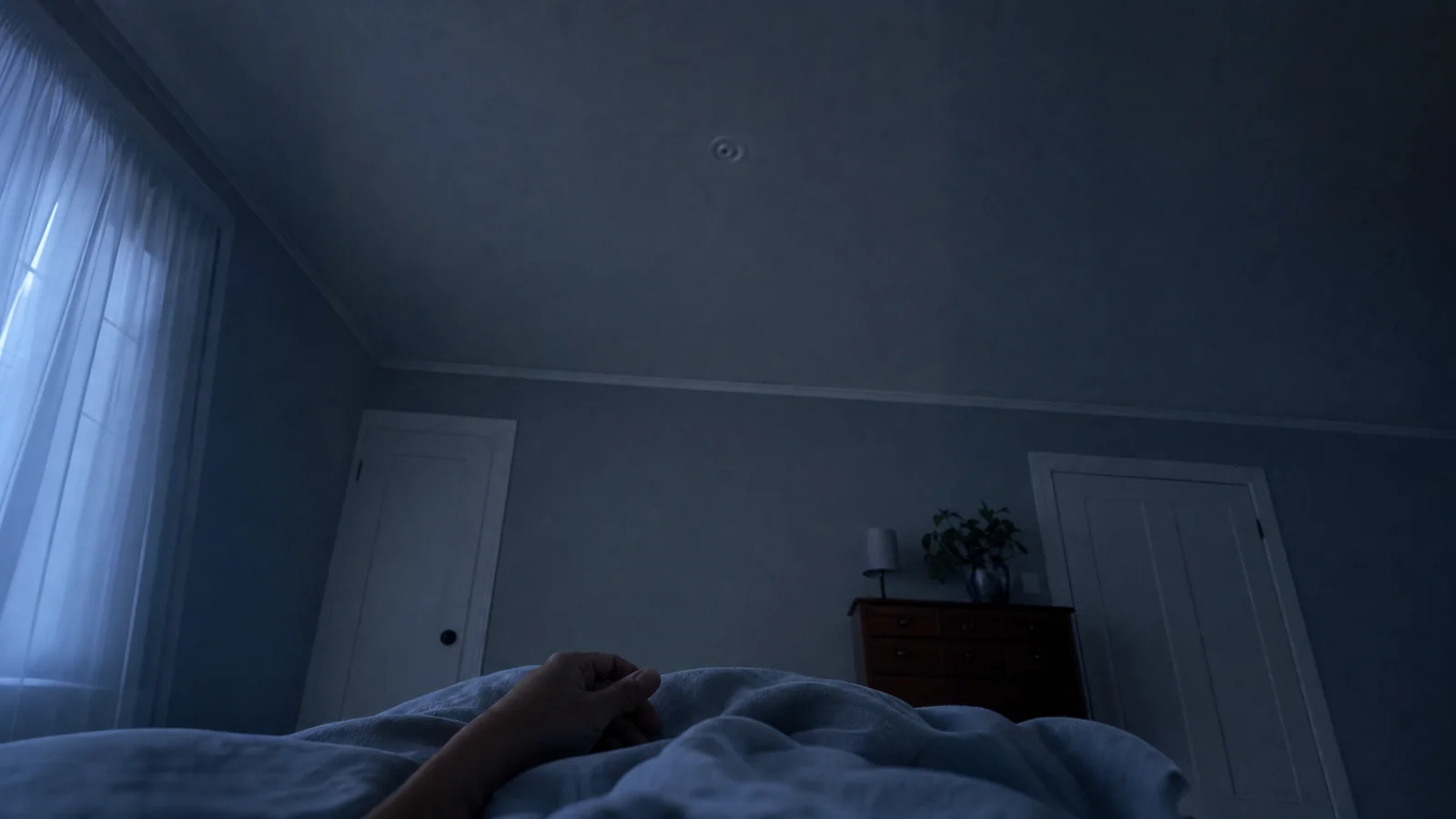
People who've experienced sleep paralysis tend to remember the moment with striking precision.
Your eyes were open, but your body wouldn't move — not even a finger. You tried to scream, but no sound came out. Your chest felt pressed down, and it felt like someone was in the room. You may have even seen them.
Then, after some stretch of seconds or minutes, it suddenly lifted.
Let's say this up front. This is a very common experience, and what's happening in your body is fairly well understood.
Lumi
"You're okay. Really.
I know you searched for this because you're scared right now.
But more than one in ten people go through this. And there's a real reason for it."
Table of contents
Your Body Is Still Asleep While Your Mind Has Woken UpMore Than One in Ten People Experience ThisThat Sense That Someone Was ThereDifferent Names Across Cultures, Identical SymptomsWhy That Particular NightWhat to Do When It HappensReducing How Often It HappensWhen It's Worth Seeing a DoctorHow This Appears in Traditional RecordsFrequently Asked QuestionsYour Body Is Still Asleep While Your Mind Has Woken Up
Sleep unfolds in several stages, and REM sleep, the stage where most dreaming happens, has one distinctive feature.
During REM, your muscles are held in a state where they barely move at all.
The reason is simple. If your body moved along with the running or fighting happening in your dream, that would be dangerous. So your brain temporarily blocks the signals sent to your muscles, leaving only your eyes and breathing muscles active.
Normally, this lock releases first when you wake up, and consciousness follows right after.
Sleep paralysis happens when that order gets scrambled. Consciousness returns first, while the muscle lock hasn't released yet. You can see the room and think clearly, but your body simply won't move.
That's the whole mechanism. Nothing is wrong with your body — the sequence just came out of order.
And the lock releases on its own, usually within seconds to a few minutes. It resolves without you needing to do anything.
More Than One in Ten People Experience This
A pooled analysis of 35 studies on sleep paralysis reports the following lifetime prevalence rates:
| Group | Prevalence |
|---|---|
| General population | About 7.6% |
| Students | About 28.3% |
| People receiving psychiatric care | About 31.9% |
Among the general population, that's close to one in ten; among students, it's closer to one in three or four. The numbers vary depending on how each study measured it, but every study reaches the same conclusion: this is not rare.
The higher rate among students stands out and is likely connected to exam periods and frequent late nights.
That Sense That Someone Was There
What makes sleep paralysis frightening isn't the inability to move. It's the sense that someone was there.
Research divides this sensation into roughly three categories.
First, a sense of presence. You feel certain something is in the room, even if you can't see it. This is often reported near the door or beside the bed.
Second, a sense of pressure on the chest. It feels like something is sitting on you, and breathing feels difficult. Your breathing muscles aren't locked, so you're actually still breathing — the inability to move is what turns it into a sensation of being crushed.
Third, a sense of floating or leaving your body. You feel suspended in the air, or as if you're watching your own body from above.
These sometimes overlap. And because the sensations are so vivid, people who experience them tend to be convinced it wasn't a dream. That reaction makes sense — your mind really was awake.
Lumi
"You said you saw something. I'm not saying you didn't.
You really did see it — your brain builds dream imagery while you're consciously awake.
It just wasn't actually there in the room."
Different Names Across Cultures, Identical Symptoms
This is the most important part of this article.
Sleep paralysis isn't unique to Korea, and every culture has its own explanation for it.
- In Korea, it's described as gwie nulligo — "being pressed down by a ghost"
- In Japan, it's called kanashibari (金縛り), meaning "bound in chains"
- English folklore describes an Old Hag sitting on the sleeper's chest
- Cambodia, Egypt, Italy, and many other cultures each have their own name and story for it
The explanations differ completely, but the described symptoms are nearly identical: unable to move, chest pressed down, a sense that someone is there.
This is the key point. When regions with no historical contact report the same symptoms, the more natural conclusion isn't that each culture's ghost happens to look identical — it's that the human body works the same way everywhere.
Culture supplies the name for the experience. The experience itself comes from REM sleep.
Why That Particular Night
The conditions under which sleep paralysis tends to occur are reported fairly consistently.
Insufficient or irregular sleep. The day after staying up late, after a time-zone change, or after a shift-work schedule changes. When sleep architecture gets disrupted, the timing of REM sleep gets thrown off along with it.
High stress. Reported more often during periods of heightened anxiety.
Sleeping on your back. This shows up repeatedly across multiple studies. Sleeping flat on your back, facing the ceiling, is linked to a much higher occurrence rate.
A family history of it. Some genetic component is suggested by the research.
Looking at these conditions, you can probably guess the pattern. Sleep paralysis tends to arrive during stretches when your sleep is already disrupted. It's rarely about something specific that happened that one night — it's about how your last few days of sleep have gone.
What to Do When It Happens
Most important first: it resolves on its own. Without doing anything, it ends within seconds to a few minutes. Simply knowing this in advance is reported to reduce the fear considerably.
Here's what's known to help in the moment.
Don't tense your whole body. Many reports suggest that straining with full force to break free actually intensifies the feeling of pressure.
Try moving a small part first. A fingertip, a toe, your eyes. These sometimes respond before larger muscles do.
Focus on your breathing. You are actually breathing. The pressure on your chest is a sensation, not an actual interruption of breath.
Silently tell yourself, "This is sleep paralysis." This single sentence genuinely helps. Fear tends to ease once you recognize what's happening.
Afterward, it's better to sit up for a moment rather than falling right back to sleep. Drifting off immediately sometimes leads to experiencing it again right away.
Reducing How Often It Happens
Special treatment is rarely necessary. For most people, cleaning up their sleep habits is enough to reduce it.
- Keep a consistent bedtime and wake time
- Avoid stretches of several sleep-deprived days in a row
- Sleep on your side — multiple studies repeatedly link the back-sleeping position to this experience
- Cut back on caffeine and alcohol before bed
- Reduce phone use right before sleep
If it suddenly increased during an exam period or a deadline crunch, it typically eases once that stretch passes.
When It's Worth Seeing a Doctor
Most cases don't require medical attention, but a few signs are worth checking out.
- Persistent, hard-to-resist daytime sleepiness. If sleep paralysis recurs alongside significant daytime sleepiness, ruling out another sleep disorder such as narcolepsy is worthwhile
- Near-daily recurrence
- Fear of falling asleep that's starting to interfere with sleep itself
- Anxiety or low mood severe enough to disrupt daily life
A sleep study can identify some underlying causes, and addressing them directly tends to be the faster path if one exists.
Avoiding sleep altogether while struggling through it alone is the worst approach. Less sleep only increases sleep paralysis.
How This Appears in Traditional Records
Lumi
"I checked the old records for a sleep-paralysis entry, and it's not in the dream-reading catalog.
Which makes sense, if you think about it. This isn't a dream — it's something that happens while you're awake."
The folk dream-reading catalog in the "Dreams" entry of the Encyclopedia of Korean Culture (a major reference work on Korean history and culture) doesn't include an entry corresponding to sleep paralysis. That's likely because the catalog interprets dreams, not physical phenomena occurring during sleep.
Several theories exist about the origin of the Korean term for it, but none is definitive. This article won't present an uncertain claim as a settled fact.
One thing is worth citing, though. Yi Ik (이익), a late-Joseon Silhak scholar, wrote in his essay Monggamnon (몽감론, "On the Causes of Dreams") that sleeping to the sound of drums produces dreams about armies, and sleeping to the sound of reading produces dreams about scholarship. The observation that external stimuli shape dreams existed 300 years ago.
Sleep paralysis belongs to the same family of ideas. The state of your body shapes the experience.
Frequently Asked Questions
Is sleep paralysis caused by a ghost? Explanations differ by culture, but the described symptoms are nearly identical. Reports of the same symptoms across regions with no historical contact point toward a bodily cause rather than a cultural one. It's explained as a delay in the release of REM-sleep muscle atonia.
I really saw something, though. That sensation is real. Your brain builds vivid dream imagery while you're consciously awake, which is why it appears so clear. It isn't a claim to dismiss — it's a well-documented phenomenon.
How long does it last? Usually seconds to a few minutes, though it feels much longer to the person experiencing it.
Is it dangerous? Not inherently. You keep breathing throughout, and it resolves on its own. Still, if it recurs alongside severe daytime sleepiness, ruling out another sleep disorder is worthwhile.
What sleep position should I use? Back-sleeping is repeatedly linked to more frequent occurrences, which is why side-sleeping is recommended.
It led into a dream afterward. That's not unusual. The boundary between REM sleep and waking is blurry, and experiences like waking from what felt like a dream, only to find yourself in another one, happen in that same zone.
It was probably frightening. That's completely understandable.
But it isn't a sign of anything. Your body's internal sequence briefly came out of order, and your brain did its best to interpret that state.
Two things you can do today: go to bed a little earlier, and try sleeping on your side. Both are genuinely known to help.
And after a few nights of proper sleep, it usually stops.
Sleep paralysis isn't something to interpret. But it's worth recording.
Noting when it happened, how your sleep had been over the preceding days, and what position you were sleeping in — even a few entries reveals a pattern. It tends to cluster around specific stretches of time.
Dream Talisman includes a journaling feature for recording your dreams and state each night. It's less an app that interprets your dream for you than one that helps you write it down before it fades.
→ Record tonight in Dream Talisman
References
- Brian A. Sharpless, Jacques P. Barber, "Lifetime prevalence rates of sleep paralysis: a systematic review," Sleep Medicine Reviews 15 (2011)
- Dan Denis, Christopher C. French, Alice M. Gregory, "A systematic review of variables associated with sleep paralysis," Sleep Medicine Reviews 38 (2018)
- "Dreams" — Encyclopedia of Korean Culture · the folk dream-reading tool catalog; Yi Ik's essay Monggamnon
- General sleep-medicine material on REM sleep atonia and parasomnias