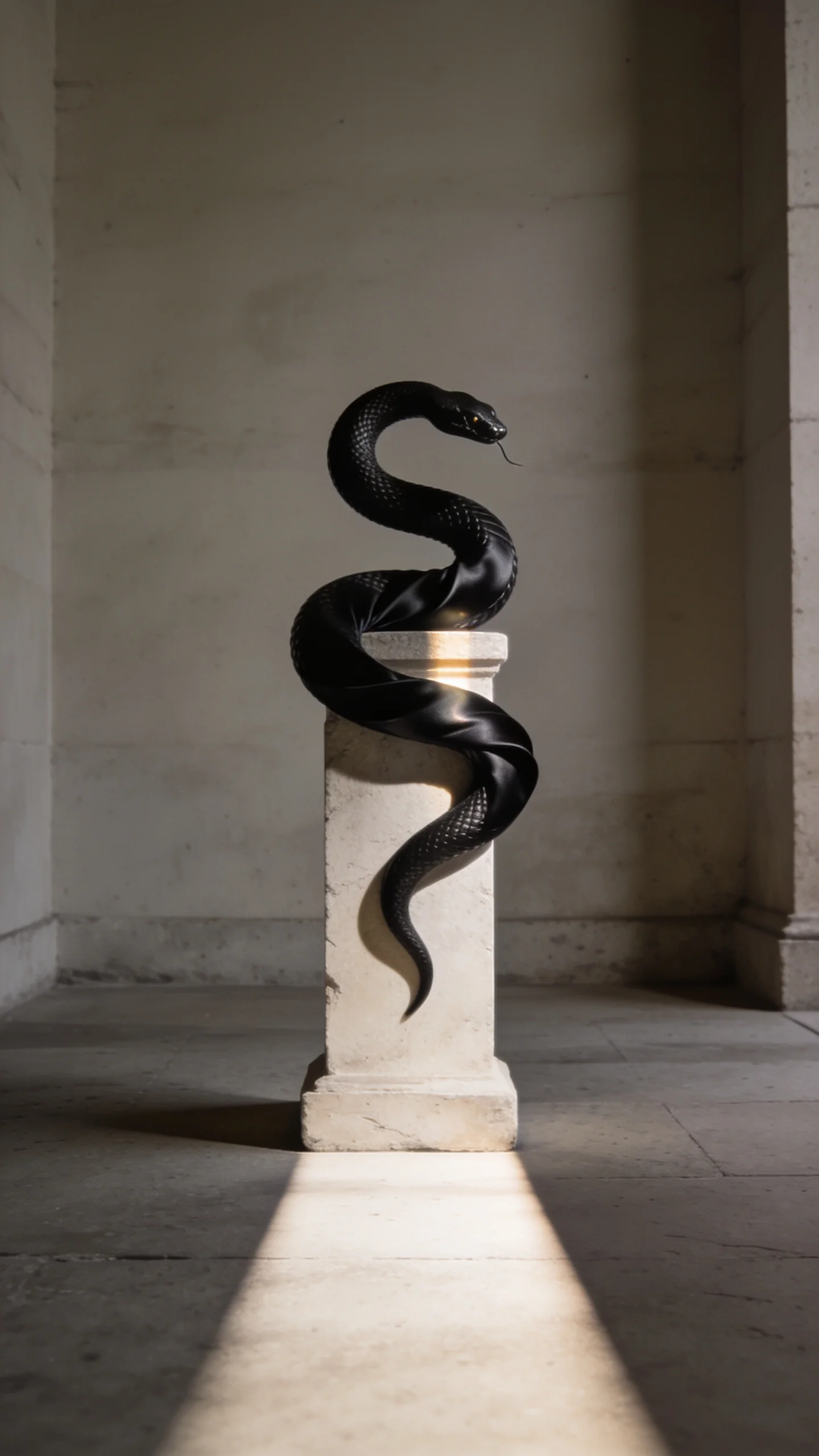
You probably woke up before dawn.
People who search after a snake dream tend to fall into one of two camps: anxious, or secretly hopeful. The first group searches "is this a bad-omen dream," and the second quietly looks up the nearest lottery retailer.
Either way, most of the interpretation articles you've read so far probably opened with the same question: was it a white snake, or a black one?
That's not the wrong question. It's just asked in the wrong order.
Lumi
"Hold on. There's something more important than the fact that a snake showed up.
What did it actually do to you?
Did it bite you? Just stare? Or did it simply slip past?
That's where the interpretation really splits."
Table of contents
It's a Verb, Not a NounWhite Snakes and Black SnakesA Biting DreamA Killing DreamSize and NumberAn Honest AccountWhat to Do TodayIt's a Verb, Not a Noun
Dig through traditional dream manuals, and an interesting pattern emerges. There's almost never a single entry labeled simply "snake" with one fixed meaning attached. Instead, entries split apart based on what the snake did.
A snake came into your embrace. A snake coiled around you. A snake bit you. You killed a snake. A snake fled from you.
Same snake, completely different conclusions each time.
Why is that? A snake works as a powerful symbol not because of how it looks, but because of how it moves. It sheds its skin, moves without sound, and appears suddenly. That movement is exactly why people of the past read the snake as a symbol of renewal and transformation.
So when you're trying to recall the dream, the order should go like this:
- What the snake did
- How you felt in that moment
- Only then, its color and size
Most people reach for the third question first, but the real weight of the interpretation sits in the first two.
White Snakes and Black Snakes
The White Snake
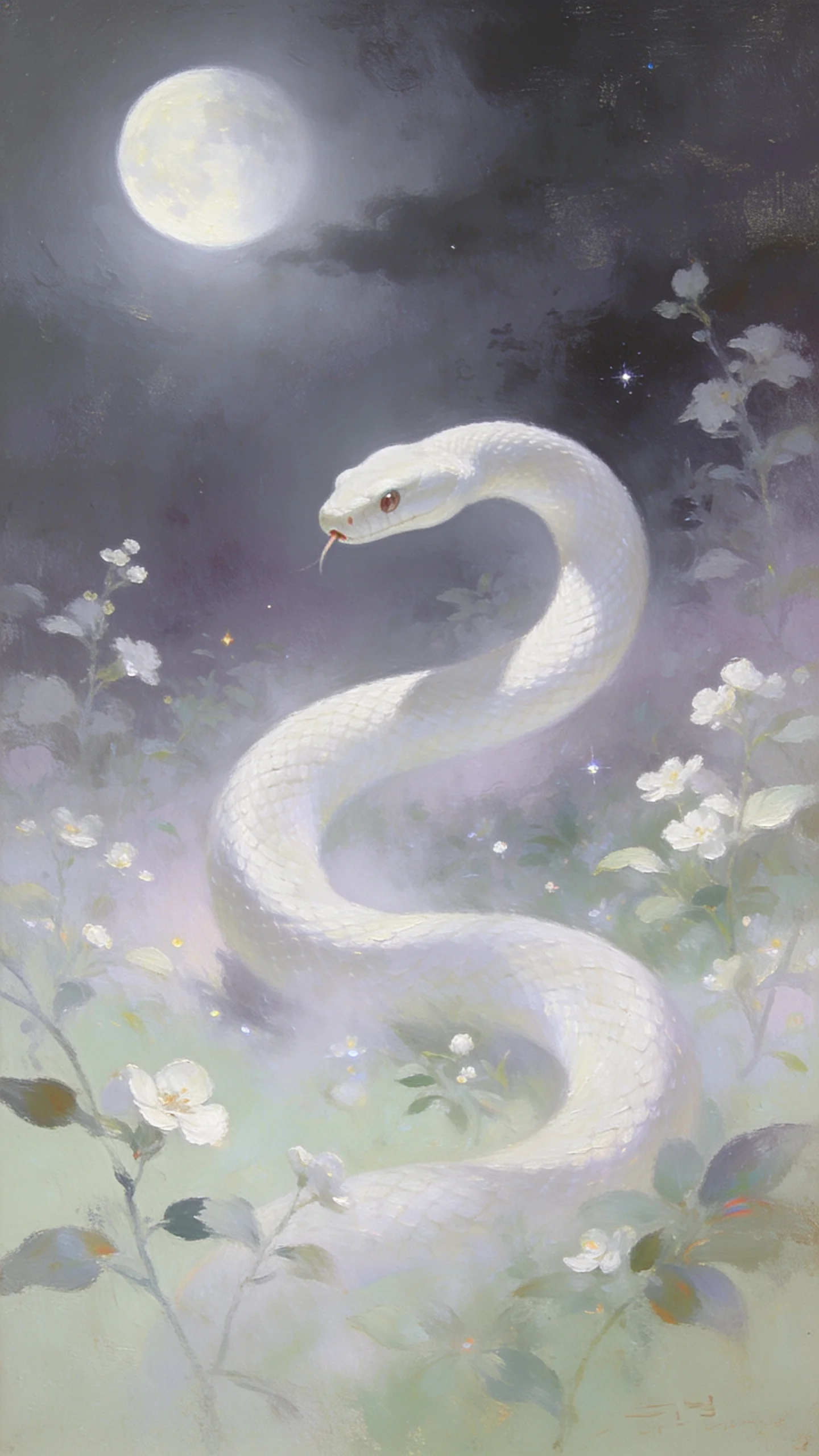
In Korean tradition, a white snake gets treated almost like a VIP.
Traditional interpretation classifies white snakes as spiritually potent creatures. They were read as a sign of meeting a noble patron or receiving wealth, and they show up often in taemong (a conception dream believed to foretell a pregnancy) accounts. The larger and more graceful the snake, the more favorable the dream was considered. A white snake coming into your embrace ranks among the most auspicious scenes in old dream manuals.
Modern psychology tells a slightly different story. In color-symbolism research, white is generally associated with purification, new beginnings, and clarity. Jungian-influenced readings sometimes interpret it as the unconscious appearing in a non-threatening form — a psychological state ready to accept change.
What's interesting is that both readings arrive at a similar conclusion, despite resting on entirely different grounds.
The Black Snake
The black snake gets misunderstood far more often.
Traditional interpretation doesn't treat the black snake as a bad-omen dream. It's actually read as a symbol of wealth, wisdom, and transformation. A black snake entering your house was read as a scene of incoming wealth — just without quite the same "wow factor" as the white snake.
Modern psychology generally holds that the darker a color, the closer it sits to unconscious territory. It's often interpreted as an image of what Jung called the "shadow" — the part of yourself you'd rather not acknowledge. Some clinical reports note an increase in dark-colored animal dreams during periods of high stress.
To sum up: the old texts read the black snake as money, and modern psychology reads it as psyche. Which one is correct? The answer is in the final section.
A Biting Dream
Lumi
"You got bitten? …It didn't actually hurt, right? In the dream, I mean.
This happens to be the most frequently reported snake-dream scene.
And how you felt at the moment of the bite is the real clue."
This is the most commonly reported variation of the snake dream, and also the one that leaves you most unsettled after waking.
Traditional interpretation takes a surprisingly favorable view here. Being bitten was read as "something entering your body." It was seen as incoming wealth or the start of a change, with the specifics shifting depending on where you were bitten — the hand pointing to wealth, the foot to travel or moving house, and so on.
Modern psychology offers a more uncomfortable read. Freud treated snakes as a sexual symbol and interpreted a biting scene as an extension of that. Modern clinical thinking tends to broaden this — reading it as boundary violation, interpersonal pressure, or anxiety about a situation you can't control.
Finnish psychologist Antti Revonsuo's "threat simulation theory" is relevant here too. It's a hypothesis that dreaming functions to rehearse threatening situations in advance, and it's often cited to explain why snakes, chases, and falling appear so frequently across cultures. It remains a hypothesis, though, and one still debated in the field. It isn't settled science.
A Killing Dream
This is the dream that tends to leave a strange residue of guilt after waking.
Traditional interpretation is fairly clear here: removing an obstacle, resolving a problem, a fresh start. But there's a condition attached. What matters is the emotion after the killing — whether it felt like relief or unease. Old dream manuals are fairly consistent in drawing that distinction.
Modern psychology lands in a similar place. Actively overpowering a threat within a dream reads as a restoration of a sense of control. But if anxiety lingered even after the killing, it may suggest that you want to believe the problem is handled, when it actually isn't resolved yet.
Once again: the emotion is half the interpretation.
Size and Number
A Large Snake
Traditional interpretation treats a snake's size as a direct scale of magnitude. A large snake means great wealth, a great patron, or a major change. This is also why the dream of a giant serpent entering a house is especially well known.
Modern psychology treats size more as an indicator of how overwhelming something feels. When you're facing something beyond what you can handle, the object in the dream tends to grow larger. A new job, a marriage, a move, a major decision — this follows the same logic as someone facing an exam dreaming of an oversized clock.
Multiple Snakes
Traditional interpretation reads this as multiple opportunities, or alternatively as tangled, complicated relationships. If the snakes are entangled with each other or surrounding you, the latter reading tends to dominate.
Modern psychology often reads this as decision overload — a classic image for when you're facing a choice and unsure about any of the options. That sense of chasing one snake only to have another enter your field of view. Anyone who's lived through that moment recognizes it.
An Honest Account
Lumi
"Wait, one thing.
This whole time, I've been giving you two versions of every reading. Did you notice?
One is the old texts. One is modern psychology.
The moment you blend the two and call it 'scientifically proven wealth luck' — that becomes a lie."
Traditional dream interpretation and modern psychology rest on different kinds of evidence.
Traditional interpretation is a symbolic system built up over centuries. What's recorded in the Encyclopedia of Korean Culture (a major reference work on Korean history and culture) and in old dream manuals reflects how people of that era read the world, and it holds real value as a humanities record in its own right. Still, it has never been tested for predictive accuracy.
Modern psychology treats dreams as activity of the brain and emotions. The interpretations of Freud and Jung hold an important place in the history of psychology, but they aren't theories adopted as-is in today's empirical research. Modern sleep psychology is more concerned with a dreamer's emotional state and memory-processing than with the literal content of the dream.
So this article doesn't blend the two.
One more thing. There's no connection whatsoever between a snake dream and lottery numbers. Neither traditional dream manuals nor psychological research mention numbers. Any "snake dream lottery numbers" you've seen somewhere was invented by someone. Looking them up for fun is your call, but that's a hobby, not dream interpretation.
The same goes for taemong. It's true that snake dreams have traditionally been read as conception dreams in many recorded cases, and that fact itself is on record. But "a snake dream equals pregnancy" doesn't follow. A taemong is, in most cases, a story attached after the fact.
What to Do Today
The most useful part of dream interpretation isn't prophecy — it's recording.
A dream starts fading about 90 seconds after you wake up. Before that happens, just three things are worth writing down.
- What the snake did
- How you felt at the time
- Color, size, and location
Collect a few weeks of these, and something interesting emerges. Certain dreams cluster around certain periods — before a deadline, when a relationship is shaky, when you're putting off a decision. A dream won't tell you the future, but it tends to tell you fairly accurately where you're standing right now.
The same snake dream leaves a different color with different people.
Dream Talisman looks at the dream scene you record together with your day stem (ilgan) in the Five Elements system, and creates a color and phone wallpaper for the day. It's less an app that interprets your dream for you than one that lets you carry today's dream with you for the day.
Curious what color that snake you just read about would turn into?
→ Record your dream in Dream Talisman
References
- Encyclopedia of Korean Culture (Academy of Korean Studies), "Dream Interpretation" entry
- Traditional Korean dream-interpretation source material
- Sigmund Freud, The Interpretation of Dreams
- Carl Jung, on individuation and archetype theory
- Antti Revonsuo, "The Reinterpretation of Dreams: An Evolutionary Hypothesis of the Function of Dreaming" (2000)
- General research in modern sleep and dream psychology