
People who dream about tigers tend to split into two groups.
One group wakes up scared — heart pounding, sheets damp with sweat. The other wakes up feeling not fear but something closer to awe, as if they'd glimpsed a mountain that turned out to be a tiger.
Same animal, completely different dream. And that difference is nearly the whole of the interpretation.
Lumi
"I'll ask if it was scary first.
But one more thing — did the tiger make a sound?
Here's why that matters: the one tiger detail that survives in the old records is about exactly that."
Table of contents
The Tiger's HourThe Only Recorded Tiger Detail Is a RoarBeing Chased by a TigerFace to Face With a TigerBitten or Clawed by a TigerA Tiger as a Conception Dream (Taemong)A Cub, a White Tiger, a Caged TigerThe Most Honest AnswerFrequently Asked QuestionsThe Tiger's Hour
Our guides to rat dreams and ox dreams (not yet available in English) look at why each animal is tied to its place in the twelve-year zodiac cycle: the rat's hour blended yin and yang, while the ox's cloven hoof made its hour purely yin.
The tiger belongs to the Hour of the Tiger, roughly 3 to 5 a.m.
According to the “Thirty-Six Beasts” entry of the Encyclopedia of Korean Culture (a major reference work on Korean history and culture), this hour belongs to yang and to the wood element in the traditional Five Elements system. Since the ox's hour was yin, the tiger marks a shift back to yang.
There's another detail worth noting. Each of the twelve zodiac animals further splits into three, producing a system of thirty-six beasts in total. Within the Tiger's Hour, the earliest segment belongs to an orangutan-like creature, the middle to a leopard, and only the final segment to the tiger itself — the tiger sits at the very end of its hour, with the leopard just before it.
In other words, people of the past didn't lump every big cat into a single category. If you're not sure whether what you saw was a tiger or a leopard, that ambiguity itself echoes an old distinction.
The Only Recorded Tiger Detail Is a Roar
The “Dreams” entry of the Encyclopedia of Korean Culture organizes folk dream-interpretation methods by category. Here is what it says about tigers under the animal section:
A tiger that opens its mouth wide and roars means the dreamer will rise to public office.
Notice the condition. It isn't seeing a tiger — it's the tiger roaring.
It's about sound, not appearance; an act that announces presence rather than size. Hearing a tiger's roar in the mountains meant knowing something was out there without knowing exactly where, and for people of the past that was likely one of the most frightening kinds of information you could receive.
That terrifying sound was read as a sign of promotion — a classic pattern in traditional dream interpretation where an inauspicious scene flips into an auspicious one. The encyclopedia itself notes that dream interpretation followed two broad approaches: reading dreams as symbols, and reading dreams as the opposite of reality.
The tiger entry leans toward the second.
So there's no basis in the records for calling a tiger dream inauspicious just because it was frightening. If anything, the one surviving example reads the opposite way.
Being Chased by a Tiger
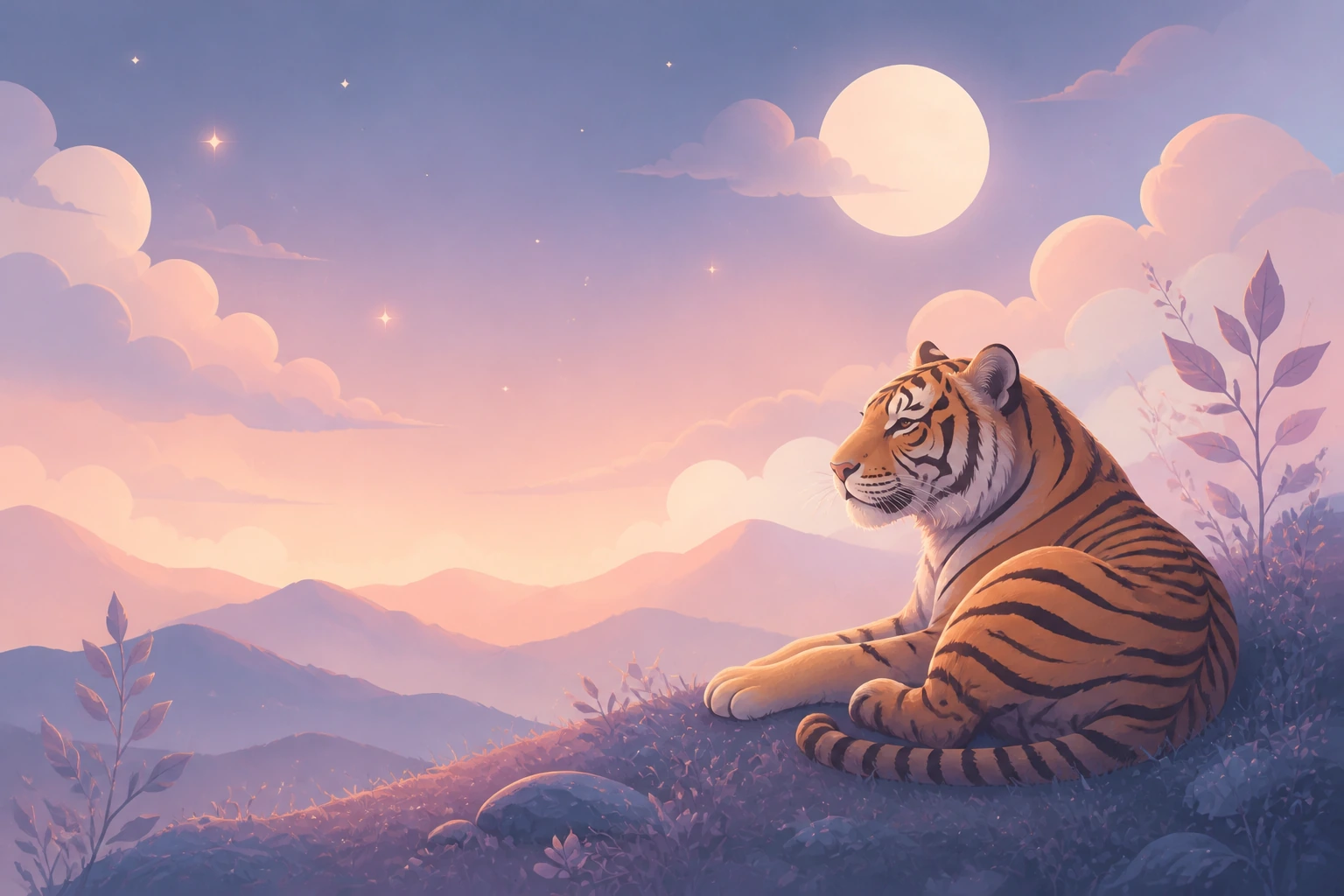
This is the most commonly reported tiger dream — and the one that ruins sleep the most.
Traditional interpretation doesn't clearly label being chased by an animal as inauspicious on its own. Whether you looked back, however, is an old distinguishing detail, which we cover in more depth in our guide to chase dreams, not yet available in English.
From a modern psychological perspective, being chased by a tiger differs from other chase dreams. Being chased by a dog or a person still leaves room for escape, but a tiger is an opponent you can neither outrun nor defeat to begin with.
So what matters in this dream isn't speed but distance. Were you watching from far away, was it right behind you, or had it already closed in beside you? Sometimes that distance mirrors how close you actually feel to whatever is pressuring you in waking life.
Whether you hid also matters. It means you couldn't confront the threat, but you did find a way to protect yourself.
Face to Face With a Tiger
A dream where you weren't chased — you were simply looking at each other. This happens more often than you'd expect.
Traditional interpretation generally reads an encounter with a wild animal as a meeting rather than a threat. The belief that the mountain spirit kept tigers as companions was widespread, and folk paintings (minhwa) often depicted tigers as guardians warding off misfortune. A fearsome animal could also be a protective one.
From a modern psychological perspective, locking eyes can be read as a sign that avoidance has ended. If you neither ran nor were attacked, that suggests you recognized the threat without being overwhelmed by it.
If you woke up feeling oddly clear-headed rather than frightened, this is likely the version you experienced.
Bitten or Clawed by a Tiger
Lumi
"Were you bitten? Did it hurt?
Remembering pain inside a dream is rarer than you'd think.
If it didn't hurt, that might not have been an attack — it might have been contact."
Traditional interpretation has a pattern where being bitten by an animal is read as something entering the body; the same structure appears in our guide to snake dreams. For tigers specifically, though, no record breaking the interpretation down by body part has been confirmed, so we won't invent one.
From a modern psychological perspective, being harmed by a large animal reads less as a boundary violation and more as being overwhelmed. What matters isn't where you were bitten but how your body reacted at the time — did you try to run, did you freeze, or did you stay strangely calm?
One thing worth stating clearly here: there is no evidence that being bitten by a tiger in a dream foretells a real accident. That claim circulates widely, but it appears in neither the records nor the research.
A Tiger as a Conception Dream (Taemong)
The tiger is one of the animals most often mentioned as a taemong (conception dream — a dream believed to foretell pregnancy) symbol, and it's one of the most searched topics related to this dream.
Traditional interpretation links a powerful animal appearing in a taemong to the child's future temperament. In classical Korean fiction, the protagonist's conception dream almost always features an extraordinary being.
A line needs to be drawn here, though.
A conception dream cannot tell you whether you're pregnant or what sex the baby will be. The widespread claim that a tiger conception dream means a son has no supporting evidence. The everyday taemong material the encyclopedia actually lists is mostly food — chili peppers, strawberries, pumpkins — or household items like brass bowls and vases. Animal conception dreams belong more to the heroic narratives of classical fiction.
And most conception dreams are stories attached after the fact: a dream only gets identified as a taemong once the child is already born. We go into this in more depth in our guide to conception dreams, not yet available in English.
If you're reading this while hoping to conceive, know that whether or not a tiger appeared, that outcome is a matter of the body, not the dream.
A Cub, a White Tiger, a Caged Tiger
A Tiger Cub
From a modern psychological perspective, a young animal reads completely differently from an adult one — the sense shifts from threat to caregiving. If the dream felt endearing rather than frightening, it may be less a tiger dream than a dream about something young and vulnerable.
A White Tiger
In folk dream interpretation, a white animal is often mentioned favorably. The White Tiger (Baekho) is also one of the Four Guardian Deities, associated with the west. That said, it doesn't appear as a separate entry in the traditional dream-interpretation texts, so we'll keep this claim modest.
A Caged Tiger
From a modern psychological perspective, this scene is less about strength itself and more the image of restrained strength — a threat that has been neutralized, but also a power that can't be used.
Whether you felt relieved or frustrated watching the caged tiger is the deciding detail. If it was frustration, the dream may not really be about the tiger at all.
The Most Honest Answer
Lumi
"People say a tiger dream always means something big is about to happen, or that it's always a jackpot sign.
Neither is true.
Only one line survives in the records. Everything else got attached later."
Traditional dream interpretation and modern psychology rely on different kinds of evidence.
After listing its dream-interpretation entries, the encyclopedia itself notes that these readings emerged naturally from many people's experiences rather than from any consistent theoretical basis. Even the Samguk Yusa (Memorabilia of the Three Kingdoms) — a 13th-century compilation of Korean legends, folklore, and Buddhist history — preserves a case where the same dream was read in opposite ways by different interpreters. Before King Wonseong took the throne, a dream of his was first read as a sign of dismissal and imprisonment; asked again, the same dream was reinterpreted as an omen that he would become king.
A few things should be said clearly.
There is no confirmed link between tiger dreams and lottery numbers. Neither the records nor the research mention numbers.
There is no evidence that a tiger conception dream means a son.
The interpretation that a tiger represents a boss or an authority figure appears often in today's dream-interpretation content, but it isn't confirmed in traditional records. The accurate way to put it is that this is a modern reading some people apply, not a traditional one.
Frequently Asked Questions
Does a scary tiger dream mean it's inauspicious? No. The one surviving tiger entry actually flips a frightening scene into something favorable. Fear isn't evidence of a bad omen — it's closer to information about how intense the scene felt.
I can't tell if it was a tiger, a leopard, or a lion. That confusion isn't unusual. Even the old classification grouped an orangutan-like creature, a leopard, and a tiger together within the same hour. Rather than pinning down the exact species, it's more useful to note the size, the distance, and how you felt.
The tiger walked right past me. This is a third scenario, distinct from being chased or facing off. Being passed by means you weren't the target. Note whether you felt relieved or oddly deflated — that detail will be worth revisiting later.
I keep forgetting my dreams. Dreams tend to start fading about 90 seconds after waking. Instead of getting up right away, staying still for a moment can help more fragments surface.
If a frightening dream cut your sleep short before dawn, going to bed a little earlier tonight is the most reliable fix.
It's also worth thinking about whether something has been pressing on you lately. Tigers tend to show up in that kind of place — and it doesn't have to be a person. It could be a deadline, or a decision.
Even the same tiger dream leaves a different color for each person.
Dream Talisman looks at the dream scene you record together with your day stem (ilgan) in the Five Elements system to create a color and phone wallpaper for the day. It's less an app that interprets your dream for you than one that lets you carry today's dream with you for the rest of the day.
Curious what color that tiger you just read about would become?
Record today’s dream in Dream Talisman
References
- “Dreams” — Encyclopedia of Korean Culture · List of folk dream-interpretation methods; the dream-reading example involving King Wonseong from the Samguk Yusa
- “Thirty-Six Beasts” — Encyclopedia of Korean Culture · The zodiac-assignment principle and its thirty-six-beast subdivisions
- “Folk Paintings (Minhwa)” — Encyclopedia of Korean Culture · Tigers in folk painting and their role in warding off misfortune
- General research in modern sleep and dream psychology