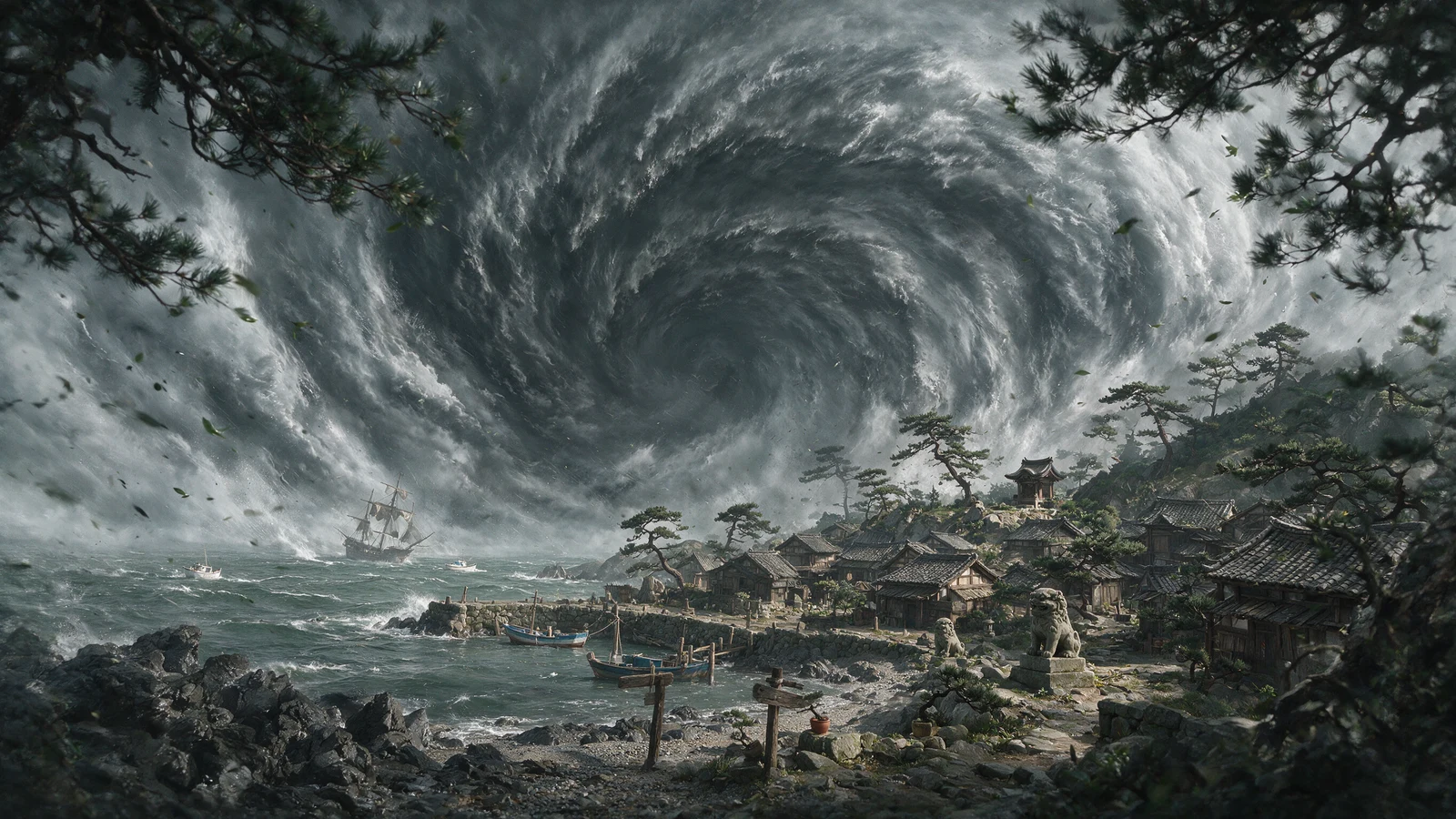
You probably remember the sound first.
A typhoon dream tends to linger less as a sequence of images than as sound and physical sensation: windows rattling, wind pushing against your body, something being torn away while you are unable to hold on. Waking to a silent room may even have felt strangely unsettling.
Most people then jump to the same conclusion: perhaps something bad is about to happen.
Older dream records tell a rather different story.
Lumi
“Do you know what wind did in old dream manuals?
It did not simply destroy things. It carried news.
One entry says that when the wind howls, word arrives from far away.”
Table of contents
Wind Was Something That Carried NewsBut Wind Accompanied by Rain Was DifferentA Dream of Being Trapped in the Middle of the StormA Dream of Taking Shelter or Holding OnA Dream Set After the Typhoon Had PassedA Dream of Being Pushed or Blown AwayThe Most Honest AnswerFrequently Asked QuestionsWind Was Something That Carried News
Commonly circulated versions of the Zhougong Jie Meng (The Duke of Zhou’s Dream Manual, a family of traditional Chinese dream interpretation texts) point in a surprising direction when they discuss wind.
They say that a howling wind brings news from afar. A sudden gale, meanwhile, is described as a sign that a command will be issued throughout the realm. A command, after all, is also a message passed from above to those below.
In both cases, the central idea is communication rather than destruction.
That makes sense in historical context. In an age when news traveled on foot, wind was one of the few things that truly crossed a great distance to reach you. It carried smells, sounds, and the changing seasons. When the wind shifted, something else was changing too.
The reference to a royal command is especially interesting. Most entries concern the individual dreamer, but wind extends beyond the private sphere. It occupies a similar place to the old entry in which a splitting sky signals concern for the state. We discuss that image in our guide to sky dreams, which is not yet available in English.
But Wind Accompanied by Rain Was Different
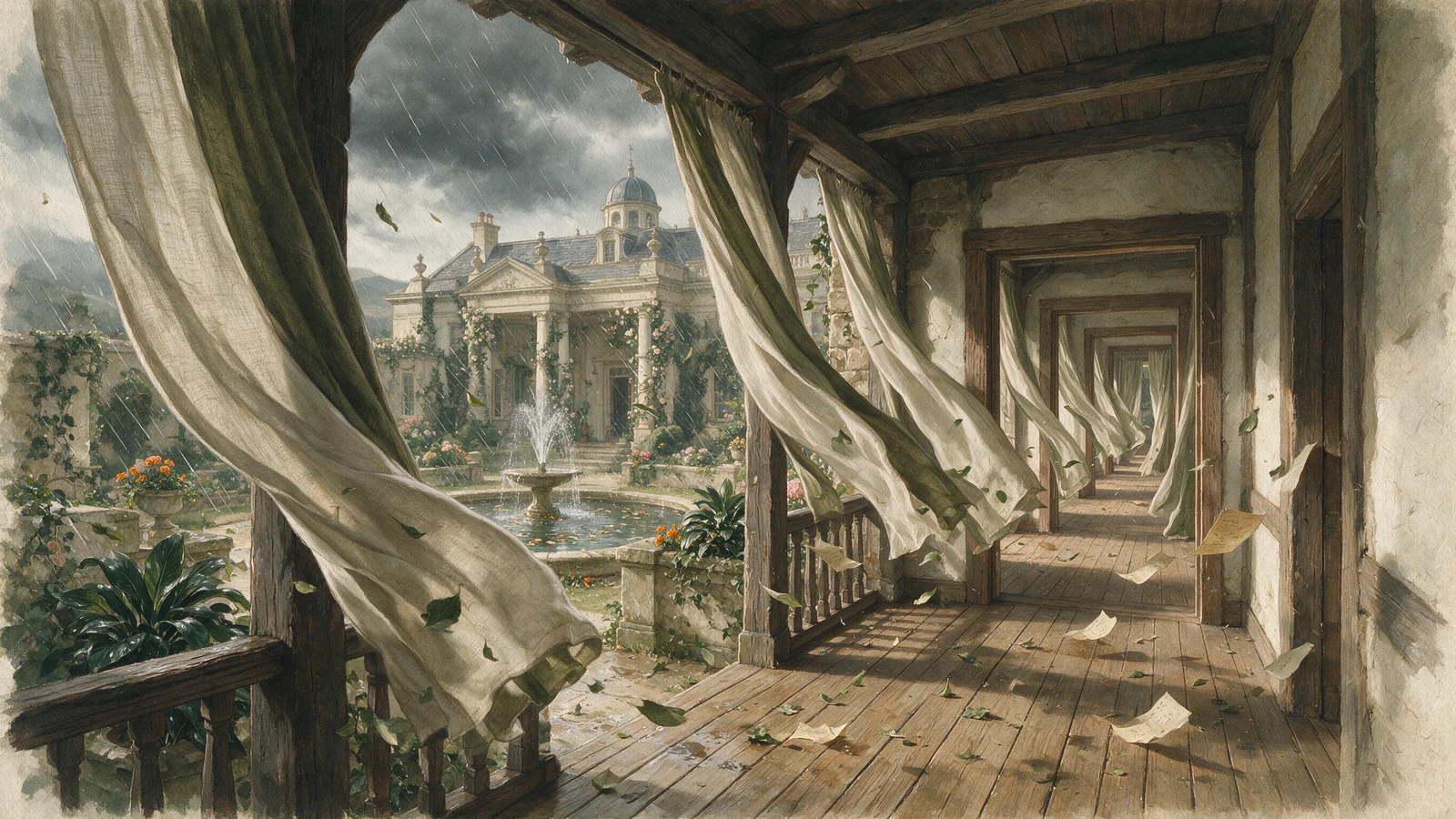
The old texts distinguish between wind alone and wind accompanied by rain.
The Zhougong Jie Meng tradition treats a dream of raging wind combined with heavy rain as deeply inauspicious. Its tone is entirely different from the entries about distant news or public commands.
The problem was not wind itself, but a force too great to manage.
That distinction is central to a typhoon dream. What we call a typhoon usually involves more than wind: rain lashes down, the world outside turns dark, and things begin to break.
From a modern psychological perspective, scale also matters. Natural-disaster imagery is often read as a representation of something beyond an individual’s control—the kind of situation that effort or judgment alone cannot prevent.
A survey of typical dream experiences involving 500 Korean adults likewise found high rates of event-driven scenes such as being chased or falling. Disaster imagery is not an unusual feature of dreams.
A Dream of Being Trapped in the Middle of the Storm
In this version, there was no way out. Whether you were indoors or outside, you were trapped inside the event.
Traditional dream interpretation does not appear to contain a separate entry for being “in the middle” of a storm. Older lists usually describe what the wind did, not where the dreamer stood.
Modern psychological readings, by contrast, often treat the dreamer’s position as important. Watching the same disaster from a distance and experiencing it firsthand are not necessarily the same dream.
The useful question is what you were doing at the time.
- Were you holding your ground?
- Were you holding on to someone?
- Or were you simply being overwhelmed?
If the second detail stayed with you, the dream may be less about the typhoon than about what you were trying to protect. If you remember whom you were holding, that is meaningful information to record.
A Dream of Taking Shelter or Holding On
Lumi
“Where did you take shelter?
Were you inside your home, or did you run just anywhere?
The difference matters. The fact that you had somewhere to go is information in itself.”
Perhaps you shut the door and stayed inside, ran into a shelter, or clung to something until the storm passed.
Traditional dream interpretation offers an intriguing entry here. A dream in which wind makes a house shake is associated not with misfortune but with moving house. A collapsing house is listed separately as inauspicious, which means the texts distinguished between a structure that shook and one that fell.
In that sense, a house that endured was not treated as a bad sign. We explore more of these distinctions in our guide to house dreams, which is not yet available in English.
From a modern psychological perspective, holding on or enduring may be read as an image of actively coping rather than merely being overwhelmed. Such scenes are sometimes reported more often by people who are already making their way through a difficult period.
It is also worth noting whether the dream gave you somewhere to shelter. A place of refuge in a dream can overlap with the waking sense that you have someone or something to rely on.
A Dream Set After the Typhoon Had Passed
The wind is gone. Outside, everything is quiet, with broken objects scattered across the ground. On waking, you may feel oddly calm.
Traditional dream interpretation viewed this kind of scene more favorably. One line in the Zhougong Jie Meng tradition says that when the sky clears and the rain disperses, every worry will fade. The aftermath was read as an image of recovery.
Modern psychological readings often arrive at a similar place. A scene of cleaning up after an event may be understood as an image of having already moved beyond it. People sometimes report dreams like this after a major ordeal has ended.
This is why it matters whether you were inside the typhoon or looking at what remained afterward. The storm may be the same, but your position in time is different.
Being in the middle of it may suggest that something still feels ongoing; standing in the aftermath may suggest that you have already passed through it.
We should not invent a historical rule, however. No verified old entry divides typhoon dreams into auspicious or inauspicious categories according to “before” and “after.” This is only one possible modern reading.
A Dream of Being Pushed or Blown Away
Perhaps the wind pushed your body, your feet would not stay on the ground, or something you were holding flew away.
Traditional dream interpretation contains one relevant line: when wind blows away a person’s clothing, illness will follow. Wind that made direct contact with the body was not viewed favorably.
That differs from the entries about news and public commands. The texts distinguished between wind arriving from afar and wind that physically pushed the dreamer.
From a modern psychological perspective, losing control of your body is often read in terms of agency. Your direction is being decided regardless of your will. This overlaps with the imagery of chase dreams and falling dreams.
We discuss the first of those in our guide to being chased in a dream, which is not yet available in English.
If you remember which object blew away, write that down too. Dreams rarely choose just any object.
The Most Honest Answer
Lumi
“Search online and you will find claims that typhoon dreams predict disasters.
The old entries do not say that. They only say that a howling wind brings news.
And even that is not a prophecy. It tells us what wind meant to people at the time: something that arrived from far away.”
Traditional dream interpretation and modern psychology rely on different kinds of evidence.
What the old records support is limited: wind was associated with news; wind combined with rain was viewed as inauspicious; and a shaking house was distinguished from a collapsing one. These were not predictions, but ways in which people of the period made sense of their world.
The list of dream-reading methods in the “Dreams” entry of the Encyclopedia of Korean Culture (a major reference work on Korean history and culture) does not include an example for wind. We therefore cannot claim a specifically Korean folk verdict on whether a typhoon dream is auspicious or inauspicious. The encyclopedia itself notes that such interpretations emerged naturally from many people’s experiences rather than from a single consistent theory.
A few points should be made clearly.
A typhoon dream does not predict a real disaster or accident. That applies to you and to your family.
It is possible that strong wind was actually blowing outside. That would not be precognition; it would be real sound entering the dream.
No verified old text supports a formula such as “inside the typhoon means bad luck, while the aftermath means good luck.” That is only a modern interpretive framework.
There is also no verified connection between typhoon dreams and lottery numbers.
Frequently Asked Questions
Is a typhoon dream an inauspicious dream? Entries about wind alone are more often connected with news. However, older records did treat wind combined with heavy rain as inauspicious.
I was trapped in the middle of the storm. The old lists do not appear to interpret the dreamer’s position. Modern readings may distinguish between experiencing the event firsthand and watching it as an observer.
I woke to the sound of rattling windows. A house shaken by wind was associated with moving rather than misfortune in the old records. It is also possible that a real sound from outside entered your dream.
The wind pushed me so hard that I thought I would be blown away. Older records did not view wind blowing at a person’s clothing favorably. A modern reading may connect the scene with a loss of agency or control.
The typhoon had already passed. Old records associate a clearing sky with the disappearance of worries. That is a historical interpretation, not a guarantee.
I keep having this dream. Record how often it returns and what happened between each occurrence. Patterns may become clearer over time. If you have also been sleeping poorly, it is better to address that first.
Typhoon dreams linger because of their sound. Auditory memories can take longer to fade than visual ones.
For today, write down just three things.
- Where were you—inside the storm, sheltering indoors, or standing in the aftermath?
- What did the wind do—shake something, break something, or push you?
- How did you feel when you woke up?
After a few weeks of notes, a pattern may emerge. Disaster dreams often cluster around periods when we are facing something that feels beyond our control.
If the rain was more vivid than the wind, our separate guide to rain dreams will explore that imagery in more detail when it becomes available in English.

Writing down a frightening dream can make it feel smaller.
In your mind, it keeps expanding. On the page, it may be only three or four lines.
Dream Talisman combines the dream scene you record with your day stem (ilgan) in the Five Elements system to create a color and phone wallpaper for the day. It is less an app that claims to interpret dreams for you than one that helps you record them before they fade.
Record today’s dream in Dream Talisman
References
- “Dreams” — Encyclopedia of Korean Culture · An eight-part list of folk dream-reading methods and two historical approaches to interpretation
- The Heaven, Earth, Sun, Moon, Stars, and Spirits section of an early edition in the Zhougong Jie Meng tradition · Passages concerning wind and storms. These are commonly quoted source lines; the wording has not been checked against a specific original edition. This is a Chinese dream-interpretation tradition with a different textual lineage from Korean folk records.
- A Study of Typical Dream Experiences Among Koreans · A survey of 500 Korean adults reporting the frequency of event-driven dream scenes
- General research in modern sleep and dream psychology