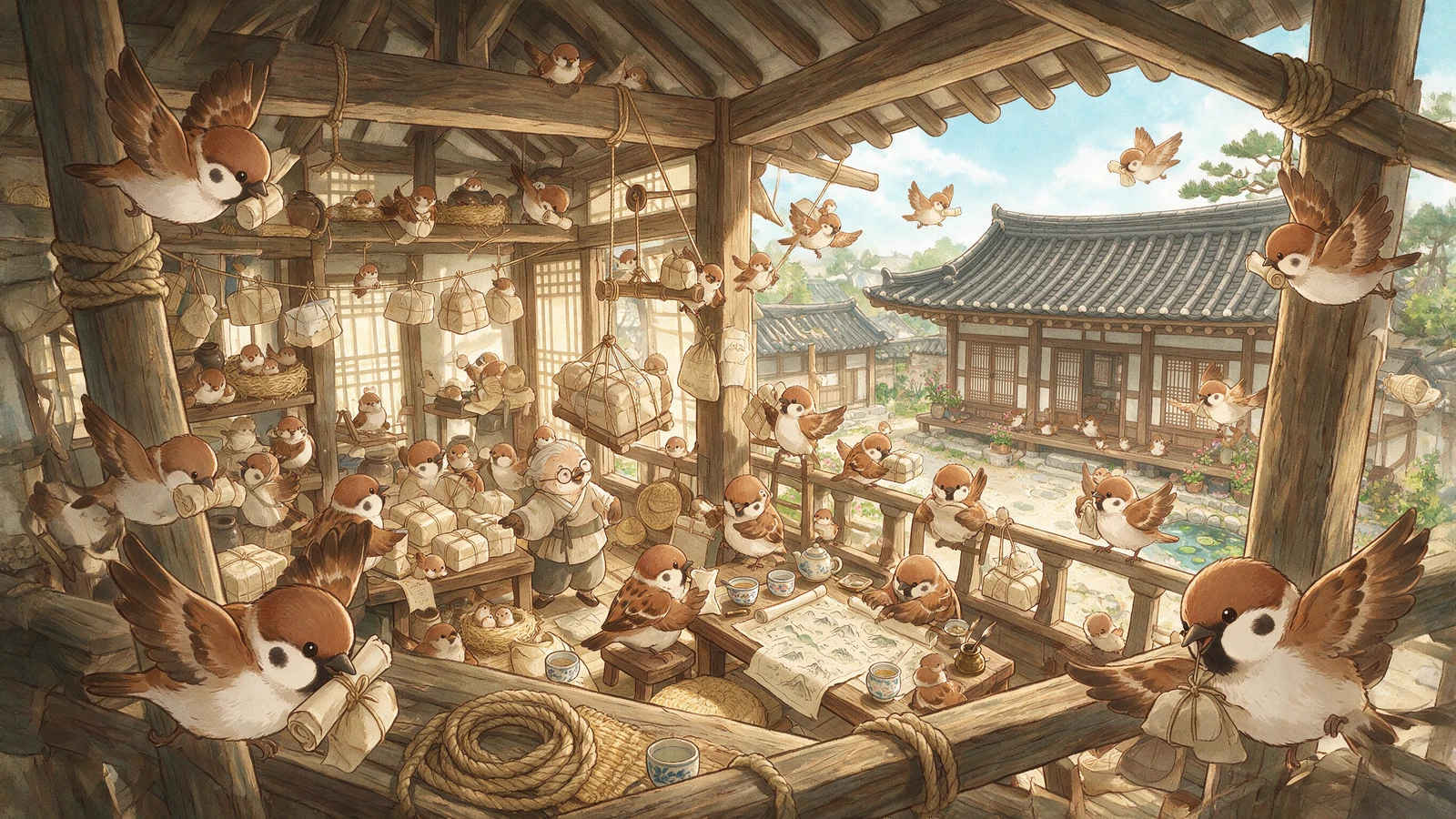
In a bird dream, what stays with you is direction.
You rarely remember exactly what kind of bird it was, but strangely, whether it came toward you or moved away stays vivid. It flew into your arms, came in through a window, or slipped away just before your hand reached it.
In traditional dream interpretation, that direction was almost the whole story.
Lumi
"Which way did the bird go?
There's a reason I'm asking.
The old entry says it plainly: when a flying bird comes into your arms, it is auspicious — every single time.
That word 'every' almost never shows up attached to any other entry."
Table of contents
Birds Flying In Were Recorded as Auspicious, No ExceptionsA Bird Flying Away Reads the Opposite WayThe Korean List Has Three Bird Entries — and All Three OverlapThe Calling BirdThe Bird You Caught, the Bird You ReleasedAn Injured or Dead BirdA Flock of BirdsIf You Searched Because of a TaemongTold HonestlyFrequently Asked QuestionsBirds Flying In Were Recorded as Auspicious, No Exceptions
Gathering the bird entries from the Wikisource text of the Zhougong Jie Meng (Duke of Zhou dream manual tradition, a classical Chinese dream-interpretation text), one direction stands out clearly.
- A flying bird coming into your arms is auspicious, without exception
- A swallow flying into your arms means you will have a distinguished child
- A crane coming into your arms means you will bear a distinguished child
- A swallow arriving means a guest is coming from far away
Almost everything about arrival reads as good.
What catches the eye here is the word "every." Most other entries in this text come loaded with fine conditions — what kind of bird, where it called from, how many there were. But the scene of a bird coming into your arms is the one marked as holding without exception.
Treating something coming into your arms as the highest possible reading is a pattern across this whole family of texts. In our guide to star dreams, a falling star meant a lawsuit, while a star landing in your arms meant a distinguished child. Whether it's a star, a bird, or the moon, the fork is always whether it touched your body.
There is one exception, though: a passage stating that a wild duck entering the house is a strongly inauspicious sign. Even though it's an arrival, it's recorded as bad. Which bird it was clearly wasn't entirely beside the point.
A Bird Flying Away Reads the Opposite Way
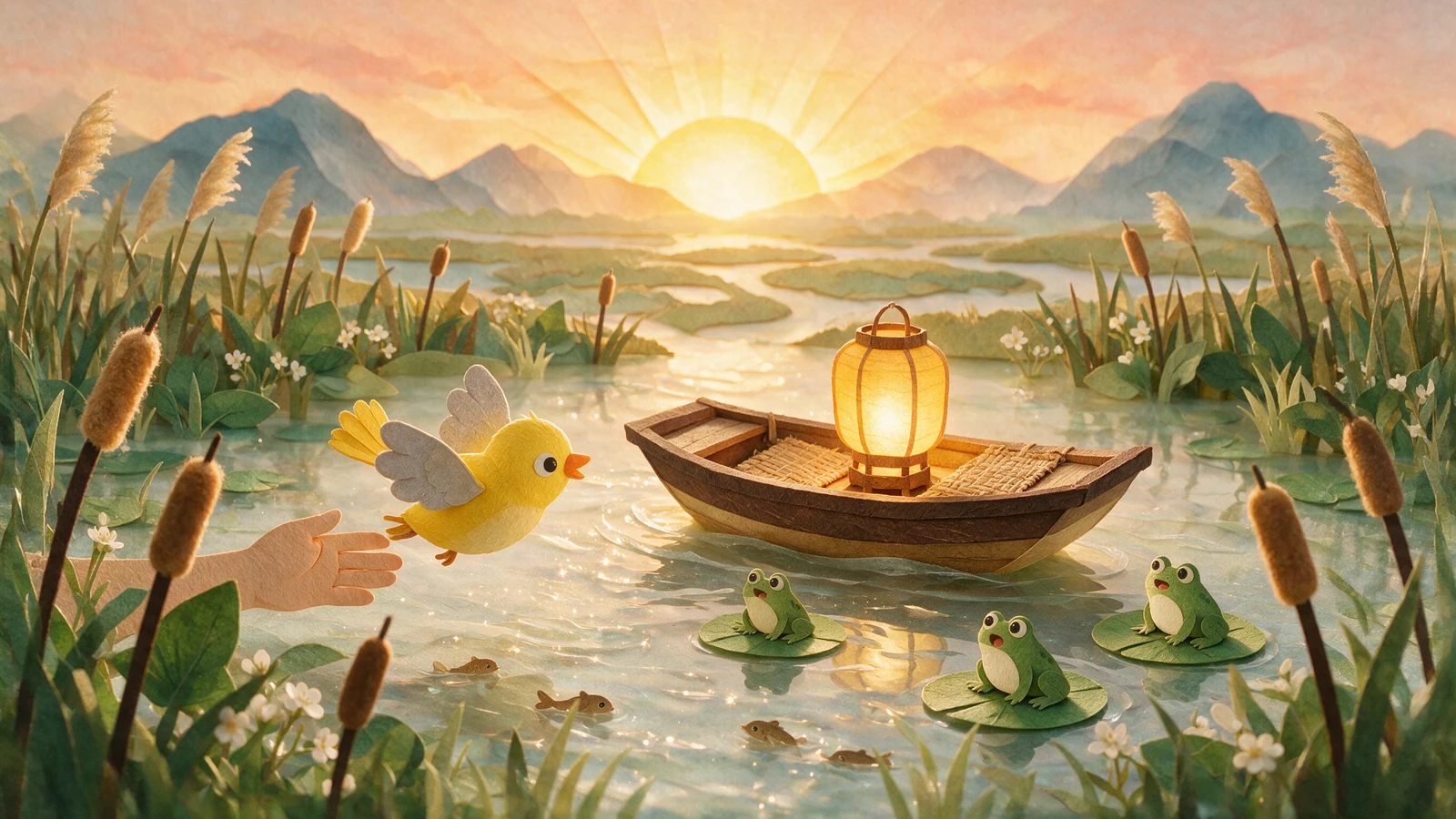
Looking at the departure scenes in the same list, the pattern flips entirely.
A crane rising into the sky is recorded as misfortune for a young child. A pair of mandarin ducks scattering apart is recorded as inauspicious for a wife. A bird calling in mid-air is also on the inauspicious side.
The same crane means a distinguished child when it comes into your arms, and misfortune for a child when it rises into the sky.
The answer was never attached to the noun "bird." It's attached to the verb — whether it came in, left, was caught, or called out.
It's the same structure as our guide to snake dreams, where what the snake did mattered before what kind of snake it was. This family of texts tends to run on that logic across the board.
From a modern psychological perspective, direction reads a little differently. Something approaching versus something receding is treated as a scene that shows which position you're standing in — waiting for something, or having just missed it.
If you remember whether you reached out or not in a dream where the bird flew away, that's worth noting too. Most people reach out and stop halfway.
The Korean List Has Three Bird Entries — and All Three Overlap
The entry on dreams in the Encyclopedia of Korean Culture (a major reference work on Korean history and culture) sorts folk-belief dream interpretation into eight categories with examples. In the animal category, birds appear in three entries.
- If a crane calls with a clear, pure sound, you will become renowned
- If a parrot calls, gossip will trouble your wife
- If a swallow flies into your arms, you will bear a son
And the Zhougong Jie Meng records this: if a crane calls, your rank and standing will be greatly revealed. A parrot brings gossip for your wife. A swallow flying into your arms means you will have a distinguished child.
All three overlap almost exactly.
That's hard to read as coincidence. It's more natural to conclude that Korean folk bird-dream interpretation inherited a substantial share of its material from this Chinese textual family. In our guide to house dreams, four house-related entries overlap the same way.
This is a different claim from "people have always thought this way." It points closer to a documented route by which the text traveled from one tradition into the other.
The Calling Bird
Lumi
"The call matters too.
A crane calling meant your name would become known; a parrot calling meant gossip.
It was never about a bird calling — it was about which bird was calling."
In traditional interpretation, calls are divided very finely. A crane's call reveals status; a parrot's call brings gossip; even a dove's call brings gossip. A crow or sparrow making a racket is recorded as a sign of wine and food to come.
A pattern emerges. A single bird calling clearly and purely reads as good; a bird making noise as part of a crowd brings talk. The parrot being tied to gossip is probably because it's a bird that mimics human speech.
From a modern psychological perspective, sound in a dream is generally read as something demanding attention. If sound is what stayed with you more than the visual scene, that's likely the center of the dream.
If you remember the call after waking, just note whether it felt soothing or grating. That's ultimately the same line the old list divides along.
The Bird You Caught, the Bird You Released
In traditional interpretation, both readings land on the good side. Catching a flying bird is recorded as bringing news from far away; releasing a crane is recorded as bringing wealth, and is auspicious.
Catching is auspicious; releasing is also auspicious. It's the same structure as our guide to rain dreams, where getting rained on and avoiding the rain were both auspicious. Old dream interpretation does this more often than you'd expect.
From a modern psychological perspective, what matters here is sensation. The fork is whether holding it felt comfortable, or releasing it felt like a loss.
A dream where you caught the bird and then lost it has a different texture, specifically. Because there was a moment it was actually in your hand, a particular sensation lingers.
An Injured or Dead Bird
This is the type that leaves the heaviest feeling after waking.
In traditional interpretation, this is a fairly practical split. Harming a sparrow or wild bird is recorded as inauspicious — disaster for a household member — while harming a chicken, goose, or domestic duck is recorded as strongly auspicious.
The line was drawn between wild birds and domesticated ones. One belonged to nature, the other to daily household life. There was probably no reason to record livestock you routinely ate as an inauspicious sign.
From a modern psychological perspective, the reading sits somewhere else entirely. There's an interpretation that treats an injured or dead bird as an image of something stopped — something that could fly, now unable to.
And let's be clear about this: there is no basis for believing this dream means something is about to happen to anyone. The old entries marking it inauspicious reflect how that era read the world, not a forecast.
A Flock of Birds
Not one or two birds, but enough to cover the sky.
In traditional interpretation, entries dealing with flocks of birds tend to focus on sound. A crowd of birds making noise together was connected to gossip, or to food.
From a modern psychological perspective, an overwhelming number reads as a question of capacity. You can take in one bird; you can't take in a hundred. There's an explanation that this kind of image shows up when too much has piled up at once, or when there are simply too many options to process.
And it matters whether the flock came at you or just passed by. If it came at you, that's less a bird dream than a case belonging with our chase dreams guide.
If You Searched Because of a Taemong
The entry on taemong (a taemong, or "conception dream," is a dream believed in Korean folk tradition to foretell a pregnancy) in the encyclopedia organizes conception-dream imagery collected from different regions by the child's sex. Under animals, "bird" appears on the girl side, and "rooster" appears on the boy side.
Same order of bird, split apart. The encyclopedia also records the logic behind that split: relative concepts like large versus small, or complete versus incomplete, were the basis for dividing male from female. And the encyclopedia states outright that this classification came from the old custom of valuing men over women and preferring sons.
It's worth reading as a record, but it isn't a tool for prediction.
A dream cannot tell you whether you're pregnant or the sex of your baby. Taemong stories are, more often than not, attached after the fact. We cover taemong generally in our baby dreams guide.
Told Honestly
Lumi
"Search 'bird dream' and you'll get flooded with claims that it means good news.
That's only half right. The old entries said that about a bird coming in.
A crane flying away is recorded on the opposite side."
Traditional dream interpretation and modern psychology rely on different kinds of evidence.
What the old record confirms is only this: birds were divided by direction and action — whether one came into your arms or flew away, which bird called, whether it was wild or domesticated. And that isn't prophecy; it's the way people of that era read the world around them.
The encyclopedia itself notes, after laying out its dream-interpretation list, that these readings emerged naturally out of many people's experience rather than from any consistent theoretical foundation.
Let's be clear about a few things.
A bird flying away does not cause anything bad to happen. The old entries marking it inauspicious reflect how that era read the world, and their predictive power has never been verified.
A bird dream doesn't bring good news, either. It's true that an entry exists linking a bird to news from far away, but that's a record, not a guarantee.
A bird dream cannot tell you whether you're pregnant or your baby's sex.
No verified connection exists between bird dreams and lottery numbers, either.
Frequently Asked Questions
A bird flew into my arms. This is the scene the old record viewed most favorably. It states that any flying bird coming into your arms is auspicious, without exception, and swallows and cranes each have their own dedicated entries.
The bird flew away. The old entries place this on the opposite side. A crane rising into the sky, or mandarin ducks scattering apart, were both recorded as inauspicious.
A bird came into the house. Generally this is on the good side, but there's an exception. A wild duck entering the house is recorded as strongly inauspicious.
I remember the bird's call. It splits by which bird it was. A crane's call means your name becomes known; a parrot's call means gossip.
I saw a dead bird. The old entries split wild birds from domesticated ones. But that's a classification from that era, not a sign that something is going to happen to someone.
Is a bird dream a taemong? It's true that birds appear in the old list of taemong imagery. But a dream cannot tell you whether you're pregnant or your baby's sex.
A bird dream ends quickly because that's simply what birds do. They never give you time to hold on.
Today, there are three lines worth writing down.
- Which direction the bird went — toward you or away
- What you did — watched, caught it, or reached and stopped halfway
- How you felt when you woke up
Give it a few weeks and a pattern tends to show. Bird dreams tend to cluster during periods of waiting for something.
If you were the one flying, our guide to flying dreams is the better fit.

The more fleeting the dream, the faster it fades.
It starts blurring about 90 seconds after waking. Even a single line about direction is enough to keep it.
Dream Talisman looks at the dream scene you record together with your day stem (ilgan) in the Five Elements system, and turns it into a color and phone wallpaper for the day. It is less an app that interprets your dream for you than one that lets you write it down before it fades.
Record today’s dream in Dream Talisman
References
- "Dreams" — Encyclopedia of Korean Culture · Folk-belief dream-interpretation animal entries, the two approaches to dream interpretation
- "Taemong" — Encyclopedia of Korean Culture · Sex-based classification of animal taemong imagery and its underlying logic, the social background of son preference
- Zhougong Jie Meng — Wikisource text (Duke of Zhou dream manual tradition) · Bird-related passages. A classical Chinese dream-interpretation text, in a separate lineage from the Korean folk record
- General research in modern sleep and dream psychology