
Butterfly dreams are strangely quiet.
Other dreams have an event; a butterfly just is, and then it's gone. It lands and flies off, hovers just ahead of you, or you follow it and lose it. It isn't frightening and it isn't clearly good, and yet it stays with you oddly long after waking.
So people search for it. What does this mean?
Let's start with the most famous butterfly dream of all. And it turns out to be a little different from what most people assume.
Table of contents
Zhuangzi Didn't Watch a Butterfly — He Became OneThe Old Dream-Interpretation List Has No ButterflyInstead, the Butterfly Opens the Dream Manual ItselfIn Joseon, Too, the Butterfly Was the Dream ItselfA Butterfly That LandedA Butterfly You FollowedA Butterfly You Caught, a Butterfly You LostA Dream Where You Were a ButterflyIf You Searched Because of a TaemongTold HonestlyFrequently Asked QuestionsZhuangzi Didn't Watch a Butterfly — He Became One
This story comes from the philosopher Zhuangzi, who lived around the 4th century BCE — roughly 2,300 years ago.
In his dream, he became a butterfly. A butterfly fluttering freely, delighting in itself, with no awareness that it was Zhuangzi at all. Then he suddenly woke, and there he was — unmistakably Zhuangzi.
The question he raised from this became famous: had Zhuangzi dreamed he was a butterfly, or was a butterfly now dreaming it was Zhuangzi?
As you can tell from reading it, this isn't dream interpretation. He wasn't asking about fortune. What he was asking was which one — the dream or reality — was the real one.
And the dream he had wasn't a dream of watching a butterfly — it was a dream of being one. Most people who search this topic and land on this article watched a butterfly. Same butterfly, different position.
Lumi
"Let me ask you one thing first.
Were you watching a butterfly, or were you the butterfly?
If it's the second one, this gets a little different. That kind of dream happens more than you'd think."
The Old Dream-Interpretation List Has No Butterfly
Let's be honest here.
The entry on dreams in the Encyclopedia of Korean Culture (a major reference work on Korean history and culture) sorts folk-belief dream interpretation into eight categories — the human body, human affairs, natural objects, houses, household items, animals, plants, and other — with examples for each. The animal category includes the dragon, the snake, the crane, the parrot, the tiger, the swallow, the rat, and the pig.
The butterfly isn't there.
The bird-and-beast entries in the classical Chinese dream manuals are the same story. The phoenix, the peacock, the crane, the parrot, mandarin ducks, the swallow, the dove, the crow, and the chicken are all broken out in fine detail, but no butterfly entry has been confirmed.
That's odd. Butterflies are common, visually striking, and would make a fine symbol. Yet they're missing from the fortune-telling lists.
Instead, the Butterfly Opens the Dream Manual Itself
The Zhougong Jie Meng (Duke of Zhou dream manual tradition, a classical Chinese dream-interpretation text) doesn't launch straight into its list. It opens with a short poem.
It begins with two lines about how chaotic dreams at night let the soul sense fortune in advance, and the third line reads: Zhuangzi was an illusory butterfly.
What follows is a string of famous dream stories — Lü Wang receiving an omen through a dream of a bear, Zheng Gao rising to nobility through a dream of a pine tree, Jiang Yan gaining eloquence through a dream of receiving a writing brush. It's a passage introducing the very concept of dream interpretation by listing famous dream tales.
Which means the butterfly is placed in this book not as something to divine, but as the image representing dreaming itself.
That seems to be the reason it's missing from the list. A butterfly already occupied too large a space to be handled as a single entry.
In Joseon, Too, the Butterfly Was the Dream Itself
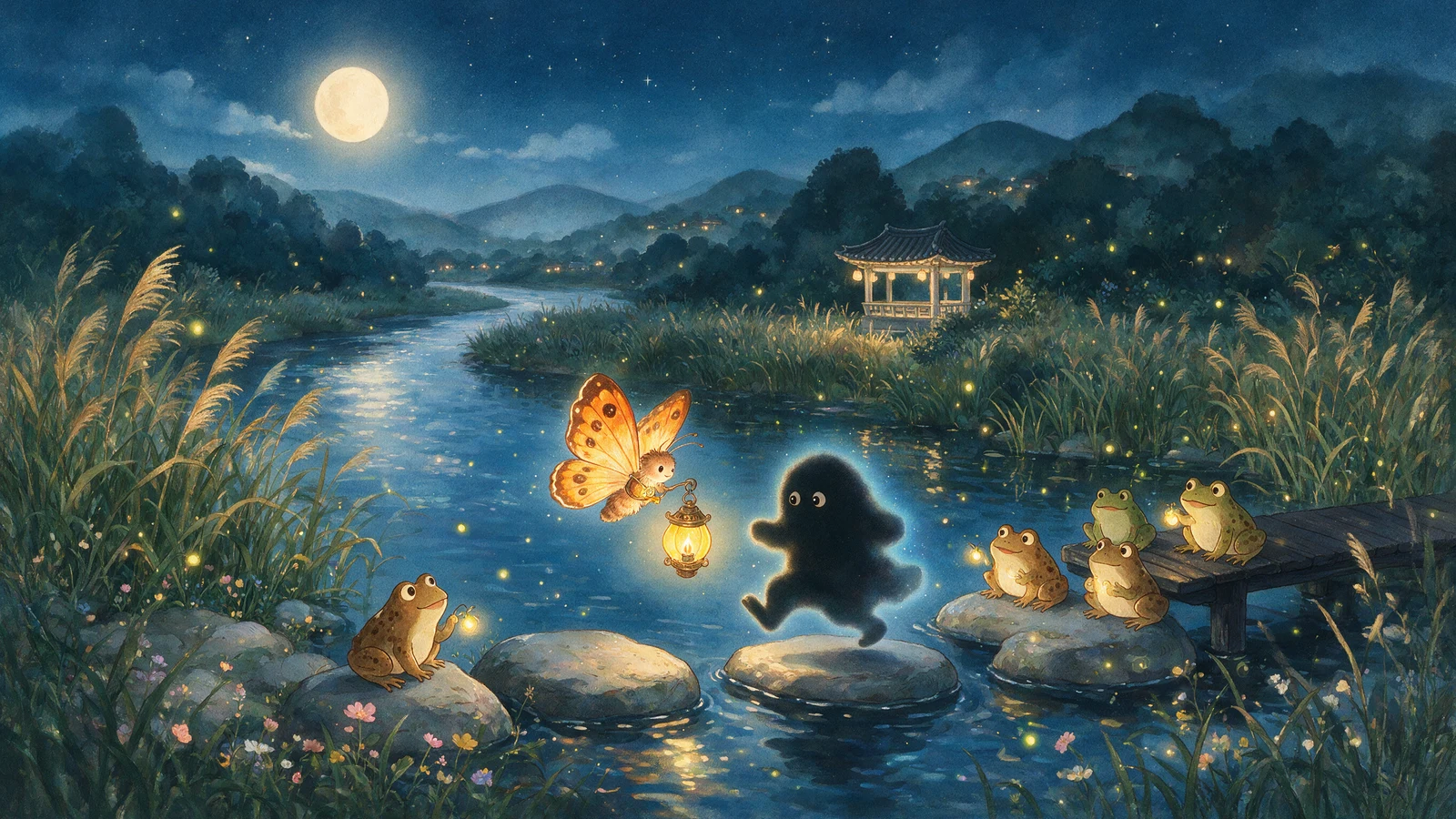
The encyclopedia, in cataloguing dream-themed poetry, mentions a sijo (a traditional short Korean verse form) by Yi Jeong-bo. It draws on Zhuangzi's butterfly-dream story and is generally classified among works that sing of the emptiness of dreams.
The Donghak gasa (a verse form associated with the Donghak religious movement) "Mongjungga" (Song of a Dream) presents a slightly different butterfly. In it, the dreamer is led by a butterfly into a world beneath the water, meets a young boy there, and comes to understand the principle by which heaven and earth cycle and all things come into being.
Here, the butterfly is a guide. It doesn't tell you your fortune — it takes you somewhere.
Set these two records side by side and a direction emerges. In Joseon as well, the butterfly was less something to divine and more a doorway into the dream itself.
A Butterfly That Landed
Lumi
"You're probably a little deflated to hear it isn't on the old list.
But it's better than making something up that isn't there.
From here on, let's read it the modern way instead."
It landed on your hand or shoulder, or kept hovering just in front of you.
In traditional interpretation, as noted above, no confirmed entry exists. No old record has been found that assigns fortune to a butterfly landing on you. Some modern dream interpretation calls it a good sign, but that isn't backed by the original texts.
From a modern psychological perspective, something touching your body is often read as an image of acceptance — a state of not pushing away what approached you.
What forks here is how you felt at the time.
- Were you glad
- Did you try hard not to move
- Did you feel nothing in particular
If the second one stayed with you, it's less about the butterfly and more about being careful not to break something. It's worth thinking about whether anything like that is going on in your life right now.
A Butterfly You Followed
You kept following a butterfly flying ahead of you.
Rather than traditional interpretation, this has a place in literary record. The "Mongjungga" mentioned earlier describes exactly this scene — following a butterfly and arriving in another world, and hearing something there.
From a modern psychological perspective, following something is often read as a state of moving toward the unknown — motion without a fixed destination.
And in this dream, you usually don't catch up. Butterflies don't fly in a straight line. If you woke up feeling wistful, what that wistfulness was pointed at is the information worth keeping.
If it led into water, our guide to water dreams is worth reading alongside this one.
A Butterfly You Caught, a Butterfly You Lost
In traditional interpretation, no confirmed entry exists here either. There's an entry for catching a bird, but none for a butterfly. We cover the bird side in our bird-dream guide.
From a modern psychological perspective, catching something is generally read as a state of trying to obtain something. But a butterfly is different from a bird. Catch it, and its wings get damaged.
So it's often the feeling afterward that stays with you — feeling bad for having caught it, feeling like you should let it go, or finding it was already damaged.
Losing it is a different texture. Losing a butterfly reads less as failure and more as simply how things go. If that felt disappointing, the disappointment itself is the information.
A Dream Where You Were a Butterfly
This is Zhuangzi's dream. And people really do have it.
In traditional interpretation, this scene belongs to philosophy rather than the dream-interpretation list. What Zhuangzi asked wasn't about fortune — it was about the boundary between dream and reality.
From a modern psychological perspective, dreaming you've become something other than your own body isn't rare. There's an explanation that point of view shifting inside a dream is a common phenomenon.
If the sensation of flying is what stayed with you most strongly, it's worth reading through our guide to flying dreams as well.
And if you woke up briefly unsure which one was real, that's a sensation recorded 2,300 years ago already. There's nothing strange about it.
If You Searched Because of a Taemong
The entry on taemong (a taemong, or "conception dream," is a dream believed in Korean folk tradition to foretell a pregnancy) in the encyclopedia organizes conception-dream imagery collected from different regions by the child's sex.
The butterfly isn't there either. Flowers appear under plants on the girl side, and birds and shellfish appear under animals, but no butterfly shows up on the list.
So there's no old-record support for the idea of a butterfly taemong. It's simply something said in modern dream interpretation.
And either way, a dream cannot tell you whether you're pregnant or the sex of your baby. Taemong stories are, more often than not, attached after the fact. We cover taemong generally in our baby dreams guide.
Told Honestly
Lumi
"Here's the interesting part, once you put it all together.
The butterfly is missing from the dream-interpretation list, but it's in the very first line of the dream manual itself.
It wasn't something to divine — it was the dream itself.
For 2,300 years."
Traditional dream interpretation and modern psychology rely on different kinds of evidence.
For the butterfly specifically, what's confirmed on the traditional side is only this: it has no entry in the dream-interpretation list, and instead repeatedly appears as the image representing dreaming itself — starting with Zhuangzi, carried into the dream manual's opening poem, and continuing into Joseon-era sijo and gasa.
We won't invent an entry that doesn't exist to fill the gap. The encyclopedia itself notes, after laying out its dream-interpretation list, that these readings emerged naturally out of many people's experience rather than from any consistent theoretical foundation. If that's true even of entries that do exist, there's even less reason to fabricate one that doesn't.
Let's be clear about a few things.
No old record confirms that a butterfly dream is an auspicious dream. No record confirms it as an inauspicious dream either. There simply is no entry.
There's no old classification for a butterfly taemong, either. And a dream cannot tell you whether you're pregnant or your baby's sex.
The idea that a butterfly represents someone who has passed away also has no basis in the old dream-interpretation record. It's closer to a symbol borrowed from a different cultural tradition.
No verified connection exists between butterfly dreams and lottery numbers, either.
Frequently Asked Questions
Is a butterfly dream an auspicious dream? There's no butterfly entry in the old dream-interpretation list, so there's no basis for calling it good or bad luck. It is true, though, that the butterfly has long been used as an image representing dreaming itself.
A butterfly landed on my hand. There's no traditional basis for this. Modern interpretation reads it as a state of not pushing away what approached you.
I kept following a butterfly. The Donghak gasa "Mongjungga" has a passage about following a butterfly into another world. It sits closer to the role of a guide.
I was the butterfly. That's Zhuangzi's dream. Point of view shifting inside a dream isn't a rare occurrence.
Is this a butterfly taemong? The butterfly doesn't appear in the old list of taemong imagery. And a dream can't tell you whether you're pregnant or your baby's sex.
It was a white butterfly. Is that a bad sign? No old butterfly entry dividing fortune by color has been confirmed. The fact that you remember the color at all is worth writing down on its own.
Butterfly dreams stay with you because there's no event to hold onto. With no story to grab, only the image remains.
But someone 2,300 years ago paused at exactly that same point. Instead of asking about fortune, he asked which one — dream or reality — was real.
Today, there are three lines worth writing down.
- Were you watching the butterfly, or were you the butterfly
- What the butterfly did — landed, led the way, or flew off
- How you felt when you woke up
Give it a few weeks and a pattern tends to show. A quiet dream usually shows up during a quiet stretch of time.
A dream with no event is easy to let slip by, because there's nothing much to write about.
But a color and a feeling, one line each, is enough. Collect a few days of these and it reads back as roughly where your mind was during that stretch.
Dream Talisman looks at the dream scene you record together with your day stem (ilgan) in the Five Elements system, and turns it into a color and phone wallpaper for the day. It is less an app that interprets your dream for you than one that lets you write it down before it fades.
Record today’s dream in Dream Talisman
References
- "Dreams" — Encyclopedia of Korean Culture · The eight-category folk-belief dream-interpretation list (no butterfly entry), Yi Jeong-bo's sijo on Zhuangzi's butterfly dream, the butterfly passage in the Donghak gasa "Mongjungga," the two approaches to dream interpretation
- "Taemong" — Encyclopedia of Korean Culture · Sex-based classification of taemong imagery (no butterfly entry)
- Zhougong Jie Meng — Wikisource text (Duke of Zhou dream manual tradition) · The Zhuangzi-butterfly line in the opening poem, the bird-and-beast entries. A classical Chinese dream-interpretation text, in a separate lineage from the Korean folk record
- The "Butterfly Dream" passage in the "Qiwulun" (Discussion on Making All Things Equal) chapter of the Zhuangzi · circa 4th century BCE
- General research in modern sleep and dream psychology