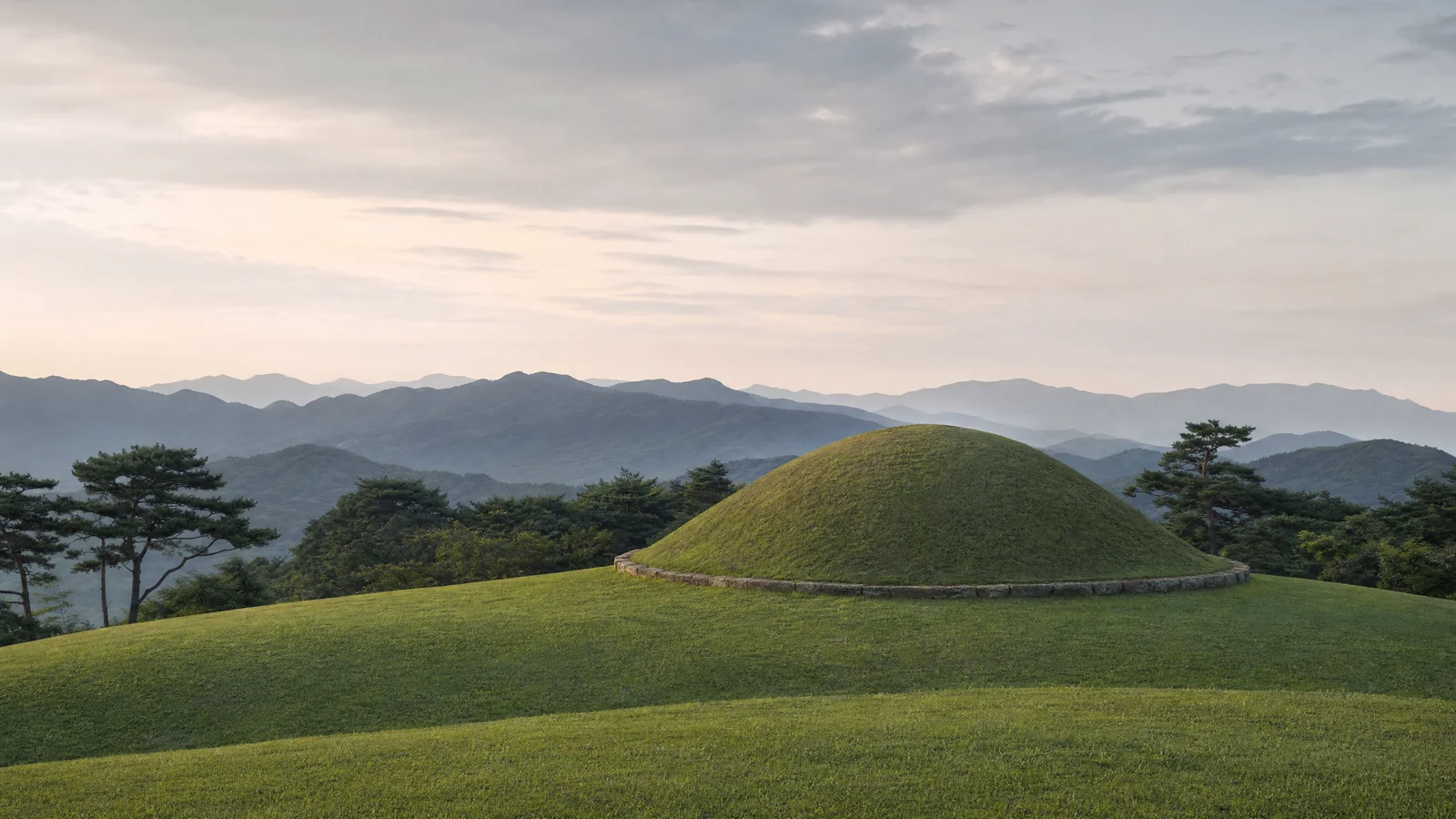
A grave dream tends to split into two worries.
One is whether someone is going to die. The other is whether something is wrong with an ancestral tomb back home. Searches lean heavily toward the second worry.
Something needs to be said first. To people of the past, a grave wasn't a place of death.
They called it something else. And that name changes the entire reading of this dream.
Lumi
"What state was the grave in?
Was it well kept, or overgrown and falling apart?
I'm asking because, to people back then, a grave was a house."
Table of contents
A Grave Was a HouseSo the Grammar of the House Entries AppliesThe Dream of Seeing a GraveThe Dream of Visiting a Grave, Trimming the GrassThe Dream of a Collapsed or Dug-Up GraveThe Dream of Entering a Grave, Seeing Your Own Grave"Is Something Wrong With My Ancestral Tomb?"The Most Honest AnswerFrequently Asked QuestionsA Grave Was a House
One of the old terms for a grave was yutaek (幽宅) — literally, "a house in the shadows."
It was read as a house in the most literal sense. If the house of the living was yangtaek (陽宅, a house of yang), a grave was eumtaek (陰宅, a house of yin). Both share the character taek (宅) — house.
So a grave was managed the same way a house was managed.
- Chosen carefully by its site
- Repaired when it fell into disrepair
- Weeded when the grass grew wild
- Visited and checked on every year
No different from maintaining a home.
That's the unexpected turn in this article's title. A grave dream reads closer to a house dream than a death dream.
So the Grammar of the House Entries Applies
The dream-interpretation catalog in the "Dreams" entry of the Encyclopedia of Korean Culture (a major reference work on Korean history and culture) doesn't have a separate entry for graves.
But the rules for the house entries are clear.
- Repairing your house brings good fortune
- Cleaning your house means an honored guest is coming
- Building a tiled-roof house means your work will go well
- A broken ridge beam is an ill omen
As covered in our house dream guide, not yet available in English, a house was read by its condition. Building, fixing, and cleaning it were good; it breaking was bad.
If a grave is a house, the same rule applies. Well kept is good. Fallen into ruin is not.
Let's be clear about one thing, though. This is the house entries applied to a grave by analogy — there's no separate grave entry in the original catalog. That's as far as the claim goes.
The Dream of Seeing a Grave
Lumi
"Did you go up close, or see it from far away?
And did you know whose grave it was?
Most people don't."
From a modern psychology view, a grave is sometimes read as the image of a place where something finished has come to rest. It isn't the event itself — it's the outcome. Something already past, still holding its shape.
A few things split the reading here.
- Was it well kept
- Was it overgrown and long neglected
- Was it collapsed
The second and third options may have less to do with the grave itself and more to do with something you haven't looked at in a long time. This overlaps with the abandoned-house scene in our house-collapse dream guide, not yet available in English.
And the feeling is the information. Was it frightening, lonely, or simply quiet?
Most people remember this dream as quiet rather than frightening. That's a distinguishing feature of it, too.
The Dream of Visiting a Grave, Trimming the Grass
This tends to appear especially often around holidays or memorial anniversaries.
In traditional interpretation, cleaning your house was said to bring an honored guest. If a grave is a house, trimming its grass corresponds to cleaning. It falls on the favorable side, since it's an act of care.
From a modern psychology view, this is an image of tending and care. But one more layer applies here.
Visiting a grave is something the living do for the dead. It's an act that continues even after the relationship has ended.
Grief research sometimes describes this as continuing a bond in a changed form rather than cutting it off entirely — a theme connected to our guide on dreaming of a deceased parent, not yet available in English.
And if a holiday or grass-trimming season is actually approaching, that's likely the real material behind the dream. Yi Ik (이익, a late-Joseon scholar of the Silhak, or Practical Learning, movement), wrote in his essay Monggamnon that what occupies the mind during the day becomes the content of dreams at night.
The Dream of a Collapsed or Dug-Up Grave
Because so many people search for this scene out of worry, it deserves its own section.
From a modern psychology view, this scene falls, as noted above, into the collapsed house category. Even the old records took a dim view of a broken ridge beam.
But that's the grammar of a record, not a prophecy.
The encyclopedia itself notes that these interpretations formed naturally from many people's experiences rather than from a consistent theoretical basis. And the Samguk Yusa (Memorabilia of the Three Kingdoms) contains a case where the same dream was read in opposite directions depending on who interpreted it.
So this dream isn't grounds for concluding that something is wrong with an ancestral tomb.
Read in a modern light, it works like this. Seeing something collapsed means it's on your mind. If you actually haven't visited in a long time, or the family has discussed the issue, or the upkeep has been weighing on you, that's the likely material.
If it genuinely bothers you, the simplest thing is to go check. Not because the dream told you to, but because it's something you'd need to confirm anyway.
The Dream of Entering a Grave, Seeing Your Own Grave
You Were Inside the Grave
From a modern psychology view, this reads less like a grave dream and more like a trapped dream. Narrow, dark, and no way out.
Whether you were trying to get out or simply staying still makes a difference. If it felt suffocating, that may be less about death and more about the feeling of your current situation.
It Was Your Own Grave
Rare, but it tends to stick with you.
We've covered seeing your own funeral in our funeral dream guide, and this scene belongs to the same family. One thing differs, though. A funeral has people in it. A grave doesn't.
So this scene is less about relationships and more about the place left behind after everything has ended. Quiet, and no one there.
Whether it felt frightening or calm makes the difference. If it felt calm, some readings take that as a sign of things having been settled.
"Is Something Wrong With My Ancestral Tomb?"
So many people arrive at this article with that exact worry, so let's settle it clearly.
It's true that the idea of an ancestor's grave affecting descendants has a long history. People examined burial sites, considered directions, and sometimes relocated graves.
But there's no evidence anywhere that a dream can tell you that.
There's no grave entry in the dream-interpretation catalog, and no record stating that a dream reveals the condition of a tomb.
And this needs to be said carefully.
There are real cases of people being urged, on the basis of a dream, to relocate a grave or hold a shamanic ritual. Saying that to a worried person is a different kind of act altogether — one this article won't engage in.
If you're worried about a family grave, the answer is to go and check. That's the surest and cheapest option there is.
The Most Honest Answer
Lumi
"A lot of people have this dream and start worrying about a family grave.
The old records don't have a grave entry at all.
What's confirmed is that a grave was called a 'house.' That's far more useful information."
Traditional dream interpretation and modern psychology rely on different kinds of evidence.
There's no grave entry in the old catalog. What's confirmed is that a grave was treated as a house, and that a house was read by its condition.
The encyclopedia itself notes, after laying out its list of dream-reading methods, that such interpretations formed naturally from many people's experiences rather than from a consistent theoretical basis.
A few points should be made clearly.
A grave dream isn't a prophetic dream.
A dream can't tell you the condition of an ancestral tomb. If you're worried, going to check is the right move.
This article won't advise relocating a grave or holding a ritual.
There's no verified connection between a grave dream and lottery numbers, either.
Frequently Asked Questions
Is a grave dream a bad omen? There's no grave entry in the dream-interpretation catalog, so there's no basis for a definite answer. Since people of the past treated a grave as a house, the grammar of the house entries can serve as a reference.
Does it mean something is wrong with an ancestral tomb? There's no evidence a dream can tell you that. If it's on your mind, visiting to check is the surest option.
The grave was collapsed. Some readings treat this the same way as a collapsed house. But that's the grammar of a record, not a prophecy.
I dreamed of visiting a grave. This falls on the favorable side, since it's an act of care. If a holiday or grass-trimming season is approaching, that may well be the material behind it.
I saw my own grave. Rare, but it happens. Whether it felt frightening or calm is the deciding factor, and a calm feeling is sometimes read as a sign of things being settled.
I keep forgetting my dreams. Dreams start fading about 90 seconds after waking. Instead of getting up right away, staying still for a moment often brings more fragments back.
A grave dream tends to linger quietly rather than frighten. That's exactly why it stays on your mind longer.
There's nothing you need to do today. If anything, take a moment to notice whether there's something you haven't looked at in a while. It doesn't have to be a grave.
And if an ancestral tomb genuinely weighs on you, go check when you next have time. Not because of the dream — just because it's something worth doing anyway.
The same dream leaves a different color in each person's memory.
Dream Talisman looks at the dream scene you record together with your day stem (ilgan) in the Five Elements system, and creates a color and phone wallpaper for the day. It's less an app that interprets your dream for you than one that helps you carry today's dream with you for the day.
Curious what color the scene you just read would become?
Record today’s dream in Dream Talisman
References
- "Dreams" — Encyclopedia of Korean Culture · Folk dream-reading tool catalog (house entries), Yi Ik's Monggamnon, the Samguk Yusa's account of King Wonseong's dream interpretation
- General material on the traditional terms yutaek (幽宅) and eumtaek (陰宅), which treated a grave as a house
- General research on continuing bonds after bereavement
- General research in modern sleep and dream psychology