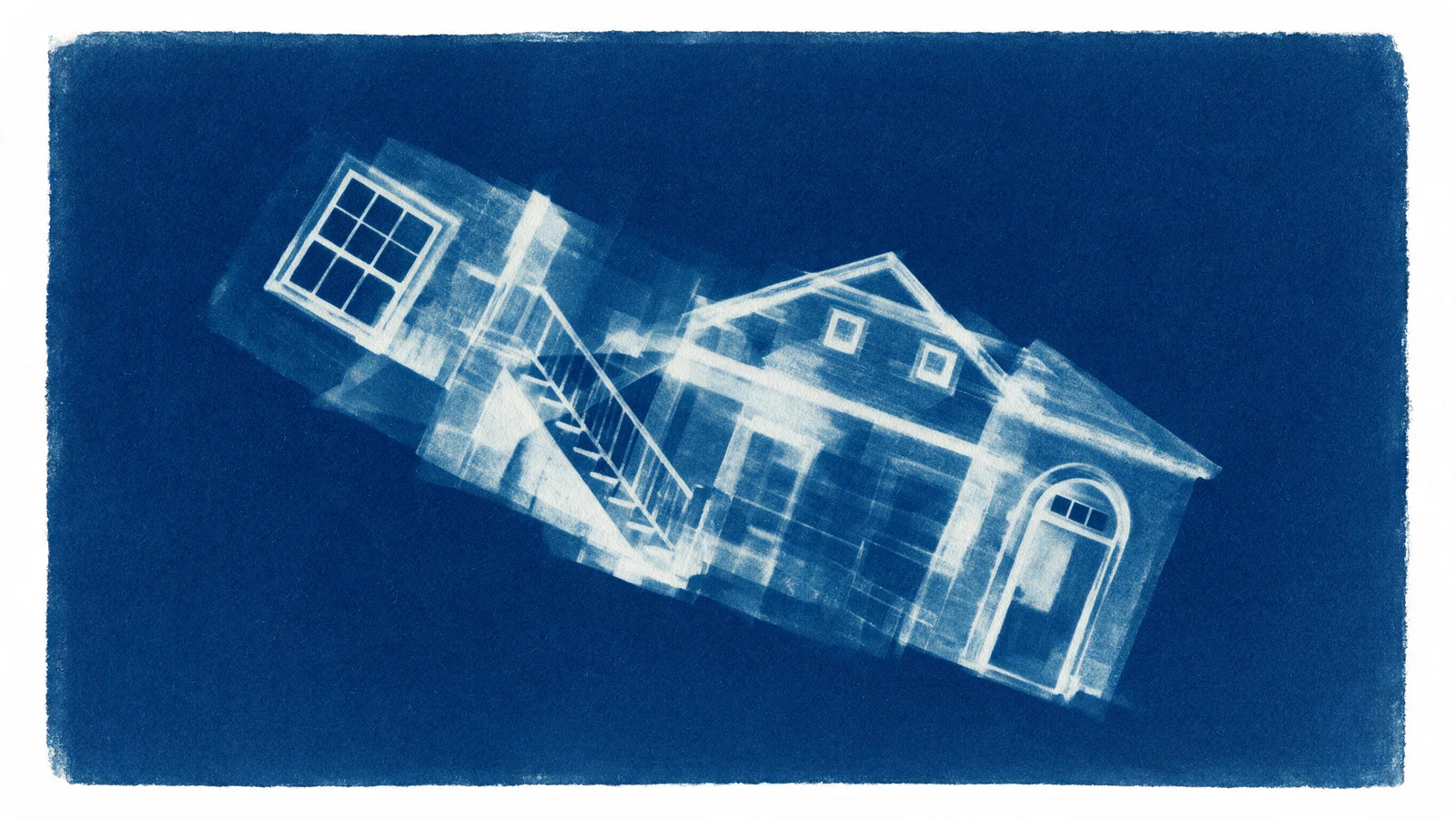
It was clearly your house.
But once you wake up and think it over, something's off. The front door was on the wrong side, there was a room that didn't exist, the view outside the window wasn't your actual neighborhood. And yet within the dream, it was unmistakably "your house."
The opposite happens too. A house you've never seen before — but in the dream, you'd lived there for years.
Lumi
"That house, have you actually been there?
…No, right? Most people haven't.
Everyone who searches for this ends up asking the same thing: is it bad if an unfamiliar house shows up?
The old manuals never asked that question. They asked what condition the house was in."
Table of contents
Dream Houses Are Mostly CompositesThe Old Records Asked About Condition, Not FamiliarityBut This List Looks FamiliarThe Dream of Entering an Unfamiliar HouseThe Dream of an Empty HouseA Collapsing House, a Broken Ridge BeamThe Dream of Your Childhood HomeThe Dream of Moving House, Fixing Up a HouseSomeone Dreamed the Same House Repeatedly, 800 Years AgoThe Most Honest AnswerFrequently Asked QuestionsDream Houses Are Mostly Composites
Familiar, yet wrong. That's the most common feature of a house dream.
A modern psychology view treats dream locations as assembled from fragments of memory. The staircase from your childhood home gets attached to your current living room, and a window you saw somewhere gets fitted in. That's why the sense of familiarity is strong, but the details don't line up.
The "Dreams" entry of the Encyclopedia of Korean Culture (a major reference work on Korean history and culture) explains this too, describing dream imagery as formed through fusion, substitution, symbolism, and figuration — two or more fragments combining and swapping places to attach themselves to something else. A house is the material where that assembly shows most clearly. A face has to stay one coherent thing, but rooms can be added indefinitely.
So there's no need to dwell on "where was that house, exactly." It's likely a house that doesn't exist anywhere.
So what should you look at instead? This is where the old records become useful.
The Old Records Asked About Condition, Not Familiarity
The Encyclopedia of Korean Culture organizes folk dream-interpretation methods into eight categories with examples, and the house category stands entirely on its own.
- Drinking in a tall pavilion brings wealth and honor
- A broken ridge beam is an ill omen
- Repairing your house brings good fortune
- Cleaning your house means an honored guest is coming
- A house catching fire means the household will prosper
- A well running dry means wealth will shrink
- A fire breaking out in the kitchen means urgent business is coming
- Building a tiled-roof house means your work will go well
None of these axes overlap. Not once do they ask whether it was your house, someone else's, familiar, or unfamiliar. Instead they ask whether it was fixed, broken, built, or swept.
They're verbs. And conditions.
This is the same structure we found in our snake dream guide, not yet available in English, where what the snake did mattered more than the snake itself. Old dream interpretation wasn't a matter of attaching one answer to one noun.
But This List Looks Familiar
Here's where it gets interesting.
The old Chinese dream manual Zhougong Jie Meng (the Duke of Zhou's dream manual) contains dozens of house-related entries. Set the text preserved on Wikisource alongside editions in the same original lineage, and lines like these appear.
- A ridge beam suddenly breaking is greatly inauspicious
- Drinking in a tall pavilion brings wealth and honor
- Renovating your house brings great fortune
- Sweeping and cleaning your house means someone will visit from far away
- A pine tree growing on the roof extends one's lifespan
Compare this to the Korean list above. The ridge beam, drinking in a pavilion, repairing the house, and cleaning it — four entries line up directly. Count the plant entry in the encyclopedia — "a pine growing on the roof brings a high official post" — and that's five.
It's hard to call this a coincidence. It's more natural to read Korean folk house-related interpretations as having inherited a substantial portion from this textual tradition.
This is different from saying "people everywhere have always thought this." It points to an actual route of textual transmission. Part of it may also be that a house, as subject matter, documented especially well. Roof, ridge beam, door, well, kitchen — easy categories to break into discrete entries.
Earlier, in our blood dream guide, the two traditions barely overlapped at all — the Korean list had no blood entry whatsoever. A house is the opposite case. The overlap depends entirely on the subject.
The Dream of Entering an Unfamiliar House
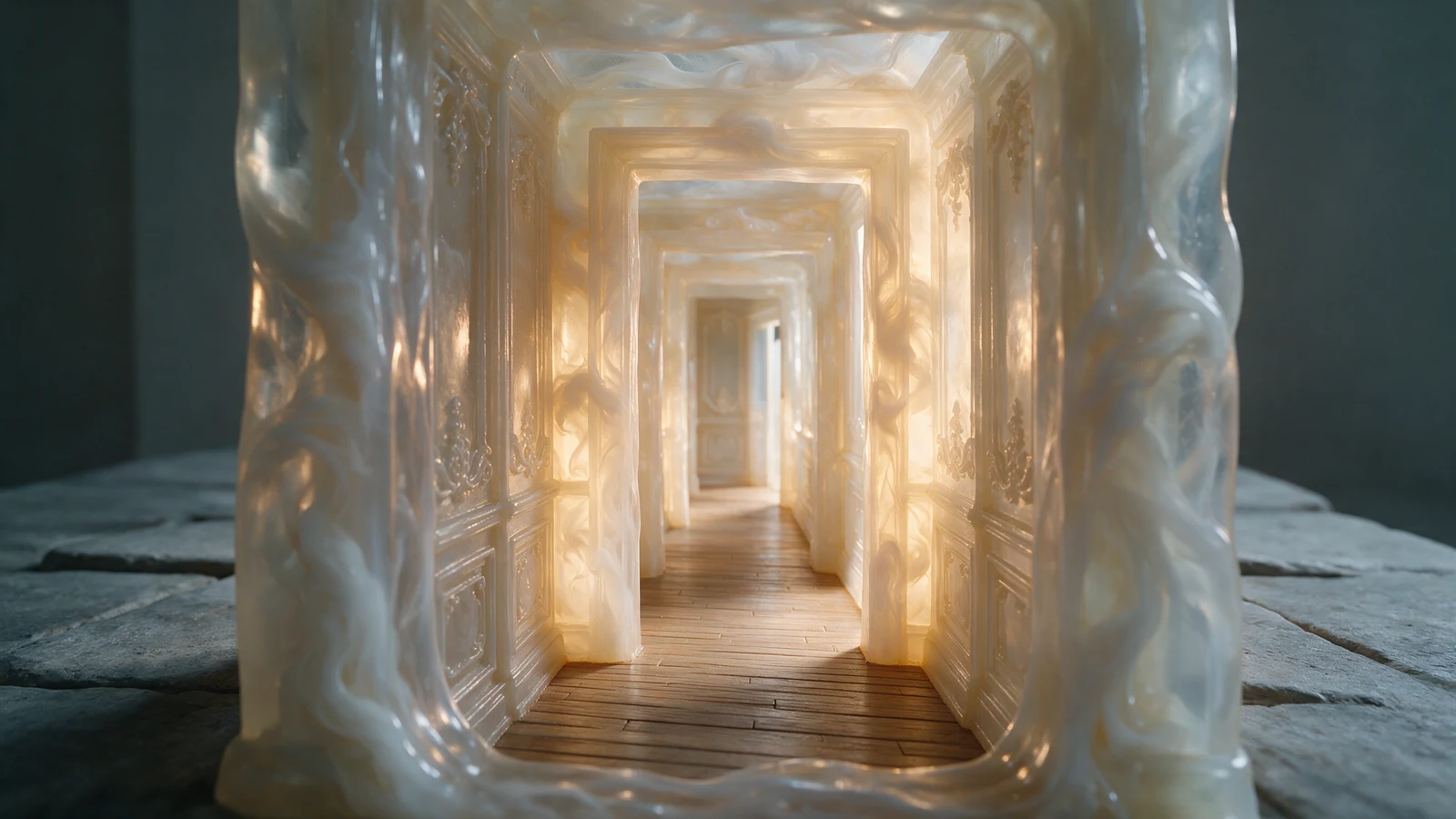
The most searched scene of all.
In traditional interpretation, the reading is surprisingly favorable. The Zhougong Jie Meng tradition contains a line stating that moving into someone else's new house is auspicious. It doesn't even record moving into a dilapidated house unfavorably.
The entries on doors split, though. A door standing wide open is greatly auspicious, but no one being behind the door is greatly inauspicious. The condition wasn't the act of entering — it was what was found inside.
A modern psychology view generally reads an unfamiliar house as an image of a place not yet lived in. Something newly started, a place you've just moved into, a relationship you're still getting used to.
The dividing line here is how you felt at the time.
- Comfortable
- As though you shouldn't be there
- Looking for the way out
If the third one stayed with you, this may be less a house dream and more a story about finding your way out — the same family covered in our chase dream guide.
The Dream of an Empty House
The door is open, but there's no sign of anyone. No one answers when you call.
In traditional interpretation, this side is firmly unfavorable. As noted above, no one being behind the door is recorded as greatly inauspicious, and a separate entry treats an empty house itself as a very bad sign. Grass growing inside a house, in the same vein, means the house will stand vacant.
To people of that era, a house wasn't just a structure — it was a state of being inhabited. A house without people wasn't a house. It was an empty shell.
A modern psychology view arrives at a similar place from a different angle. An empty house is generally read in connection with a sense of emptiness — long stretches of time alone, or something having ended before the next thing has begun.
One thing should be said clearly here. There's no evidence that this dream means something is happening to anyone. The old entries recorded it as inauspicious according to the reading conventions of their time, and no such prediction has ever been verified.
A Collapsing House, a Broken Ridge Beam
Lumi
"The ridge-beam dream is a little unusual.
It's in both the Korean and Chinese records, and both call it inauspicious.
That kind of exact overlap is rarer than you'd think."
The house shakes, the ceiling caves in, or a support beam breaks.
In traditional interpretation, both traditions say the same thing. The Korean folk catalog records a broken ridge beam as an ill omen, and the Zhougong Jie Meng tradition records a ridge beam suddenly breaking as greatly inauspicious. There's also an entry stating that a collapsing roof means misfortune for the household.
Interestingly, wind is treated differently. A dream where wind blows and shakes the house is recorded not as misfortune, but as moving house. Collapsing and shaking were read as separate categories.
A modern psychology view often connects a collapsing structure with whatever had been holding it up — a ridge beam or a support column, something bearing weight from above, giving way. Some accounts note that this scene appears more often during periods that feel overwhelming.
And if anxiety and stress genuinely run high for you right now, that tends to factor in too. Research comparing dream content across groups with different anxiety and stress levels found differences in dream themes such as misfortune, injury, and anger. This isn't a claim that a specific event is being predicted — just an observation that your current state tends to bleed into dream content.
We've covered this scene in full detail, including cracked walls and abandoned houses, in our house collapsing dream guide.
The Dream of Your Childhood Home
The house you grew up in, one that's since been torn down, a place you moved out of over a decade ago.
Let's be honest here. This entry doesn't appear in the old dream-interpretation catalog. By today's standards this is one of the most common house dreams, but the old records have no place for it. In an era when staying in one home for life was the default, there would have been little need to create such an entry.
So this dream has to be read in a modern light.
A modern psychology view generally connects an old house with who you were during that period. The place stands in for the time. The sensation of that era may have become relevant again, or something left unresolved from back then may still be sitting there.
There's usually a trigger behind it.
- Moving recently, or an upcoming move
- Something shifting with family
- Seeing an old photo or object
- Feeling like your current place isn't permanent
That last one is surprisingly common. When your present situation doesn't feel like settling down, the era when it did tends to resurface.
Yi Ik (이익, a late-Joseon scholar of the Silhak, or Practical Learning, movement), wrote in his essay Monggamnon that what you see and hear during the day becomes the content of dreams — noting that hearing a drum while sleeping brings dreams of military affairs.
The Dream of Moving House, Fixing Up a House
In traditional interpretation, this is the brightest territory of all. In the Korean list, repairing a house brings good fortune, building a tiled-roof house means your work will go well, and cleaning your house means an honored guest is coming. The Zhougong Jie Meng tradition likewise records renovating a house as greatly auspicious.
Nearly every act of tending to a house falls on the favorable side.
A modern psychology view is fairly straightforward here too. Fixing, moving, and organizing are generally read as the image of change in progress. There's an account that this increases around an actual move or job change.
If the packing wouldn't finish, or the boxes arrived without your things, or the renovation never seemed to end, though, the tone shifts. That leans less toward change and more toward something unfinished.
Someone Dreamed the Same House Repeatedly, 800 Years Ago
This comes from a record left by Yi Gyu-bo, a scholar of the Goryeo dynasty, in his essay "Mongseol" ("On Dreams").
In his account, he would always find himself seated atop a tall pavilion. Below the pavilion was a vast sea, and water would rise up over the pavilion and soak the bedding where he lay. He had this same dream for six or seven years running.
Then, in the year gyeongin, he was found guilty of an offense and exiled to Wido Island. He came to lodge in an old man's house — and that house had a tall pavilion, facing a vast sea. It matched the dream exactly.
Yi Gyu-bo read this as proof of a dream's spiritual power. In another of his writings, he noted that the spirits communicate quietly, and that faith is sometimes rewarded, so how could it all be empty.
We don't read it that way. But one fact holds up regardless. A recurring dream of an unfamiliar house existed 800 years ago too, and it stayed with someone enough to be written down. That's not so different from the reason you searched for this article today.
The part about water rising into the house is covered separately in our water dream guide, not yet available in English.
The Most Honest Answer
Lumi
"Search for house dreams and you'll find plenty of claims about financial fortune.
There is something like that in the old entries — but only for building, fixing, or sweeping.
There's no entry that says a house simply appearing means something on its own."
Traditional dream interpretation and modern psychology rely on different kinds of evidence.
What's confirmed in the old records is that house-related dream interpretation split along a house's condition and whatever hand had touched it. And that isn't a prophecy — it's how people of that era read the world. The encyclopedia itself notes, after laying out its list of dream-reading methods, that such interpretations formed naturally from many people's experiences rather than from a consistent theoretical basis.
There's also a case where the same dream split between interpreters. In the Samguk Yusa's (Memorabilia of the Three Kingdoms) account of King Wonseong, a dream of entering a well was first read as an omen of imprisonment, then read by someone else as an omen of entering the royal palace. One well, two different answers.
A few points should be made clearly.
An unfamiliar house appearing doesn't make this a bad-omen dream. The old entries never used familiarity as their axis.
There's no evidence that a house dream determines a move or a real estate matter. It's true that the old records favor building and fixing a house, but that's a record, not a prediction.
A collapsing house doesn't foretell an accident. Not for you, and not for your family either.
There's no verified connection between a house dream and lottery numbers, either.
Frequently Asked Questions
Is it a bad dream if an unfamiliar house appears? The old entries never divided by familiarity. There's actually a line that reads moving into someone else's new house favorably.
It was my house, but the layout was different. Very common. Dream locations are assembled from multiple memories, so the sense of familiarity is strong even when the details don't match.
An empty house appeared. The old entries read this unfavorably. But that reflects how that era read the world — it doesn't mean anything is happening to anyone.
The house collapsed. Entries about a collapsing ridge beam or roof are unfavorable in both the Korean and Chinese records. In modern terms, this is often connected to a period when whatever was holding you up is under strain.
My childhood home keeps appearing. This entry doesn't exist in the old dream-interpretation catalog. In modern terms, it's connected to who you were during that period. If it recurs, note the interval and what was happening around it — it reads better in hindsight.
Does a moving dream mean I'm actually going to move? No. There's a line in the old records connecting wind shaking a house to moving house, but that's a record, not a prediction.
There's a reason house dreams stay with you. Other dreams pass through as scenes, but a house stays put. That's why the space keeps coming back to mind even after you wake.
Three things worth writing down today:
- What condition the house was in — new, empty, collapsing, or under repair
- Where you were — on your way in, on your way out, or simply inside
- How you felt when you woke up
Track it for a few weeks and something interesting appears. House dreams tend to cluster during periods when your circumstances are shifting.
Some dreams involve a house that doesn't exist anywhere, yet you can't stop thinking about it.
Writing it down helps. While it's still in your head the layout keeps shifting, but putting it into words fixes it in place.
Dream Talisman looks at the dream scene you record together with your day stem (ilgan) in the Five Elements system, and creates a color and phone wallpaper for the day. It's less an app that interprets your dream for you than one that helps you write it down before it fades.
Record today’s dream in Dream Talisman
References
- "Dreams" — Encyclopedia of Korean Culture · Folk dream-reading tool catalog (house and plant entries), the fusion/substitution explanation of dream imagery, Yi Gyu-bo's "Mongseol," Yi Ik's Monggamnon, the Samguk Yusa's account of King Wonseong's dream interpretation
- Zhougong Jie Meng — Wikisource text · Door- and well-related entries. This is a Chinese dream-interpretation tradition with a different textual lineage from Korean folk records
- The original Zhougong Jie Meng, house entries · Widely cited passages as commonly circulated; no comparison against original editions was performed
- Research on differences in dream content by waking anxiety and stress level
- General research in modern sleep and dream psychology