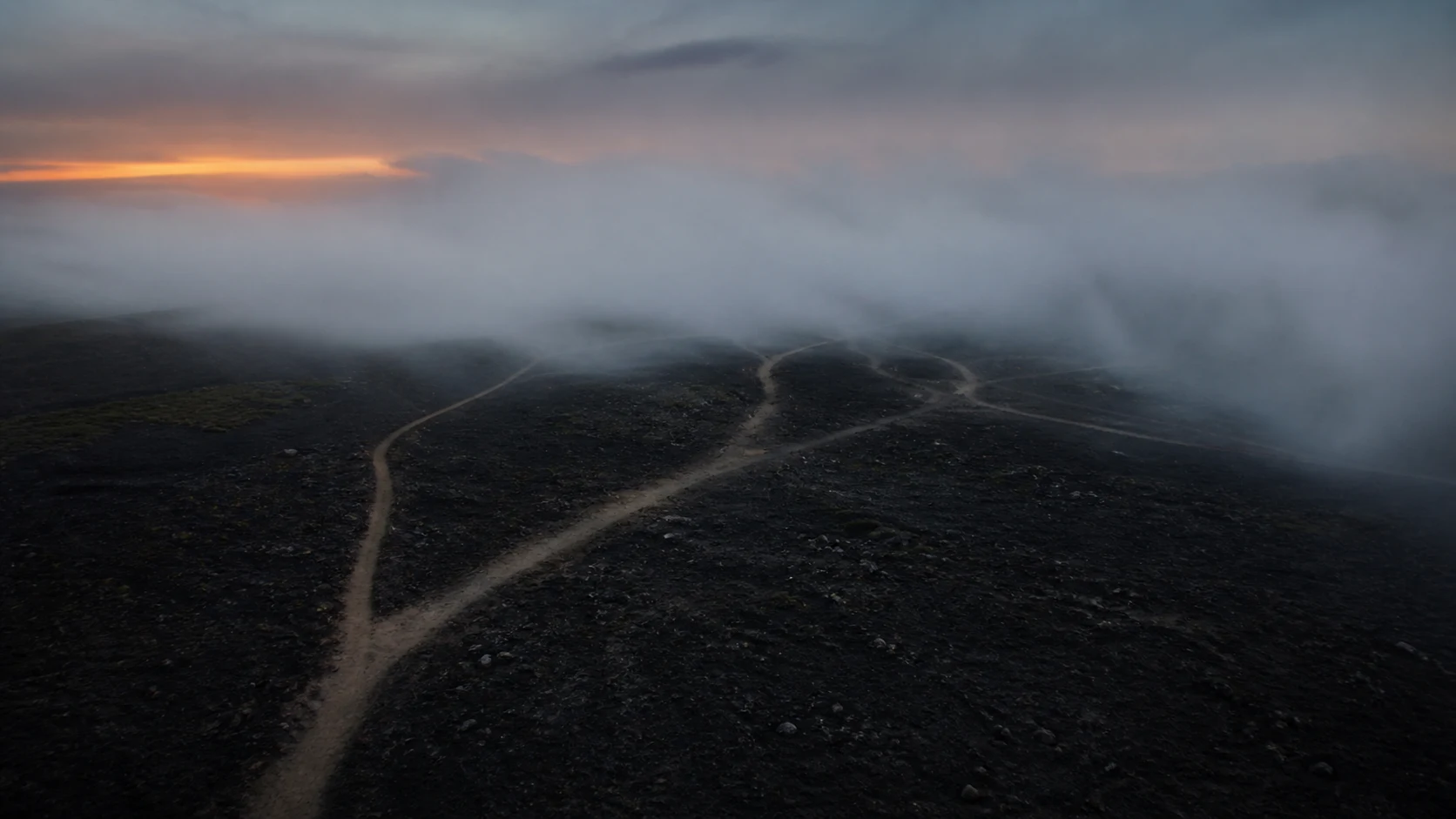
You were going somewhere.
That much was clear. You were headed toward a destination, but at some point the road turned unfamiliar, and you couldn't find your way back to where you'd started either. Then you woke up and noticed something strange.
You couldn't remember where you had been trying to go.
The road stayed vivid, but the destination was gone. That gap is the real signature of this dream.
Lumi
"Where were you headed?
...You don't know, do you? Most people don't.
But the old records noticed that too. Losing the road wasn't the real problem. Having something you were trying to reach was."
Table of contents
A Thousand-Year-Old Manuscript Has This Exact EntryBut an Exact Opposite Passage Exists TooA Dream of Stopping at a Fork in the RoadWho Was Walking With YouA Dream Where the Road Breaks Off or CollapsesA Dark Road That Keeps BendingA Dream of Not Being Able to Get HomeThe Most Honest AnswerFrequently Asked QuestionsA Thousand-Year-Old Manuscript Has This Exact Entry
A dream-interpretation manuscript from around the Tang dynasty was recovered from the Dunhuang caves (a cliffside complex of Buddhist grottoes in northwest China that preserved thousands of ancient manuscripts). It's commonly known as the Dunhuang Dream Book.
It contains this line:
Losing your way means failing to achieve what you sought.
It's short, but one detail stands out. The conclusion isn't really about the road. It's about the goal.
The scene described is getting lost, but the meaning attached to it points toward purpose. That suggests the people who wrote this saw the destination as the real subject of the dream, not the path itself.
The same manuscript also records the opposite condition.
- Traveling a road that keeps going means all your affairs will open up and you'll get everything you sought
- A road that is smooth and straight is a strongly auspicious sign
- Roads open in all four directions mean connections in every direction
- A road that ends in a dead end is inauspicious
A single pattern runs through all of it. Moving forward was read as good luck; being unable to move was read as bad luck.
None of these entries judge the road itself as good or bad. What they track is whether travel is still possible.
This is the same grammar as the cart entries covered in our car accident dream guide — in the old catalog, a vehicle's fortune also came down to whether it could keep moving.
But an Exact Opposite Passage Exists Too
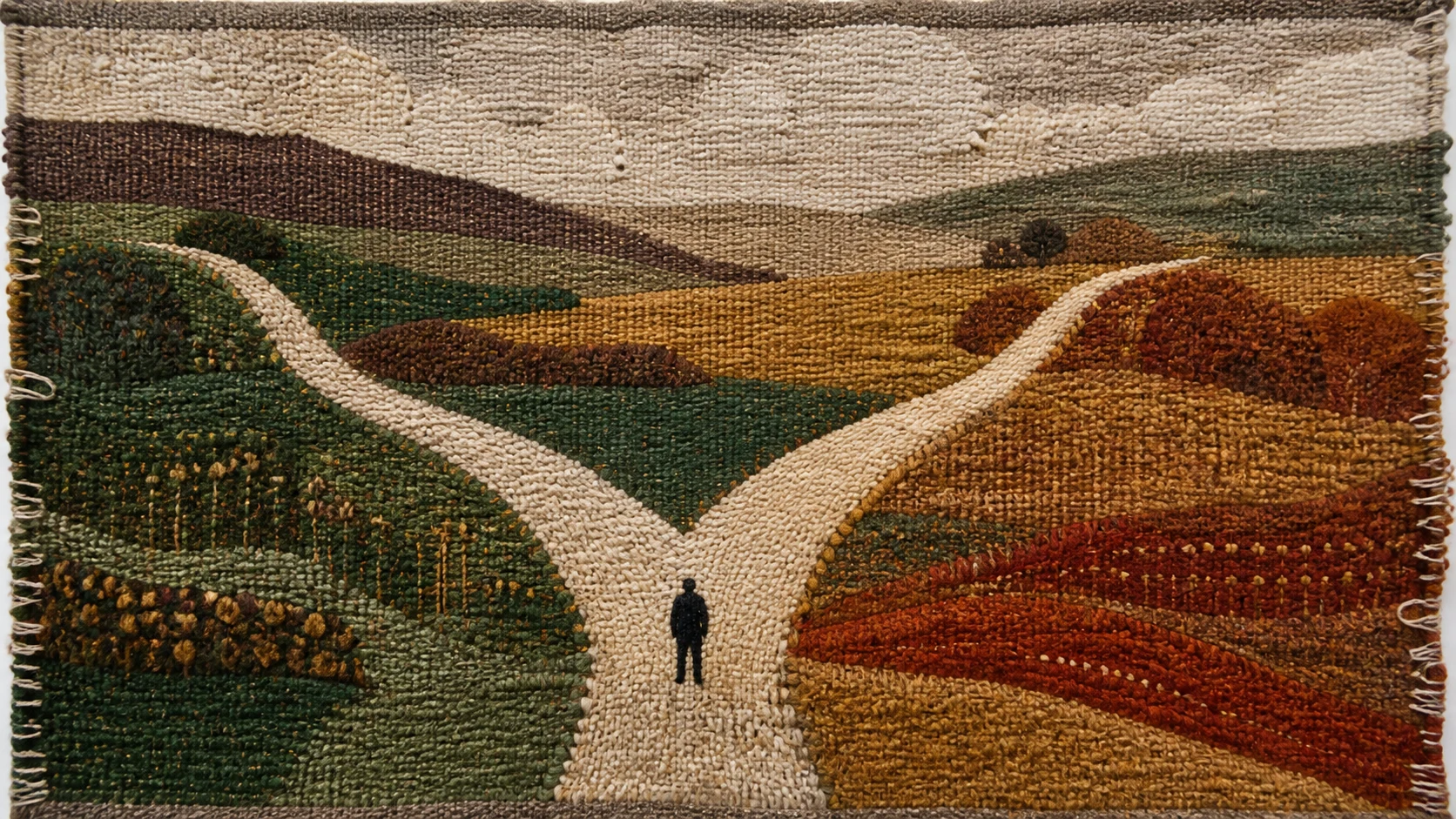
This is where it gets more interesting.
Texts in the Zhougong Jie Meng (Duke of Zhou dream manual tradition, a well-known Chinese dream-interpretation lineage) contain this line:
If you even forget where you lost your way, it is auspicious.
That contradicts the earlier entry. One source says losing your way means failing to reach your goal. The other says forgetting that you're lost at all is a good sign.
Both readings of the same scene survived, and they point in opposite directions. The same thing happens with a broken mirror in our mirror dream guide, not yet available in English — one reading calls it a farewell, the other a reunion.
The Dreams entry of the Encyclopedia of Korean Culture (a major reference work on Korean history and culture) explains that traditional dream interpretation followed two different attitudes. One read dreams as symbols. The other held that dreams show the opposite of reality. Under that second view, a scene of wandering and confusion could actually mean things are about to resolve.
If you ask which reading is correct, the honest answer is that neither has ever been tested as a prediction.
Still, placing the two passages side by side reveals a real split. The first belongs to someone still searching for something. The second belongs to someone who has let go of what they were searching for.
So what matters in this dream isn't the fact that you were lost. It's whether you felt urgency while you were wandering, or not.
A Dream of Stopping at a Fork in the Road
This is the scene where you stood before two paths and couldn't decide which way to go. It's also often the moment you remember standing still longest in the dream.
In traditional interpretation, there's an entry that matches this exactly. The Menglin Xuanjie (夢林玄解, a Ming-Qing dynasty Chinese dream manual) tradition records a dream of struggling to move forward at a fork in the road, and reads it as indecision — being unable to commit to a plan because the benefits aren't clear.
Read today, the interpretation still holds up.
The same tradition also records the opposite case: a road with several branches ahead of you is a sign of good news to come. In other words, having multiple options wasn't the problem — being unable to choose between them was.
From a modern psychological perspective, this scene is also frequently read as an image of standing before a decision. The explanation given is that it tends to surface when you have real choices available but haven't found confidence in any of them.
What differs from person to person is the feeling attached to that moment.
- Did you feel rushed
- Did it feel like it didn't matter which way you went
- Did you want someone else to decide for you
If the third one stayed with you, this dream is probably less about the road and more about a decision you've been putting off.
Who Was Walking With You
Lumi
"Were you alone, or was someone with you?
Here's why that question matters.
An old entry says traveling a road with a friend brings discord.
You were walking with a friend, and that's the inauspicious version. A little strange, right?"
The Zhougong Jie Meng tradition records three separate lines about traveling companions.
- Setting out on a road alone is inauspicious
- Traveling a road with a friend brings discord
- Traveling a road with an enemy means winning a lawsuit
Reading these together is disorienting. Traveling with a friend is bad, and traveling with an enemy is good.
These entries are hard to translate directly into a modern framework, but at least one thing is clear. The old catalog treated who you were with as meaningful — just as meaningful, in its own way, as the condition of the road.
From a modern psychological perspective, a traveling companion in a dream isn't read as information about that specific person. Figures who appear in dreams are typically understood as assembled from fragments of memory rather than as the actual individual.
So what's worth noting isn't who was walking beside you, but whether their presence felt reassuring or made you more anxious.
If the person's face was unclear or unfamiliar, our stranger dream guide, not yet available in English, covers that scenario as well.
A Dream Where the Road Breaks Off or Collapses
This covers scenes where the road simply disappeared, ended in a cliff, or gave way beneath you.
In traditional interpretation, this leans inauspicious. The Dunhuang Dream Book states that a road ending in a dead end is inauspicious, and the Zhougong Jie Meng tradition adds that a main road collapsing means a loss of wealth.
The Menglin Xuanjie tradition breaks this down even further. A dream of a main road splitting apart and caving in is read differently depending on the dreamer: a merchant loses profit, a scholar loses recognition, someone in litigation ends up imprisoned, a sick person's illness drags on, and a marriage prospect turns out poorly.
The outcome shifts depending on who's dreaming it. This particular textual tradition frequently reads that way. Our rain dream guide, not yet available in English, carried the same kind of qualifier — a note that travelers and the ill needed to be read separately.
From a modern psychological perspective, a road disappearing beneath you is often read as an image of not being able to see a way forward. The goal is set, but the method to reach it hasn't come into focus yet.
A Dark Road That Keeps Bending
This is the scene where a path exists, but it's narrow, dim, and keeps curving. The feeling that lingers is of walking and walking without getting anywhere.
In traditional interpretation, this exact image is recorded. The Menglin Xuanjie tradition describes a dream of a narrow road that is dark and full of bends, reading it as blocked energy and repeated obstacles in one's affairs. The darker the road gets with each turn, the less favorable any new plan will be, according to this text.
But there's a condition attached here too. If the road suddenly brightens, it becomes strongly auspicious.
The same tradition also records a road that gradually rises and brightens: a scholar's position improves, and a merchant's business flourishes. But if the road suddenly turns low and dark again, that's read unfavorably.
Direction is the real axis here — whether the road is brightening or darkening matters more than the darkness itself.
From a modern psychological perspective, a dark road is generally read as a state of not being able to see what's ahead — the kind of feeling that shows up when information is missing or an outcome is still unknown.
If this dream keeps recurring, it's worth noting the intervals between occurrences. Our recurring dream guide, not yet available in English, covers that in more detail.
A Dream of Not Being Able to Get Home
This scene is different from the others: there was no destination you were trying to reach. You were trying to return, and couldn't. The direction runs the opposite way.
In traditional interpretation, there's a relevant passage. The Menglin Xuanjie tradition records a dream of setting out on a road and being unable to return, reading it as inauspicious — separation from a spouse or friend, misfortune in luck and reputation, and illness that fails to heal.
In the old catalog, not being able to return was treated as a heavier sign than not being able to arrive.
From a modern psychological perspective, a scene where you can't find your way back is often read as a state of losing your point of reference. Some accounts note that this dream tends to increase during periods of major change, such as moving or changing jobs.
It's also worth remembering that the house in the dream may not have been your actual home. Dream settings are typically assembled from fragments of memory rather than any one real place. Our house dream guide covers that idea in more detail.
The Most Honest Answer
Lumi
"Search online, and you'll find plenty of pages calling a lost dream a bad omen.
A thousand-year-old manuscript does say that — failing to achieve what you sought.
But another text says forgetting you were ever lost is a good sign.
Both records still exist, side by side."
Traditional dream interpretation and modern psychology draw on different kinds of evidence. And on this particular topic, the tradition itself is split.
What the old records confirm is this: moving forward was generally read as favorable, being blocked as unfavorable, and the road's brightness, your companions, and forks in the path were each recorded separately. None of that amounts to prophecy — it reflects how people of that era made sense of the world around them.
The Encyclopedia of Korean Culture's list of eight traditional dream-reading methods doesn't include a dedicated example about roads. And after laying out its full list of interpretive approaches, the encyclopedia states plainly that these readings formed naturally out of many people's lived experience, not from any consistent theoretical foundation.
A few points are worth stating clearly.
A lost dream doesn't mean something is actually about to go wrong. The old entries that read it as inauspicious reflect how people of that era interpreted the world — their predictive power has never been verified.
It's not unusual to forget the destination, either. Dreams don't fill in every detail of a scene when they're constructed.
A dream doesn't reveal anything true about the person who was walking with you.
There's no confirmed connection between lost dreams and lottery numbers.
Frequently Asked Questions
Is a lost dream a bad-omen dream? The Dunhuang Dream Book says it means failing to achieve what you sought. But the Zhougong Jie Meng tradition contains the opposite line — that forgetting you were ever lost is auspicious.
I can't remember where I was trying to go. That's very common. And in a sense, the old entries landed on the same place: they focused on "what you sought" rather than the road itself.
I couldn't decide at a fork in the road. That's a scene the old records address directly. It was read as a state of indecision — unable to move forward because the outcome wasn't clear.
The road just ended. A dead-end road leans inauspicious in the old catalog, though the texts add that the reading should shift depending on the dreamer's circumstances.
It was a dark, narrow road. The direction mattered more than the darkness itself. A road that kept darkening as it bent was read unfavorably; one that suddenly brightened was read as strongly auspicious.
I couldn't get back home. The old catalog treats failing to return as more serious than failing to arrive. In modern terms, this is sometimes linked to periods when your sense of stability is shifting.
Lost dreams tend to stay with you because they don't end. You wake up having neither arrived nor returned.
That missing ending can feel unsatisfying, but the old records shifted the question at exactly that point. They didn't ask how far you got — they asked what you were trying to reach.
Three things worth writing down today:
- Where you were trying to go — if you can't remember, writing that down is fine too
- Who was with you
- Whether the road was getting brighter or darker
If the first line comes up empty, that's information too. It may simply mean nothing feels settled right now.
If you were traveling, our travel dream guide, not yet available in English, is the closer match. If someone was behind you, see our chase dream guide instead.

A dream with no clear ending is awkward to record. It's hard to know where to stop writing.
In that case, a single line about the destination is enough. Collect a few weeks of those lines, and you'll start to see which stretches felt unsettled.
Dream Talisman looks at the dream scene you record together with your day stem (ilgan) in the Five Elements system, and creates a color and phone wallpaper for the day. It's less an app that interprets your dream for you than one that helps you write it down before it fades.
Record today’s dream in Dream Talisman
References
- Dunhuang Dream Book (敦煌本夢書) — A Tang-dynasty-era dream-interpretation manuscript recovered from the Dunhuang caves. Road-related passages. These are commonly quoted lines rather than a checked original edition
- Original-edition Zhougong Jie Meng entries on geography and travel — Passages on roads and traveling companions. Same caveat as above. This is a Chinese dream-interpretation tradition with a different textual lineage from Korean folk records
- Menglin Xuanjie (夢林玄解) road-related entries — Same caveat as above
- "Dreams" — Encyclopedia of Korean Culture · The eight-branch folk dream-reading method list (no dedicated road entry), the two traditional attitudes toward dream interpretation
- General research in modern sleep and dream psychology