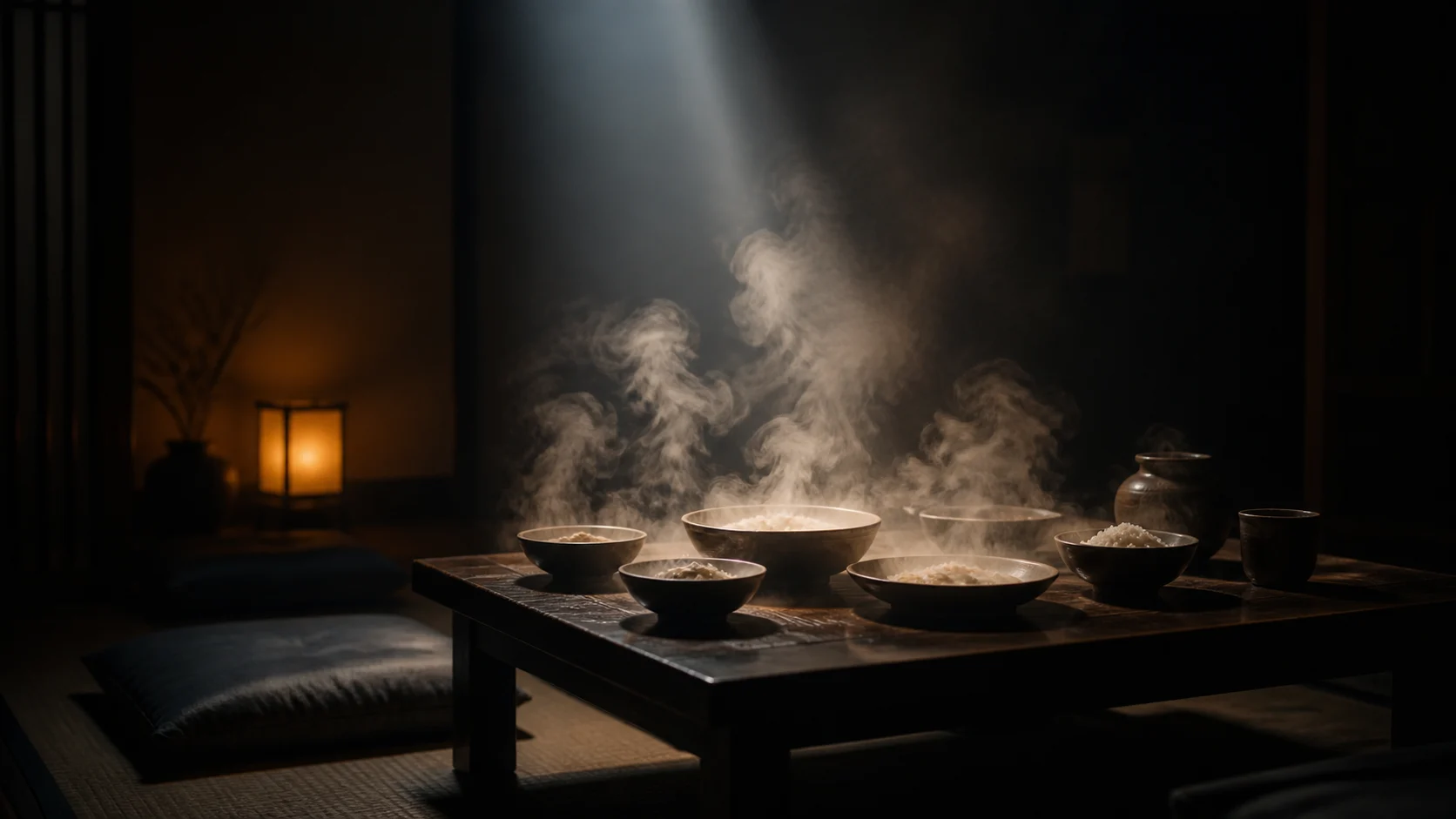
The eating itself was probably vivid.
But here's the strange part. You remember what you ate, but you can't remember what it tasted like. And that's actually the normal shape of this dream.
Let's start there. Tasting something in a dream is far rarer than most people assume.
Lumi
"Did you actually taste anything?
...You don't remember, right? That's normal.
Researchers analyzed 3,372 dreams and found taste showed up in about 1% of them.
If you tasted something, that's the unusual case."
Table of contents
Taste Shows Up in Roughly 1% of DreamsThe 'You Dreamed About Food Because You're Hungry' Line Isn't ConfirmedIf You're Managing What You Eat Right NowIn the Old Lists, Eating With Others Was the BaselineDid You Eat Alone, or With OthersWhat Kind of Scene Was ItTold HonestlyFrequently Asked QuestionsTaste Shows Up in Roughly 1% of Dreams
There's research surveying how often the senses appear in dreams. One study, from 1998, analyzed 3,372 dreams from 164 people.
Taste and smell each appeared in only about 1% of them.
Sight and sound show up in nearly every dream, while taste and smell turn up roughly once in a hundred.
A larger dataset tells a similar story. An analysis of over 28,000 dreams from a public dream database found taste experiences in roughly 200 of them — about 0.7%. Researchers searched by keyword and then confirmed each result by hand.
Ask people to recall from memory, though, and the numbers jump. Asked whether they had ever, in their whole life, had a dream involving smell or taste, about 33% of men and 40% of women said yes.
The two numbers are measuring different things. The first is how many actual recorded dreams included it; the second is whether it had ever happened at all, across a lifetime.
Put together, it comes out like this:
Roughly one in three or four people has had a dream where they tasted something at some point in their life. But in any given recorded dream, tasting something is rare — something like one in a hundred.
So if you remember that taste from last night, that puts you in the uncommon category.
The 'You Dreamed About Food Because You're Hungry' Line Isn't Confirmed

Search this dream and you'll almost always run into one explanation: you dreamed about food because you're hungry.
Plausible-sounding. But no study confirming this directly could be found.
There's no data showing how much food dreams increase before and after fasting or dietary restriction. No representative study directly comparing hunger and the frequency of food dreams has been confirmed either.
So this article won't present that as fact.
What can be said is this: there's a broader view that dreams connect to waking concerns, and this could be explained through that lens. But that's an explanation, not verification.
Yi Ik (이익), a late-Joseon-era scholar of the Silhak (Practical Learning) school, wrote in his essay "Monggamnon" ("On the Sensations Behind Dreams") that things touching the body during sleep can become part of a dream. It's an old observation, but it hasn't been confirmed with respect to food specifically either.
If You're Managing What You Eat Right Now
This part is worth addressing directly.
If you're dieting or managing your food intake and found this article after a food dream, there's something worth knowing first.
An increase in food dreams isn't a sign that something is wrong. As noted above, the idea that hunger itself increases food dreams was never confirmed in the first place.
One more thing. There is research on the dreams of people with eating difficulties — a study comparing 275 dreams total from 12 patients and 11 controls found that themes of food, weight, and self-criticism appeared more often in the patient group.
But this is a small, exploratory study with a very limited sample. And it should not be read as "frequent food dreams mean an eating disorder." That isn't what the finding means at all.
That's as far as the evidence goes.
That said, if concerns about eating have been weighing on you lately, or you feel a lot of guilt after eating, or managing your meals is making daily life difficult, that's a separate matter from the dream itself. Talking to a professional is the better path. It's common, and support is available.
This article won't suggest any particular meal size or goal. That isn't something to address here.
In the Old Lists, Eating With Others Was the Baseline
Turning to tradition, there's more material here than most dreams.
The classical Chinese dream manual known as the Zhougong Jie Meng (Duke of Zhou's Dream Interpretation — a dream-divination text with a long circulation history in China, distinct in lineage from Korean folk tradition) has a chapter grouping food, wine, meat, and vegetables together. A commonly circulated edition preserved on Chinese Wikisource contains lines like these:
- If you eat together with others, wealth and status are coming.
- If you drink water, great benefit will come.
- If guests arrive for a feast, the household is about to break apart.
- If a person of high rank hosts you at a banquet, illness will follow.
The first two and the last two run in opposite directions.
Eating together, plainly, is wealth and status. But a feast is inauspicious — and a banquet hosted by someone of high standing brings illness.
By today's sense of things, that's strange. Isn't that supposed to be the good seat at the table?
The old list's grammar explains it, though. The encyclopedia lays out two traditional attitudes toward dream interpretation — reading dreams as symbols, and reading dreams as the reverse of reality. Entries where a good-looking scene flips into misfortune belong to the second category.
This is the same grammar we found in our separate guide to family dreams — a couple sitting side by side at a banquet, and the conclusion was divorce.
So the summary here is this: the old list judged the occasion more than what was eaten.
The entry on dreams in the Encyclopedia of Korean Culture (a major reference work on Korean history and culture) doesn't have a confirmed independent entry for eating a meal in its folk-belief dream-interpretation list. Under the social-etiquette section, there's a line about inviting a guest to drink together bringing long life, alongside a neighboring line about drinking with a stranger bringing gossip.
The axis here is the same: who you ate with.
Did You Eat Alone, or With Others
This axis appears both in the old list and in today's searches — but it doesn't carry the same weight in each.
Traditional interpretation records eating with others favorably. But there's no confirmed entry specifically addressing eating alone. Either it wasn't considered anything special, or it was simply rare.
Read in modern terms, it's widely claimed that eating alone versus eating with others carries different psychological meanings. But no representative study confirming this has been found.
So this article won't write "eating alone in a dream means loneliness" as fact.
What can be said is this: if you remember who you were with, that's worth writing down. And the old list used that same axis, too.
What Kind of Scene Was It
This dream branches into quite a few distinct scenes.
You Ate Until You Were Full
Traditional interpretation places eating together on the side of wealth and status.
You Ate but Never Felt Full
You kept eating and it never ended, or you couldn't taste anything.
Read in modern terms, this reads less like a food story and more like a scene that won't resolve — the same structure as locking something only to find it open again, or packing a bag that never seems to empty.
You Couldn't Eat
The food was right there but you couldn't reach it, couldn't find a seat, or someone else ate it first.
Traditional interpretation has no direct entry here. But across several chapters, the old lists were generally organized around whether something was achieved or not.
The Food Was Spoiled
You realized it either after eating or before.
The most unsettling type to wake up from. No traditional entry lines up clearly here.
It Was a Feast
Traditional interpretation places this on the inauspicious side, as noted above — worth remembering precisely because it runs opposite to how it feels today.
You Drank Water
Traditional interpretation favors this. There's a line stating that drinking water brings great benefit.
If the water itself left the strongest impression, our separate guide to water dreams covers that too.
You Ate With Someone Who Had Passed Away
This belongs to a different category. The Korean folk-belief list includes an entry stating that if a deceased ancestor appears and offers food or speaks, good fortune follows.
We've covered this in more detail in our separate guide to dreams of the deceased.
You Clearly Tasted Something
As covered above, this is the rare case. If you remember what it tasted like, it's worth writing down.
Lumi
"One of those eight sounded familiar, didn't it?
The old list also cared less about what you ate than what kind of occasion it was.
That's a bit different from how we tend to search for this today."
Told Honestly
Lumi
"'You dreamed about food because you're hungry' — everyone says that.
It's never actually been confirmed. Plausible, but no evidence.
What we do have numbers for is how rare tasting actually is."
Traditional dream interpretation and modern research rely on different kinds of evidence.
What's confirmed. Taste and smell appear in roughly 1% of recorded dreams — around 0.7% in a large public database too. Asked to recall across a lifetime, about 33% of men and 40% of women report having had at least one dream involving smell or taste. The old lists recorded eating together as wealth and status, and a feast as inauspicious.
What isn't confirmed. There's no evidence that hunger increases food dreams. The claim that eating alone and eating with others carry different psychological meanings hasn't been verified either. There's no confirmed independent entry for eating a meal in the Korean folk-belief list.
The encyclopedia itself notes, after laying out its dream-interpretation list, that these readings emerged naturally from many people's experience rather than from any consistent theoretical foundation.
A few things are worth stating plainly.
A food dream doesn't predict wealth or a visitor. The old entries recording it as fortune are historical record, not prophecy.
It can't be said with certainty that hunger caused the dream, either. That hasn't been confirmed.
Frequent food dreams don't mean there's a problem with how you eat.
No verified connection exists between food dreams and lottery numbers, either.
Frequently Asked Questions
Is an eating dream a good-omen dream? The old list favored eating together with others. A feast, though, runs on the inauspicious side.
I couldn't taste anything. That's normal. Taste appears in roughly 1% of recorded dreams.
I could clearly taste something. That puts you in the uncommon category. Worth writing down what it was.
Was it because I'm hungry? That explanation is everywhere, but it's never actually been confirmed.
I ate alone. There's no old entry specifically addressing eating alone, and the modern reading hasn't been verified either.
There was a feast laid out. The old list read that inauspiciously — worth noting since it runs opposite to how it feels today.
I'm dieting and keep having food dreams. That alone isn't a sign of a problem. If eating is weighing on you emotionally, though, talking to a professional is the better path.
What's slightly unsatisfying about this dream is the missing taste. You ate well, but there's no sensory memory of what it was.
That's simply how it usually goes, though. Dreams are good at building sight and sound. The tongue, less so.
Today, there are three things worth writing down.
- Who you were eating with — this is the axis the old list drew its line on
- What kind of occasion it was — an ordinary meal, or a feast
- Whether you could taste anything
If the answer to that last one is yes, that was a one-in-a-hundred kind of night.
A dream with faint sensory detail tends to come into focus once you write it down.
If you couldn't taste anything, note that too — it's information. One line about who you were with will make it far easier to read later.
Dream Talisman looks at the dream scene you record together with your day stem (ilgan) in the Five Elements system, and turns it into a color and phone wallpaper for the day. It is less an app that interprets your dream for you than one that lets you write it down before it fades.
Record today’s dream in Dream Talisman
References
- 1998 study on sensory experience in dreams (164 people, 3,372 dreams) · Taste and smell each appeared in roughly 1% of reported dreams; recall surveys found about 33% of men and 40% of women reporting at least one lifetime occurrence. The two figures measure different things
- Analysis of over 28,000 dreams from a public dream database · Roughly 200 (0.7%) contained taste experiences, identified by keyword search and confirmed by hand
- Study comparing dreams of people with eating difficulties and controls (12 patients, 11 controls, 275 dreams) · A small, exploratory study; not generalizable
- Zhougong Jie Meng (Duke of Zhou's Dream Interpretation), commonly circulated edition — Chinese Wikisource · Passages from the food, wine, meat, and vegetables chapter. A classical Chinese dream-interpretation text, distinct in lineage from Korean folk records
- "Dreams" — Encyclopedia of Korean Culture · The folk-belief dream-interpretation list's social-etiquette entries, the two traditional attitudes toward dream interpretation, Yi Ik's "Monggamnon." No independent entry for eating a meal confirmed
- General research in modern sleep and dream psychology