
A mirror dream makes you check again once you wake up.
You stand in front of the bathroom sink and look at your face. In the dream it was unmistakably you, but something about it felt subtly off.
There's no shortage of old records about this dream. The trouble is, they contradict each other — directly.
Table of contents
The Same Dream Reads as Both Separation and SuccessChunhyang Also Dreamed of a Breaking MirrorWhat the Old Catalog Actually Tracked Was the Mirror's ConditionA Dream of a Breaking MirrorA Dream Where the Face in the Mirror Was DifferentA Dream of an Empty or Blurry ReflectionA Dream of Someone Else in the MirrorThe Most Honest AnswerFrequently Asked QuestionsThe Same Dream Reads as Both Separation and Success
The folk dream-interpretation section on household objects, part of the Dreams entry of the Encyclopedia of Korean Culture (a major reference work on Korean history and culture), records this line:
If a mirror breaks, a married couple will separate.
That's an inauspicious dream, and it's also a widely known interpretation.
But the same encyclopedia introduces a different story just before that entry, drawn from the Yongjae chonghwa (용재총화, a Joseon-dynasty essay collection).
Three scholars once dreamed different dreams on their way to a state examination. One dropped a mirror on the ground, one saw mugwort hung above a door, and the third dreamed of flower petals scattered by the wind.
They went to a dream interpreter, but he wasn't home — only his son was there. The son told them all three objects were inauspicious, and that none of them would get what they wished for.
The father came home shortly after, scolded his son, and reinterpreted the dreams in a poem. A mirror falling to the ground can't help but make a sound, he said. Mugwort is something people look up to, and fallen petals are followed by fruit, so all three men would make a name for themselves.
All three went on to pass the state examination.
Lumi
"It's the same mirror.
In one record, a couple separates. In another, someone passes a state exam.
Both are old records. And this isn't a one-off — it happens again and again."
Chunhyang Also Dreamed of a Breaking Mirror
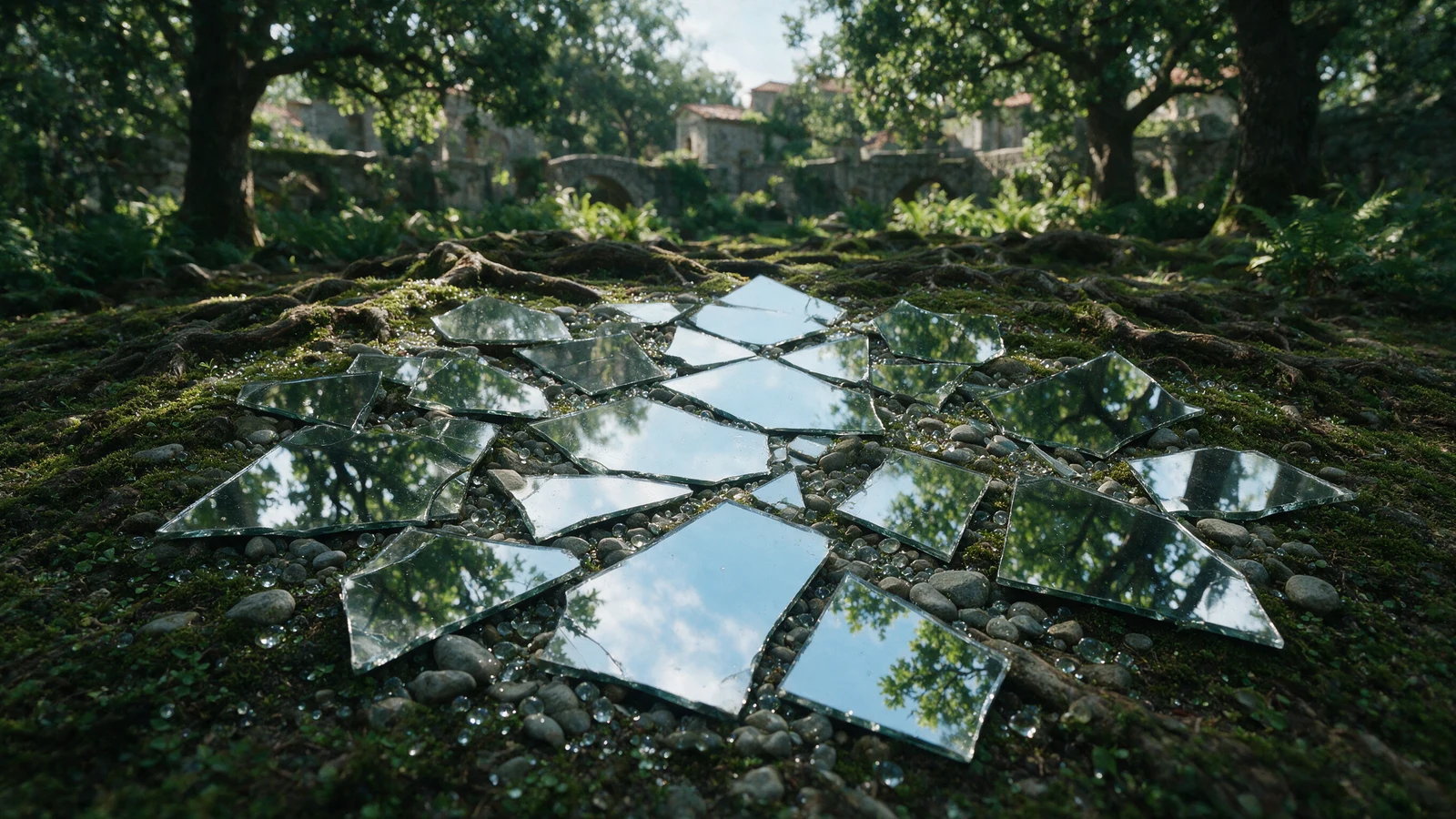
A mirror dream also appears in Chunhyangga (춘향가), the pansori and novel tradition known in English as The Tale of Chunhyang.
Chunhyang, imprisoned, has an ominous dream. Flowers fall, a mirror breaks, and a scarecrow hangs high above a door. She reads it as a dream foretelling her own death.
But the person who interprets it for her reads it the opposite way. Fallen flowers mean fruit is coming, a broken mirror means the two people who each keep half of it will reunite with an old bond, and a scarecrow hung high means rising to a position everyone looks up to.
The logic and even the poetic device closely mirror the Yongjae chonghwa story. The grammar of reading something ominous-looking in reverse shows up again and again.
The encyclopedia sums up this pattern separately: traditional dream interpretation followed two attitudes, one reading dreams as symbols, the other holding that dreams show the opposite of reality.
A breaking mirror sits exactly where those two attitudes collide head-on. The folk interpretation list read it symbolically and called it separation. The literary interpreters read it in reverse and called it a good omen.
If you ask which one is correct, the honest answer is that neither has ever been tested as a prediction.
What the Old Catalog Actually Tracked Was the Mirror's Condition
Gathering the entries from old Chinese dream manuals makes the underlying pattern clearer.
- A mirror that reflects brightly is auspicious; one that reflects dimly is inauspicious
- Seeing someone reflected in a broken mirror means that person will be scattered apart
What stands out in the first line is this: it isn't about what the face looked like. It's about whether the mirror itself was bright or dim.
The second line follows the same logic. The issue isn't the broken mirror itself, but who was reflected in it.
Put together, the old catalog's real questions were these:
- Was the mirror bright or dim
- Was it whole or broken
- Who was reflected in it
There's no entry asking about the identity of the face. The very thing we're most curious about today simply isn't addressed in the old catalog.
A Dream of a Breaking Mirror
Lumi
"If you had a broken-mirror dream and searched it online, you probably found the separation story.
That entry is real. It genuinely exists.
But the point of this article is that a success story sits right next to it."
This is the most-searched scene by far.
In traditional interpretation, the readings split exactly as described above. The Korean folk list records it as a married couple's separation, while literary interpreters reversed it — reading the sound of breaking and the sharing of two halves as a sign of reunion.
The separation reading also appears in our ex-lover dream guide. The old catalog tended to treat a broken or misaligned image as its condition for reading a parting.
From a modern psychological perspective, a shattered image is often read as an image of not appearing whole — something split into fragments.
What differs here is the feeling attached to the moment.
- Were you startled
- Did it feel like a loss
- Did you feel nothing at all
If the third one stayed with you, that's information too. Dreams without much attached emotion aren't unusual.
A Dream Where the Face in the Mirror Was Different
This is the version that lingers longest after waking. You were certain it was you, but the face didn't match.
In traditional interpretation, there's no entry for this. As covered above, the old catalog tracked the mirror's condition, not the identity of the reflection.
From a modern psychological perspective, this is better explained as a general feature of how dreams work. The encyclopedia itself explains that dream imagery forms through condensation and displacement — two or more elements combined and swapped, then attached to something else entirely.
That's why, inside a dream, your sense of identity and your actual face operate independently. You can be certain it's you even when the face doesn't match, or recognize someone even when their face is missing entirely. The same thing happens in dreams about unfamiliar people, covered in our stranger dream guide, not yet available in English.
That said, this article won't take the extra step of endorsing a common claim: "the face in the mirror is your true inner self" is a widely circulated explanation, but it's a specific theory's interpretation, not a confirmed fact.
If there's something worth paying attention to, it's this — not that the face was different, but how you felt seeing it. Frightening, unfamiliar, or, just as easily, something you actually liked.
A Dream of an Empty or Blurry Reflection
This covers standing in front of a mirror and seeing nothing, or a reflection that was hazy or rippled like water.
In traditional interpretation, there's an entry tied to brightness. A mirror that reflects brightly is auspicious; one that's dim is inauspicious. The dim, unclear version wasn't read favorably.
From a modern psychological perspective, a reflection that won't come into focus is often read as a state that hasn't been decided yet — something that shows up while you're in the middle of a decision or a transition.
Text and small details are also commonly unreadable in dreams generally. A blurry face in a mirror may belong to that same category.
A Dream of Someone Else in the Mirror
This covers standing in front of the mirror and seeing someone else reflected, or seeing a face when no one else was actually there.
In traditional interpretation, there's one relevant entry: seeing someone reflected in a broken mirror means that person will be scattered apart. It's a rare case where the mirror and a person are addressed together.
From a modern psychological perspective, the identity of that person isn't information about them specifically. A figure appearing in a dream is an image assembled from your own memory.
So it's best not to read meaning into it, or reach out to that person, just because they showed up in a dream.
If their hairstyle looked different, our haircut dream guide is also worth checking — the two often appear together.
The Most Honest Answer
Lumi
"The idea that a broken mirror means separation — that's true, that entry exists.
But people from the same era also recorded passing a state exam from the same dream.
Both records survived. Picking just one and calling it the answer would be dishonest."
Traditional dream interpretation and modern psychology draw on different kinds of evidence. And on this topic, the tradition itself splits head-on.
What the old records confirm is this: readings depended on whether the mirror was bright or broken, and who was reflected in it, and both a reading and its exact opposite survive for the same scene.
The encyclopedia, after laying out its full list of interpretive methods, states plainly that these readings formed naturally out of many people's lived experience, not from any consistent theoretical foundation. The same pattern shows up in the King Wonseong account in the Samguk Yusa (Memorabilia of the Three Kingdoms), where the same dream was read by different interpreters as both losing a position and ascending to the throne.
A few points are worth stating clearly.
A broken mirror doesn't mean a couple will separate. That entry exists, but its predictive power was never verified, and a record with the exact opposite reading survives right alongside it.
The claim that a mirror reveals your true inner self isn't a confirmed fact either. It's simply a widely circulated interpretation.
Seeing a different face isn't strange in itself. Inside a dream, your sense of identity and your actual face operate independently.
There's no confirmed connection between mirror dreams and lottery numbers.
Frequently Asked Questions
Is a broken-mirror dream a bad-omen dream? The Korean folk list records it as a married couple's separation. But the Yongjae chonghwa and The Tale of Chunhyang both preserve records reading the same scene as a good omen.
The face in the mirror wasn't mine. There's no old entry for this scene. Inside dreams, your sense of identity and your actual face commonly operate independently.
Nothing was reflected at all. The old catalog tracked brightness — a dim or unclear reflection wasn't read favorably. Modern readings often connect this to a state that hasn't been decided yet.
Someone else appeared in the mirror. It isn't information about that specific person. Figures in dreams are images assembled from your own memory.
I was smiling in the mirror. No old entry addresses facial expression specifically. How you felt seeing it is the more useful thing to note.
I cleaned up the broken mirror. There's no entry covering that action either. But if a sense of wanting to put things back in order stuck with you, that feeling itself is worth noting.
Mirror dreams stay with people because they're easy to check. The moment you wake up, you can just stand in front of a real mirror.
And most of the time, nothing is wrong. That act of checking is part of what makes this dream memorable.
Three things worth writing down today:
- What condition the mirror was in — bright, dim, or broken
- Who was reflected in it
- What you felt seeing it
That third one usually tells you the most.

A dream that leaves an uneasy feeling loses some of its grip once you write it down.
While it stays in your head, the face keeps shifting. Put it into a sentence, and it holds still.
Dream Talisman looks at the dream scene you record together with your day stem (ilgan) in the Five Elements system, and creates a color and phone wallpaper for the day. It's less an app that interprets your dream for you than one that helps you write it down before it fades.
Record today’s dream in Dream Talisman
References
- "Dreams" — Encyclopedia of Korean Culture · The folk dream-reading household-object entries, the Yongjae chonghwa story of three scholars, the explanation of condensation and displacement in dream imagery, the two traditional attitudes toward dream interpretation, the King Wonseong dream-interpretation case in the Samguk Yusa
- Original-edition Zhougong Jie Meng body/object entries — Mirror-related passages. These are commonly quoted lines rather than a checked original edition. This is a Chinese dream-interpretation tradition with a different textual lineage from Korean folk records
- The Tale of Chunhyang (춘향전), the prison-dream and interpretation passage — Details vary across different editions of the text
- General research in modern sleep and dream psychology