
You probably checked your finger first.
The moment you woke up, you checked and it was still there. But in the dream, it had clearly slipped off, no longer fit, or vanished somewhere. That sensation lingers for the rest of the day.
It feels heavier if the ring was a wedding ring. You start wondering whether it means something is wrong.
Open an old dream manual, though, and the ring turns up in an unexpected place.
Lumi
"Do you know which chapter rings were filed under in old dream manuals?
Mirrors, hoops, hairpins, bracelets, combs.
Those five belong together. And the chapter is really governed by the mirror."
Table of contents
Small Things Worn on the Body Were Grouped TogetherBut a Standalone Ring Entry Is Hard to FindWhat Happened to the RingObjects in Dreams Are Naturally BlurryIf It Was a Wedding RingThe Most Honest AnswerFrequently Asked QuestionsSmall Things Worn on the Body Were Grouped Together
The commonly circulated Zhougong Jie Meng (the Duke of Zhou's dream manual, a family of traditional Chinese dream-interpretation texts) sorts its entries into 27 chapters. The tenth chapter covers mirrors, hoops, hairpins, bracelets, and combs.
Rings aren't a standalone entry — they sit inside this chapter. And everything grouped together here shares one trait.
They're all small objects worn on the body. And they all have a fixed shape, so damage to them is immediately obvious.
The best-known line in this chapter concerns mirrors.
- A bright reflection in a mirror is auspicious; a dim one is inauspicious
- Seeing someone reflected in a broken mirror means separation
The tool-related dream entries in the "Dreams" entry of the Encyclopedia of Korean Culture (a major reference work on Korean history and culture) carry the same idea: a broken mirror means a married couple will separate. The same entry lists seeing scissors as a sign that wealth is coming.
That's where the underlying logic shows itself. This chapter was really asking whether something stayed whole or not.
Cracked, split, or broken read as the bad sign. Rings belonged to that same group.
We cover mirrors on their own in our mirror dream guide — an interesting case where two records read the exact same scene in opposite directions.
But a Standalone Ring Entry Is Hard to Find

Let's be honest here.
Mirrors get multiple entries, but a passage devoted to rings alone is hard to confirm. The Encyclopedia of Korean Culture doesn't list one either.
There's a reason for that. What we think of today when we picture a ring — a promise, a marriage, a token of a relationship — is a more recent idea than it seems.
Korea did have gakkaji, traditional paired rings, since long ago. But their use was different from today's, and the modern custom of exchanging rings as a marriage token spread more widely after the modern era began.
So the claim that "a ring dream means marriage luck" isn't backed by old records. Some modern dream sites say it anyway, but that idea comes from somewhere else.
Standard scales used to survey typical dream themes don't include a ring item either. No data measuring how often this dream occurs has been confirmed.
This dream is really one you can only read through a modern lens.
What Happened to the Ring
If there's anything genuinely worth reading in this dream, it's here. And the scenes vary quite a bit.
As covered in our lost belongings dream guide, the old catalog based its conclusions on what the object stood in for. An official's hat stood in for a position, so losing it meant losing that position; a mirror reflected a partner, so a broken mirror meant the partnership broke.
Asked the same way here: what did that ring stand in for?
It Slipped Off
It had loosened on your finger and slipped off, or came loose while you were washing your hands.
This is the most commonly searched version. Read in a modern light, this differs from losing something outright. It's still nearby. Most dreamers try to find it right away within the dream.
It Was Lost and Never Found
You don't even know where it slipped off, and it never turns up.
This differs in tone from the scene above. Here, the act of searching takes up most of the scene.
It Broke or Cracked
This is the scene closest to the old catalog's real axis. In this chapter, the inauspicious side wasn't losing something — it was breaking.
Still, that's how people of that era read the world. It doesn't mean anything is actually about to happen.
It Didn't Fit
It wouldn't go on your finger, was far too loose, or looked like it belonged to someone else.
Read in a modern light, this isn't about the object — it's about the sensation of something not fitting. It overlaps with the theme of clothes not fitting in a dream.
You Received It
Someone put it on your finger, or gave it to you as a gift.
The closest traditional entry to this scene involves receiving an official robe or new clothing, which reads favorably overall. It just isn't specifically about rings.
You Gave It, or Took It Off and Returned It
Giving is a different scene from receiving. And the act of taking it off tends to stick in memory on its own.
You Saw Someone Else's Ring
Whether or not the other person was wearing one, or it was a ring you'd never seen before.
This isn't information about that person. Every figure in a dream is a composite image assembled from your own memory.
Lumi
"One of those seven rang true, didn't it?
Slipping off, breaking, and not fitting are all different scenes.
What the old catalog weighed most heavily was breaking."
Objects in Dreams Are Naturally Blurry
This part is worth mentioning directly.
If you woke up wondering "was that actually my ring," that's a common experience.
A study analyzing dreams featuring clocks found that clocks appeared in only 0.74% of roughly 12,000 dreams — but the more notable finding was what came next. Most of the clocks in those dreams weren't the actual clock the dreamer used every day.
That's true even for an object worn every single day.
So the ring in your dream was likely different from your actual ring too — a different shape, a stone that wasn't really there, a color that didn't match.
That doesn't mean it's meaningless, though. The fact that you experienced it as a ring is itself information — worth noting, along with whose ring it was connected to.
If It Was a Wedding Ring
Many readers come looking specifically for this section, so it gets its own space.
Let's say this up front. There's no evidence this dream means anything is actually wrong in a relationship. It isn't a prophetic dream.
It's true that the old catalog includes an entry where a broken mirror means a married couple will separate. But a record exists of the exact same scene read the opposite way. The Yongjae chonghwa (a Joseon-dynasty essay collection) tells of three scholars who dreamed of dropping a mirror, reading it as a mirror breaking makes a sound, so your name becomes known — and that dreamer went on to pass the state examination.
Two records from the same era point in opposite directions. Quoting only one of them turns it into a false claim.
The Encyclopedia of Korean Culture notes that dream interpretation followed two different attitudes: reading dreams as symbols, and reading dreams as the reverse of reality. There was no fixed rule for choosing between them.
So it's best not to reconsider a relationship based on this dream, or bring it up with your partner. Doing so would only make the other person anxious for no reason.
If anything is worth examining, it's how you felt after waking — anxious, relieved, or unaffected. That reflects something that was already there, rather than new information the dream provided.
If the wedding scene itself was what stuck with you, we cover that separately in our wedding dream guide, not yet available in English.
The Most Honest Answer
Lumi
"Search for 'ring slipping off dream' and you'll find plenty of claims that it predicts a breakup.
A standalone ring entry is hard to confirm in the old catalog.
There is a mirror entry, though — and even that one has two opposite readings of the same scene on record."
Traditional dream interpretation and modern research rely on different kinds of evidence. This particular topic has thin direct evidence on both sides.
What's confirmed. In old dream manuals, rings were grouped in the same chapter as mirrors, hairpins, bracelets, and combs, and that chapter turned on whether an object stayed whole or broke. The Korean folk catalog also includes an entry where a broken mirror means a married couple will separate. Objects that appear in dreams are frequently not the actual object the dreamer uses.
What isn't confirmed. A standalone ring entry is hard to confirm. There's no evidence that a ring dream predicts marriage or separation. No standard dream-theme scale includes a ring item.
The encyclopedia itself notes, after laying out its list of dream-reading methods, that such interpretations formed naturally from many people's experiences rather than from a consistent theoretical basis.
A few points should be made clearly.
A ring slipping off in a dream doesn't predict a breakup.
Receiving a ring in a dream doesn't predict a marriage, either.
It's best not to treat a partner differently because of this dream.
There's no verified connection between a ring dream and lottery numbers.
Frequently Asked Questions
Is a ring slipping off in a dream a bad-omen dream? A standalone ring entry is hard to confirm in the old catalog, so there's no basis for calling it good or bad luck. The chapter it belongs to weighed breaking more heavily than losing.
I lost my wedding ring in the dream. It isn't a prophetic dream. How you felt after waking is really the only thing worth reading here.
The ring broke or cracked. This is the scene closest to the old catalog's actual axis. Still, that reflects how people of that era read the world, and it has never been tested for predictive accuracy.
I received a ring. There's no traditional basis specific to rings. Receiving new clothing or an official robe reads favorably in the old catalog, but that isn't about rings.
It didn't feel like my ring. That's common. Objects that appear in dreams are frequently not the actual object the dreamer uses.
It didn't fit my finger. The sensation of something not fitting is more informative here than the object itself.
Should I mention it to my partner? Better not to. There's no reason to make someone anxious over something that isn't real information.
This dream tends to stick in memory because it's so easy to check. You just look at your hand the moment you wake up. And it's almost always fine.
That checking is part of the dream itself.
Three things worth writing down today:
- What happened to the ring — did it slip off, get lost, break, or not fit
- Whose ring it was connected to
- How you felt when it broke or disappeared
The second point is the most useful part of this dream. The old catalog, too, based its conclusions on what an object stood in for.
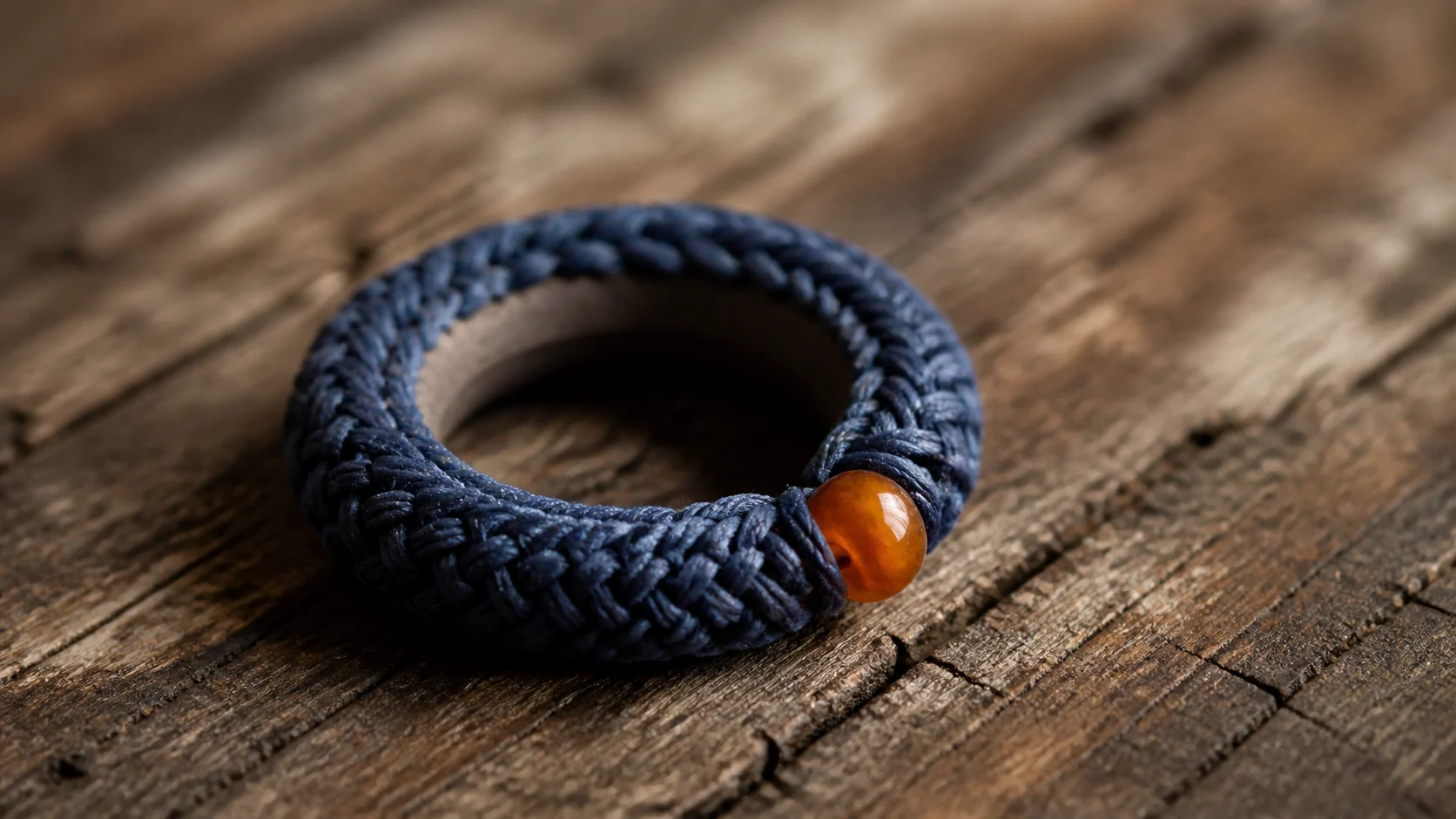
A dream where only a single small object remains is easy to write down.
Just add one line about what kind of ring it was. Collect a few weeks of these, and you'll start to notice whether the same object keeps recurring.
Dream Talisman looks at the dream scene you record together with your day stem (ilgan) in the Five Elements system, and creates a color and phone wallpaper for the day. It's less an app that interprets your dream for you than one that helps you write it down before it fades.
Record today’s dream in Dream Talisman
References
- Zhougong Jie Meng — "Mirrors, Hoops, Hairpins, Bracelets, and Combs" chapter · covers this chapter's structure and the mirror-related lines. This reflects commonly circulated lines rather than a checked original edition, and is a Chinese dream-interpretation tradition with a different textual lineage from Korean folk records. A standalone ring entry is hard to confirm
- "Dreams" — Encyclopedia of Korean Culture · the folk dream-reading tool catalog, the Yongjae chonghwa account of three scholars' mirror dream, and the two attitudes toward dream interpretation. A ring entry is not confirmed
- Schredl, M. (2021), "Clocks in Dreams," Clocks & Sleep 3(4) · an observation that objects appearing in dreams are often not the actual object the dreamer uses
- Nielsen, T. A. et al. (2003), "The Typical Dreams of Canadian University Students," Dreaming 13(4) · no ring-related item appears among the 55 items
- General research in modern sleep and dream psychology