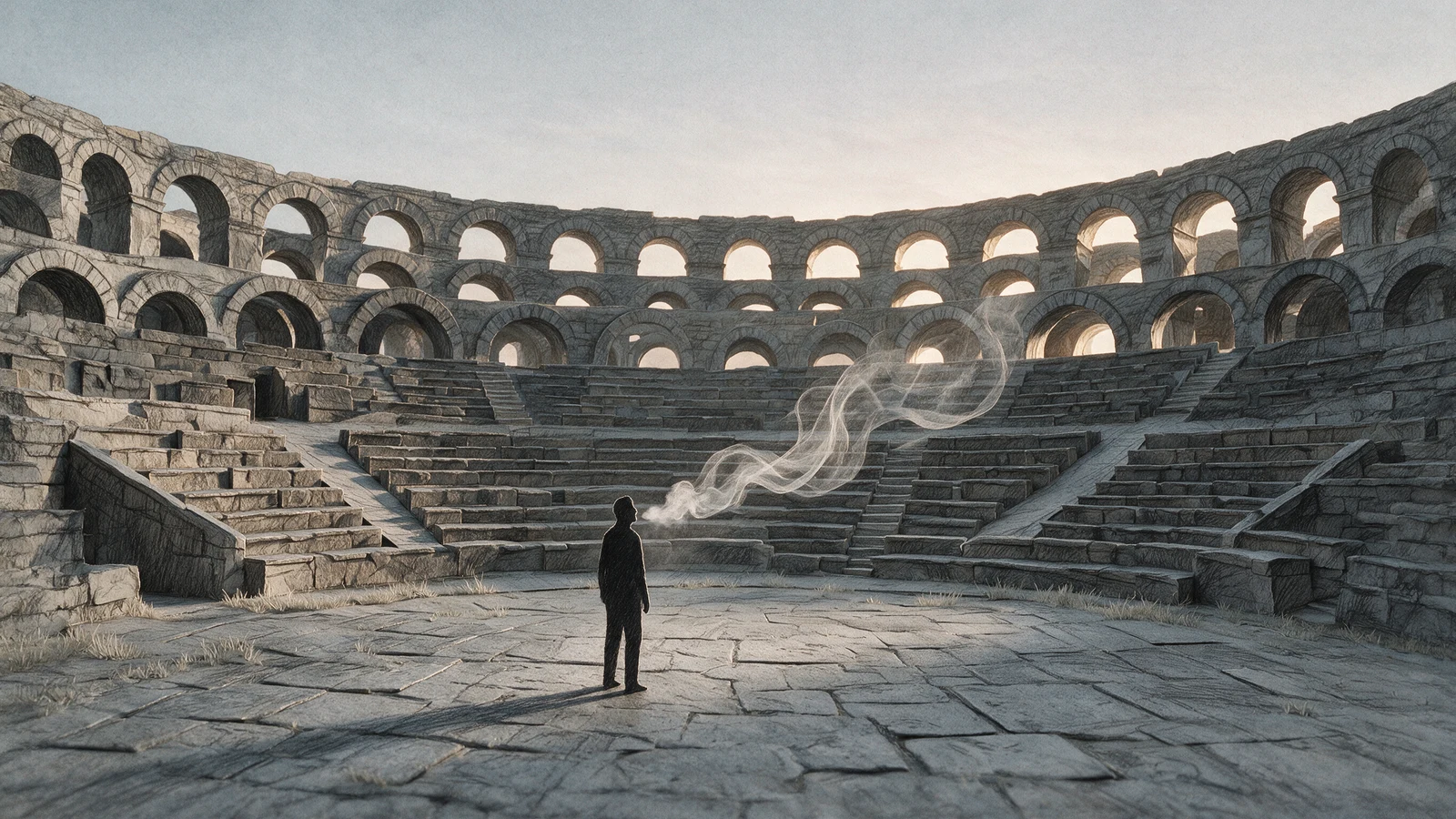
You tried to scream.
The breath was there, but nothing came out of your throat. You tried to call a name and only your mouth moved. You pushed with everything you had, and only air leaked out. That helplessness stays with you long after you wake.
People who search for this dream usually want to know the same thing: does this mean I can't do something in my life?
Before getting to that, there's something to check first. This might not have been a dream at all.
Table of contents
There Is a State Where You Genuinely Cannot Make a SoundWhen That Happens, Check Your Sleep Before You Check the DreamWhen Your Body Moved but Only Your Voice FailedPeople Lost Their Voice in Dreams 400 Years Ago TooThe Old Interpretation Catalog Has No Entry for ThisThe Dream of Shouting and No One HearingThe Dream of Needing to Flee, and No Sound Coming OutThe Honest AnswerFrequently Asked QuestionsThere Is a State Where You Genuinely Cannot Make a Sound
Around the moment of falling asleep or waking up, there's a state where your mind is fully alert but your body won't move and no sound comes out. In Korea, people have long called this being "pressed by a ghost" (gawi-nul림, a folk term for sleep paralysis).
Medicine explains this as sleep paralysis. During REM sleep, your muscles stay in a relaxed, powerless state, and if consciousness wakes up before that state has fully released, this happens. A meta-analysis covering 76 studies and roughly 167,000 people found that this experience is reported far from rarely.
It has a few defining features.
- You're conscious, but your body won't move
- You try to make a sound, and nothing comes out
- There's a sensation of pressure on your chest
- You may sense a presence or hear sounds that aren't there
- It typically resolves within seconds to a few minutes
If any of this sounds familiar, this isn't a dream to interpret — it's something that happened to your body.
Lumi
"Wait, let me check one thing first.
Were your eyes open, but your body wouldn't move?
Could you see the room, and did you know you were already awake?
…If so, this isn't a dream-interpretation question. Keep reading below."
When That Happens, Check Your Sleep Before You Check the Dream
Sleep paralysis isn't dangerous on its own, but if it keeps recurring, it can make you afraid to fall asleep, which then damages your sleep further.
It's especially worth paying attention if these show up together.
- Delaying sleep because you've become afraid of it
- Daytime sleepiness that's hard to manage
- Repeated experiences of hearing or seeing things that aren't there
- Inconsistent sleep schedule
If this describes you, it's worth consulting about your sleep rather than trying to interpret the dream. When sleep breaks down, heavier dreams tend to increase. That's the order it usually happens in.
And this isn't strange or rare. There's no need to be frightened by it.
When Your Body Moved but Only Your Voice Failed
From here on, this is genuinely a dream question.
You were somewhere else, not your bedroom — walking or running — but your voice wouldn't come. This is different from sleep paralysis. It happened inside the dream itself.
Lumi
"Who were you trying to talk to?
That matters more than you'd think. Most people remember.
And who that person was is usually half the answer."
From a modern psychology perspective, this scene is generally read as an image of trying to do something and being unable to. But one widely circulated claim needs to be filtered out here.
The idea that "a voiceless dream means you're holding in a secret" is not a verified fact. It's one symbolic interpretation among others, and treating it as settled can manufacture a problem that isn't actually there.
What you can actually check instead is this.
- Who were you trying to speak to
- Do you remember what you were trying to say
- Did the other person not hear you, or did your voice simply not come out
The third question is the fork in the road. Not being heard and not being able to make a sound are different scenes.
People Lost Their Voice in Dreams 400 Years Ago Too

Jeong Cheol (정철, a mid-Joseon poet and government official, circa 1585), wrote a dream passage into his poem "Sok Miin Gok" ("Song of the Beautiful One, Continued"). The Dreams entry of the Encyclopedia of Korean Culture (a major reference work on Korean history and culture) cites this passage as a classic example of a dream appearing in Korean poetry.
The speaker finally meets someone they've longed for in a dream. The person's face has aged beyond how they remembered it. And just as the speaker tries to say everything they've been holding onto, tears kept coming and the words wouldn't come out. Their throat closed up before they could say what they meant, and then a rooster's crow woke them.
That's a 400-year-old record, but the structure is identical to today's. They met, there was something to say, they couldn't say it, and they woke up.
That means this dream isn't unusual at all. The context around former lovers is covered separately in our ex-lover dream guide.
The Old Interpretation Catalog Has No Entry for This
Let's be honest here.
Neither the eight-category folk interpretation catalog in the Encyclopedia of Korean Culture, nor the body-related chapter of the old Chinese dream manuals, has a confirmed entry for losing one's voice.
The closest related entries deal with voices and sound in general, but they're usually about someone else crying, singing, or a bird calling — not a scene where you yourself can't speak.
So this dream's auspicious or inauspicious meaning can't be found in the old records. Modern dream-interpretation sites make various claims about it, but none of them are backed by traditional texts.
This dream can only be read in modern terms. And as shown above, a good portion of these cases aren't interpretation material at all — they're a sleep phenomenon.
The Dream of Shouting and No One Hearing
Here, the words came out, but the other person didn't react. Someone nearby doesn't seem to hear you, or their reply comes back completely off-topic.
From a modern psychology perspective, this belongs to a different category than the scene above. It's not framed as your own problem — it's framed as a problem of transmission.
It's often noted that conversations in dreams rarely stay coherent from start to finish. So a mismatched exchange isn't necessarily a special signal — it may just be how dreams tend to construct themselves.
That said, if you're currently in a situation where communication genuinely isn't landing, that feeling can bleed into the dream. Being repeatedly overruled in meetings, or repeating the same point at home without being heard, are common triggers.
The Dream of Needing to Flee, and No Sound Coming Out
This is the most frightening combination — being chased by something while your voice won't come and your legs won't move.
A survey of typical dream experiences among 500 Korean adults found that event-driven scenes like being chased or falling were reported at high frequency. That means this is a common dream.
From a modern psychology perspective, this combination is usually read as a sensation of being outside your own control — a body that won't obey you.
If the chase felt like the stronger part of the dream, our chase dream guide covers that separately.
And if this scene keeps recurring, it's worth checking your sleep again, as covered above. Experiences during the REM transition period can bleed into dream content.
The Honest Answer
Lumi
"Search for voiceless dreams and you'll find plenty of claims that it means you're holding in a repressed secret.
That's not a verified fact.
But a state where your body genuinely can't move is verified. It has a name, and there's research behind it.
It's worth reading this one in a different order than usual."
This topic needs to be handled a little differently from other dreams, because a substantial share of it isn't interpretation material at all — it's a sleep phenomenon.
Let's separate what's confirmed from what isn't.
What's confirmed. Around the edges of sleep, there's a state where consciousness is present but the body won't move and no sound comes out. It's explained by REM muscle relaxation overlapping with waking consciousness, often accompanied by fear, chest pressure, or sensing something that isn't there.
What isn't confirmed. There's no evidence that this dream predicts anything. The idea that it reflects repressed emotion or a hidden secret isn't a settled fact either. The old interpretation catalog has no entry for it at all.
A few points should be made clearly.
A voiceless dream is not an inauspicious dream. There's no old record assigning it an auspicious or inauspicious reading.
It doesn't mean someone is holding you down, either. "Pressed by a ghost" is an old expression, but the actual explanation for the state belongs to sleep science.
This dream can't tell you about your health or your future. But if it keeps recurring, that's reason enough to look at your sleep.
There's no verified connection between this dream and lottery numbers.
Frequently Asked Questions
I tried to scream and nothing came out. If it happened inside a dream scene, this is a common type. If your eyes were open but your body wouldn't move, it may be sleep paralysis.
Was I being pressed by a ghost? That's an old expression. Today it's explained as sleep paralysis — a state where consciousness and muscle relaxation overlap.
This keeps happening to me. Recurrence can make bedtime frightening, which damages sleep further. If you're severely sleepy during the day or have become afraid to fall asleep, a sleep consultation is worth considering.
Does this mean I'm holding something in? That's one interpretation, but it isn't a verified fact. It's best not to treat it as settled.
What do the old dream-interpretation catalogs say about this? There's no entry at all. We won't manufacture one where none exists.
I spoke, but the other person didn't hear me. That's a different category. Conversations rarely stay fully coherent in dreams to begin with.
The reason this dream feels so frightening is that the sensation was real. Your throat genuinely tensed, and genuinely nothing came out.
So being scared by it isn't strange at all.
Three things worth writing down today:
- Were your eyes open — could you see the room, or were you somewhere else
- Who were you trying to speak to
- How did you feel when you woke up
The first question matters most. That's where the line falls between a dream and a sleep phenomenon.
If the same dream keeps returning, our recurring dream guide covers that pattern as well.

A frightening dream shrinks once you write it down.
For this dream especially, noting the interval helps. Collect a few weeks of entries and it usually overlaps with periods when you weren't getting enough sleep.
Dream Talisman looks at the dream scene you record together with your day stem (ilgan) in the Five Elements system, and creates a color and phone wallpaper for the day. It's less an app that interprets your dream for you than one that helps you write it down before it fades.
Record today’s dream in Dream Talisman
References
- A systematic review and meta-analysis of sleep paralysis · 76 studies, roughly 167,000 people combined. REM muscle relaxation overlapping with waking consciousness, accompanying experiences and frequency
- "Dreams" — Encyclopedia of Korean Culture · The dream passage in Jeong Cheol's "Sok Miin Gok," the eight-category folk interpretation catalog (no matching entry found)
- Study on typical dream experiences among Koreans · Reporting frequency of event-driven dream scenes among 500 adults surveyed
- General research in modern sleep and dream psychology