
You were probably out of breath.
Mountain dreams stay in the body. Your legs felt heavy, you kept looking up, and the summit was in sight but never seemed to get closer. Or maybe you'd already reached the top and were looking down.
This dream takes up a lot of space in the old catalogs. Geography, mountains, rocks, and trees are grouped into a single chapter, and within it, mountains split into several distinct readings.
And the line they draw is different from how we tend to think about it today.
Lumi
"Did you make it to the top? That's probably what you'd expect me to ask.
But the old entries don't go that far.
They only ask one thing — did you fall while climbing?"
Table of contents
Nearly Every Climbing Entry Is FavorableWhat's Unlucky Is Falling or CollapsingMountains Appear in Korean Records TooIf You Searched Here for a TaemongWhat Kind of Mountain Was It?If What Stayed With You Was Physical FatigueThe Most Honest AnswerFrequently Asked QuestionsNearly Every Climbing Entry Is Favorable
Gathering the mountain-related passages from the Wikisource text of the Chinese Zhougong Jie Meng (Duke of Zhou dream manual tradition), a clear pattern emerges.
- Climbing a high mountain brings great fortune
- Entering the body of a mountain means favorable outcomes in all matters
- Living on a high mountain brings joyful events
- Finding wealth on a mountain path brings prosperity
- Climbing onto a rock and holding a stone means a transfer to a new post
- Climbing a mountain while carrying something means conceiving a noble child
Almost all of it is favorable. Climbing is good, and simply being inside the mountain is good.
None of these entries, though, separately asks whether you actually reached the summit. They don't distinguish between still climbing and having already arrived.
That's exactly where this diverges from how we read it today. We tend to treat reaching the summit as the marker of achievement, while the old catalog was concerned with the state of being up high itself.
We noted something similar in our stairs dream guide, not yet available in English: there's no dedicated entry for stairs at all, and every climbing-related entry instead concerns mountains, trees, and rooftops.
What's Unlucky Is Falling or Collapsing
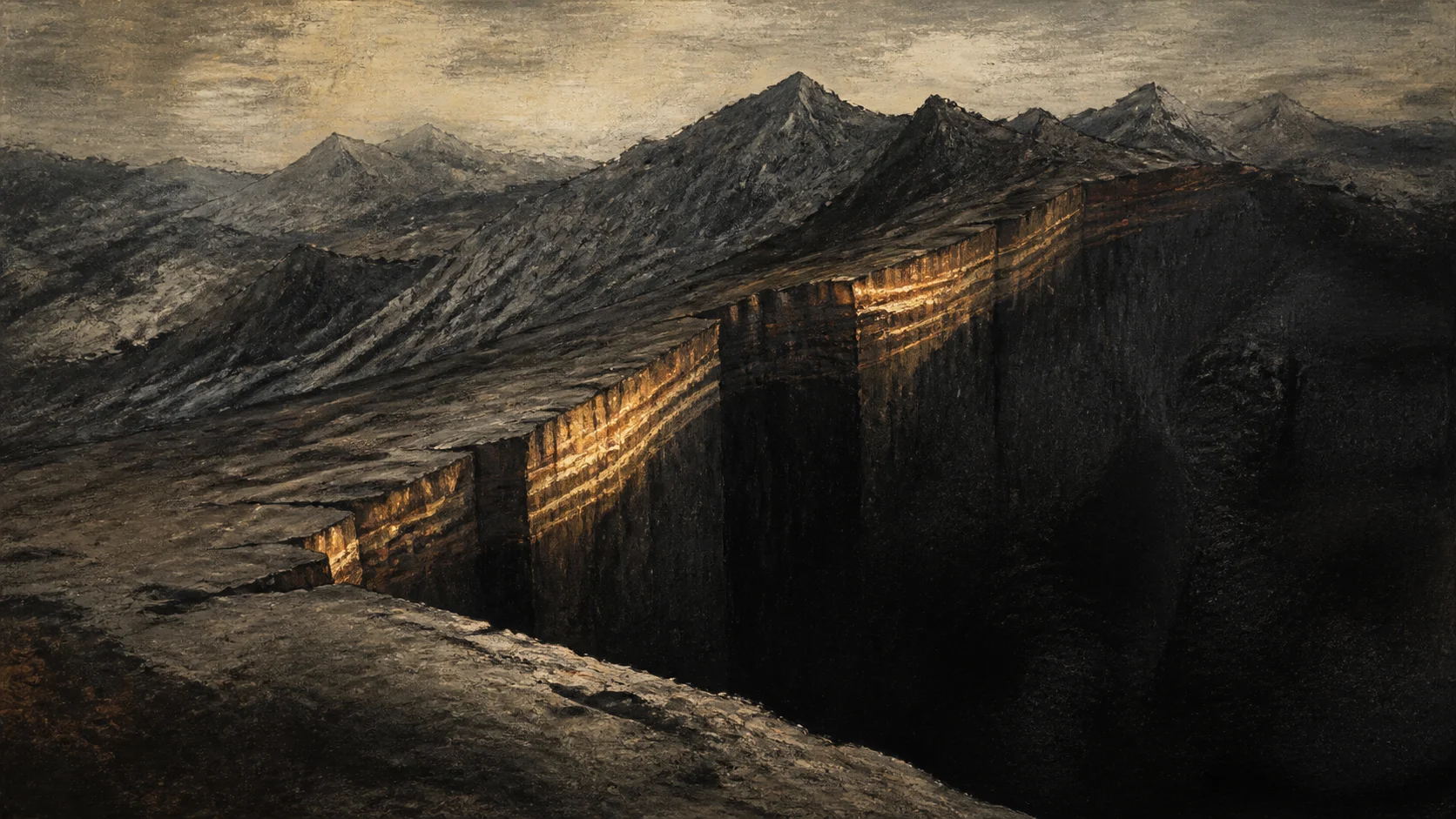
Looking at the unlucky passages in that same chapter tells a different story.
- Climbing a mountain and then falling to the ground means losing your position
- Climbing a mountain and having it collapse is a violent, unlucky sign
- Climbing a tree and having it suddenly snap means injury or death
All three share the same structure. You climb, and then the ground gives out beneath you.
There's no entry anywhere that reads the act of climbing itself as unlucky.
So the order for working through this dream is as follows.
- Did you fall, or did something collapse? This is the line the old catalog actually drew.
- Where were you — climbing, at the summit, or inside the mountain?
- What was your feeling at the time?
If the answer to the first question is no, the old catalog reads this dream favorably in most cases.
Read in a modern light, a scene where the ground gives way beneath you is sometimes connected to whatever has been holding you up. One explanation ties an uptick in scenes like this to periods that feel like more than you can handle.
If the sensation of falling was strongest, see our falling dream guide. If the ground itself split open, see our earthquake dream guide.
Mountains Appear in Korean Records Too
The natural-object section of the folk dream-interpretation list in the Dreams entry of the Encyclopedia of Korean Culture (a major reference work on Korean history and culture) includes this line:
If you climb a mountain and it collapses, something unlucky will happen.
This matches the tone of the Chinese passages. It isn't the climbing that's unlucky — it's the collapsing.
The same catalog also includes a line stating that rising into the sky brings a high government post. Both traditions treat upward movement as favorable.
We cover that passage in our sky dream guide, not yet available in English.
This is one of the rare topics where the two traditions agree so closely. As noted earlier in our tree dream guide, not yet available in English, five of six plant-related entries overlapped between the two records — and mountains belong to that same family.
If You Searched Here for a Taemong
The list above includes this line: climbing a mountain while carrying something means conceiving a noble child.
What's worth noticing here isn't the mountain — it's that you were carrying something.
The taemong entry of the Encyclopedia of Korean Culture makes this point when summarizing taemong (conception dream) characteristics: whatever form a taemong takes, it almost always involves physical contact — the object enters your arms, you carry it, or you bite into it.
Mountains aren't separately classified as taemong imagery on their own. The condition is the act of carrying something while climbing.
Either way, no dream can tell you whether you're pregnant or reveal your child's sex. Taemong stories are usually attached after the fact. Taemong dreams more broadly are covered in our baby dream guide.
What Kind of Mountain Was It?
This dream splits into quite a few distinct scenes.
You Were Climbing
The most common form. It usually comes with the sensation that the end was never in sight.
Along the axis of traditional interpretation, this is a favorable position. The act of climbing itself was read positively.
You Reached the Summit
Traditional interpretation doesn't offer much of a distinct passage for reaching the summit. The closest match is the general entry favoring climbing a high mountain.
Read in a modern light, what matters here is your feeling at the time — relief, letdown, or worry about the descent ahead.
If the third option is what stayed with you, this may not really be about the mountain at all — it may be about what comes next.
You Couldn't Make It Up
The path was cut off, your strength gave out, or no matter how far you went, the summit never got closer.
Traditional interpretation has no entry for this. Still, several chapters confirm that the old catalog generally cared about whether you could move or not.
If your feet wouldn't move, see our can't-run dream guide.
You Were on Your Way Down
Traditional interpretation has no confirmed entry that reads coming down negatively.
This is worth stating plainly. The idea that climbing is good and descending is bad isn't supported by the old catalogs. What's marked unlucky is falling — not descending.
You Were Inside the Mountain
Not at the summit, not mid-climb — just present somewhere within the mountain itself.
Traditional interpretation favors this. There's a passage stating that entering the body of a mountain brings favorable outcomes in all matters.
A related passage states that sitting or lying down in a forest cures illness. We cover that in our tree dream guide, not yet available in English.
The Mountain Collapsed
This is the passage traditional interpretation treats most seriously. It appears in both Korean and Chinese records.
Even so, this dream doesn't predict a disaster or accident.
You Got Lost
You lost your sense of direction somewhere on the mountain.
This is less a mountain dream and more a lost dream. It's covered in our lost dream guide. As explained there, the old records tended to place the conclusion on what you were seeking, when it came to paths.
Someone Was with You
Traditional interpretation does address a traveling companion — but that entry belongs to the road category, not mountains. It states that traveling with a friend leads to discord, a line that's difficult to carry over directly into how we'd read it today.
Lumi
"One of those eight probably matched, didn't it?
The old catalog only marks two things as unlucky.
Falling, and the mountain collapsing.
Everything else lands on the favorable side."
If What Stayed With You Was Physical Fatigue
This is worth noting.
Mountain dreams tend to leave stronger bodily sensations than most other dreams. The feeling of being out of breath or having heavy legs often carries over even after waking.
The observation that whatever touches the body during sleep gets woven into dreams isn't new. Yi Ik (이익), a late-Joseon Silhak scholar, wrote in his essay Monggamnon (몽감론) that whatever touches the body during sleep becomes part of the dream.
So any of the following could have supplied the raw material.
- You walked a long distance or exercised earlier that day
- You slept in an uncomfortable position, or something was pressing on you
- Your blanket was heavy
None of these can be pinned down as the definite cause, though. No study directly compares mountain dreams with a person's actual physical state.
Standard scales that survey typical dream themes don't include a mountain item either. That means there's no way to say how common this dream actually is.
The Most Honest Answer
Lumi
"Search 'mountain climbing dream' and you'll find claims that it signals success.
The old entries do read it favorably — but that's a historical record.
And notice this: they never asked whether you reached the top."
Traditional dream interpretation and modern research draw on different kinds of evidence.
What's confirmed. In the old interpretation texts, climbing a mountain is generally read favorably, and simply being inside a mountain is favorable too. What's marked unlucky is falling while climbing, or the mountain collapsing. Korean folk records include a line reading a collapsing mountain as unlucky as well, so both traditions point the same direction here.
What isn't confirmed. There's no separate entry addressing whether you reached the summit. There's no entry that reads descending negatively. Standard dream-theme scales don't include a mountain item, and there's no data measuring how frequent this dream actually is.
The encyclopedia itself states, after laying out its list of interpretive methods, that these readings formed naturally out of many people's lived experience, not from any consistent theoretical foundation.
A few points should be made clearly.
A mountain-climbing dream doesn't predict success or a promotion. The old entries recorded it favorably, but that's a historical record, not a prediction.
Not reaching the summit doesn't carry a negative meaning either. The old catalog never used that axis.
There's no basis for reading a descending dream as decline.
A collapsing-mountain dream doesn't predict a disaster.
There's no verified connection between mountain dreams and lottery numbers, either.
Frequently Asked Questions
Is a mountain-climbing dream an auspicious dream? The old entries read climbing favorably. That's a historical record, though, and they never separately asked whether you reached the summit.
I didn't make it to the top. That condition doesn't appear in the old catalog. Not reaching the summit doesn't carry a negative meaning.
I was on my way down. There's no confirmed old entry reading descent negatively. What's marked unlucky is falling.
The mountain collapsed. Both Korean and Chinese records treat this as unlucky. Even so, it doesn't predict an actual disaster.
I got lost on the mountain. That's closer to a lost dream. The old records place the conclusion on what you were seeking when it came to paths.
My legs were sore when I woke up. Daytime fatigue or your sleeping position may have factored in. This isn't confirmed, though.
I was carrying something as I climbed. The old entries connect this to conception. Even so, no dream can reveal pregnancy or a child's sex.
The reason mountain dreams stay in the body is that you genuinely exerted yourself. You kept climbing throughout the whole dream.
Yet the old catalog never asked about the outcome of that effort. It only asked one thing: did the ground hold beneath you?
By today's standards that might feel anticlimactic, but there's a certain logic to it. What matters more than how far you got is often whether you're still standing.
Today's task comes down to three lines.
- Did you fall, or did something collapse? — the line the old catalog drew
- Roughly where were you?
- How did your body feel on waking?
If the answer to the first line is no, the old catalog reads this dream favorably in most cases.
A dream you lived through physically tends to settle once you write it down.
One line about where you were is enough. Track it for a few weeks, and you'll start to see whether it was always the same spot.
Dream Talisman looks at the dream scene you record together with your day stem (ilgan) in the Five Elements system, and creates a color and phone wallpaper for the day. It's less an app that interprets your dream for you than one that gets you to write it down before it fades.
→ Record your dream in Dream Talisman
References
- Original Zhougong Jie Meng text — Wikisource · Mountain-related passages from the "Geography, Rocks, and Trees" chapter. A Chinese traditional dream-interpretation text with a different lineage from Korean folk records. No entry addresses whether the summit was reached
- Dreams — Encyclopedia of Korean Culture · The natural-object section of the folk dream-interpretation catalog; Yi Ik's essay Monggamnon; general commentary on dream interpretation
- Taemong — Encyclopedia of Korean Culture · Physical contact as a defining taemong trait
- Nielsen, T. A. et al. (2003), "The Typical Dreams of Canadian University Students," Dreaming 13(4) · No mountain-related item among the 55 survey questions
- General research in modern sleep and dream psychology