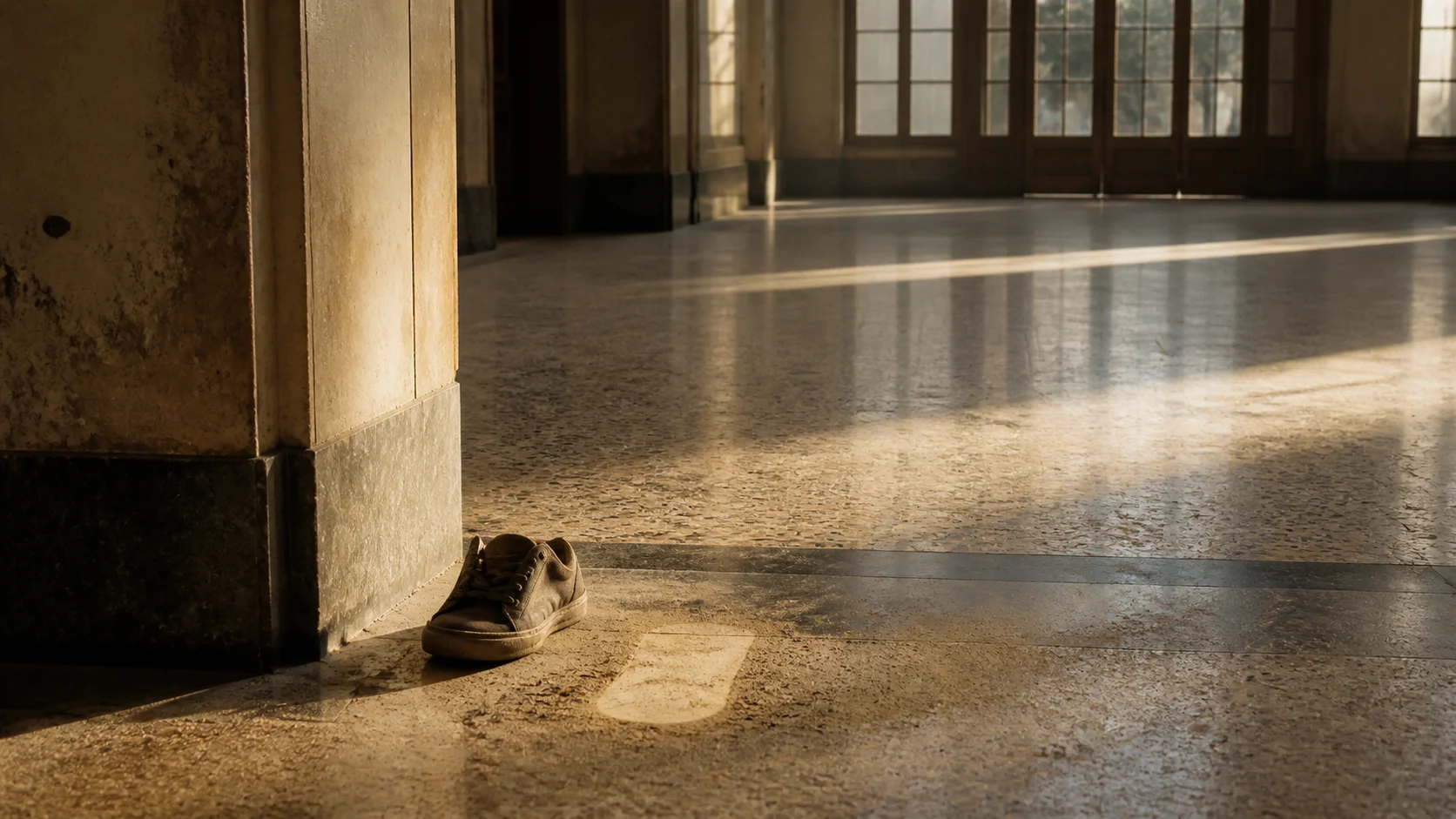
Your feet probably felt exposed.
Maybe you couldn't leave because you had no shoes, or only one remained, or you were wearing someone else's. Or maybe you were entirely barefoot. And in the dream, that kept getting in your way.
This dream tends to show up when you're trying to go somewhere. So it feels less like a dream about shoes and more like a dream about being unable to leave.
But open the old catalog, and the direction shifts. The conclusion isn't about movement — it's about people.
Lumi
"Do you know what the old entries say happens when you lose a shoe in a dream?
A person leaves you.
Not your feet — a person. That's a bit unexpected."
Table of contents
Shoe Entries Always Conclude With PeopleBut a Shoe Slipping Off Is DifferentBy SceneIf Your Feet Simply Wouldn't MoveThe Most Honest AnswerFrequently Asked QuestionsShoe Entries Always Conclude With People
The old Chinese dream manual Zhougong Jie Meng (the Duke of Zhou's dream manual, a family of traditional Chinese dream-interpretation texts) has a chapter grouping official hats, clothing, and shoes together. Gathering its shoe-related lines produces this:
- Obtaining shoes is auspicious for those beneath you
- Losing shoes means those beneath you will run away
- Borrowing shoes means gaining someone else's help
- Worn-out shoes mean your children and spouse will fall ill
- Wearing hemp sandals brings harmony to everything
Reading through this is strange. It's an entry about shoes, but every single conclusion is about people.
Gaining shoes is good for subordinates, losing them means subordinates flee, borrowing them means receiving help.
Why would that be?
There's a reasonable guess. In that era, shoes were paired with the idea of someone moving on your behalf — you needed to walk to get anywhere, and having someone to walk for you was itself a form of power. Shoes and people ended up occupying the same conceptual space.
The same rule we saw in our lost belongings dream guide shows up here too. The old catalog based its conclusions not on the object itself, but on what that object stood in for. An official's hat stood in for a position, so losing it meant losing that position; shoes stood in for movement, so losing shoes meant the person who provided that movement was leaving.
The folk dream-reading catalog in the "Dreams" entry of the Encyclopedia of Korean Culture (a major reference work on Korean history and culture) doesn't list a shoe entry as an example. The lines above come from a Chinese text with a different lineage from Korean folk records.
But a Shoe Slipping Off Is Different

The same chapter includes this line.
When wooden clogs slip off, misfortune has already passed.
That's the opposite direction from the entries above. Losing a shoe means a person leaves, but a shoe slipping off means bad luck is over.
The old catalog, in other words, drew a line between losing something and having it slip off.
Translated into modern terms, this makes sense. Losing something happens without your knowledge, while slipping off happens right in front of you. One is a loss; the other is a release.
The same chapter also notes that removing your shoes and tying a sash is inauspicious — another case where the manner of removal changes the reading.
So the order for working through this dream looks like this:
- What happened to the shoe — lost, slipped off, or worn out
- Whose shoe it was — yours, someone else's, or borrowed
- What happened as a result — couldn't leave, or left anyway
The old catalog actually drew its distinctions around points 1 and 2.
By Scene
This dream splits into quite a few distinct variations.
You Lost a Shoe
This is the most commonly searched version. You set it down and it's gone, or you don't remember where you left it, or you're still searching when you wake up.
Traditional interpretation, as covered above, points toward a person leaving. But that reflects how people of that era read the world, and it has never been tested for predictive accuracy.
Read in a modern light, this usually shows up as part of a larger scene of being unable to leave — you can't go anywhere without your shoes.
Only One Was Missing
The pair doesn't match, or you're walking with just one shoe on.
People often say this particular scene sticks with them more than most, likely because having half of something is more uncomfortable than having nothing at all.
No traditional entry specifically addressing a single missing shoe has been confirmed.
It Didn't Fit
Too big, too small, or your foot simply won't go in.
Read in a modern light, this isn't about the object at all — it's about the sensation of something not fitting. It overlaps with the theme of clothes not fitting in a dream, which we cover in our clothes dream guide.
You Were Wearing Someone Else's Shoes
They aren't yours, or you realize partway through that they belong to someone else.
Traditional interpretation has a nearby entry here: borrowing shoes means gaining someone else's help. Wearing someone else's shoes isn't recorded on the bad side.
They Were Worn Out or Falling Apart
The sole comes loose, holes appear, or they fall apart as you walk.
Traditional interpretation takes this scene seriously: worn-out shoes mean your children and spouse will fall ill. Once again, the conclusion lands on people.
Still, there's no evidence this dream carries information about anyone's actual health.
You Put On New Shoes
You bought them, received them as a gift, or wore them for the first time.
Traditional interpretation generally reads acquiring something new as favorable. The same chapter includes a line stating that receiving a new official post brings a noble child.
You Were Barefoot
You had no shoes at all, or they slipped off at some point without your noticing.
Traditional interpretation offers little on bare feet specifically. But the body-related entries in the Korean folk catalog include one stating that being naked brings good fortune — at minimum, an undressed state wasn't read as a bad sign.
If you were barefoot in front of other people, that overlaps with the scene we cover in our public embarrassment dream guide.
You Couldn't Leave Because of Your Shoes
You were searching for them and ran late, or had nothing to wear and couldn't set out.
This is less a shoe dream and more a dream about being late. It's common enough to appear as a formal item on standard scales used to survey typical dream themes — we cover it in our missing-flight dream guide.
Lumi
"One of those eight rang true, didn't it?
Losing, slipping off, and not fitting are all different entries in the old catalog.
Lumping them together won't get you an answer."
If Your Feet Simply Wouldn't Move
Sometimes the shoes aren't the issue — your feet themselves won't cooperate.
Read in a modern light, this belongs to an entirely different family. There's a stretch of sleep where muscle tension nearly disappears, and scenes of trying to run or walk get built on top of that state.
We cover this in our can't-run dream guide.
Standard dream-theme scales include being physically restrained and unable to move as a formal item too. That's a sign of how common this scene is.
The Most Honest Answer
Lumi
"Search for 'losing shoes in a dream' and you'll find claims that it means losing wealth.
The old entries didn't say wealth. They said people.
And even that isn't a prophecy — it just means shoes and people occupied the same space back then."
Traditional dream interpretation and modern research rely on different kinds of evidence.
What's confirmed. In old dream manuals, shoe entries generally conclude with people: obtaining shoes favors subordinates, losing them means they leave, and borrowing them means gaining help. And losing a shoe was treated differently from having it slip off — a slipped-off shoe was read as bad luck already passing.
What isn't confirmed. The Korean folk catalog doesn't list a shoe entry as an example. No standard dream-theme scale includes a shoe item. No data measuring how often this dream occurs has been confirmed.
The encyclopedia itself notes, after laying out its list of dream-reading methods, that such interpretations formed naturally from many people's experiences rather than from a consistent theoretical basis.
A few points should be made clearly.
Losing a shoe in a dream doesn't mean someone is actually about to leave. The old entry reflects how people of that era read the world.
A shoe wearing out in a dream isn't information about anyone's health, either.
A blanket reading of "shoes equal wealth" isn't how the old catalog actually worked. Its conclusions point toward people.
There's no verified connection between a shoes dream and lottery numbers.
Frequently Asked Questions
Is losing a shoe in a dream a bad-omen dream? The old entries lean toward a subordinate leaving. But that's a record, not a prediction.
Only one shoe was missing. No traditional entry specifically addresses a single missing shoe. Having half of something tends to feel more uncomfortable in memory than having nothing at all.
A shoe slipped off. The old catalog separated losing from slipping off. A slipped-off shoe is recorded as bad luck that has already passed.
I was wearing someone else's shoes. That isn't recorded on the bad side. Borrowing something in the old catalog leans toward receiving help.
I was barefoot. A dedicated bare-foot entry is hard to confirm. Still, the Korean catalog doesn't read an undressed state as inherently bad.
My shoes didn't fit. The sensation of something not fitting is more informative here than the object itself.
I couldn't leave because of my shoes. That belongs to the family of lateness dreams, common enough to appear as a formal item on standard scales.
This dream feels frustrating because one small thing keeps you from leaving. Nothing major has happened, yet your feet are stuck.
The old catalog, though, read those feet as standing in for a person. That's a distant idea by today's standards, but it's worth noting that shoes were never treated as mere objects.
Three things worth writing down today:
- What happened to the shoe — lost, slipped off, or ill-fitting
- Whose shoe it was
- Where you couldn't go as a result
If that third line comes up empty, that's informative too — it may mean there was nowhere to go in the first place.
If the road itself is what stuck with you, our lost dream guide covers that separately.

A dream where only a small object remains is easy to write down.
Just add one line about what it kept you from doing. Collect a few weeks of these, and you'll notice whether you're always getting stuck at the same point.
Dream Talisman looks at the dream scene you record together with your day stem (ilgan) in the Five Elements system, and creates a color and phone wallpaper for the day. It's less an app that interprets your dream for you than one that helps you write it down before it fades.
Record today’s dream in Dream Talisman
References
- Zhougong Jie Meng — "Official Robes, Clothing, and Shoes" chapter · lines on obtaining, losing, borrowing, and slipping off shoes. This reflects commonly circulated lines rather than a checked original edition, and is a Chinese dream-interpretation tradition with a different textual lineage from Korean folk records
- "Dreams" — Encyclopedia of Korean Culture · the folk dream-reading tool catalog's body-related entries. A shoe entry is not listed as an example
- Nielsen, T. A. et al. (2003), "The Typical Dreams of Canadian University Students," Dreaming 13(4) · items on arriving late and being unable to move. No shoe-related item appears
- General research in modern sleep and dream psychology