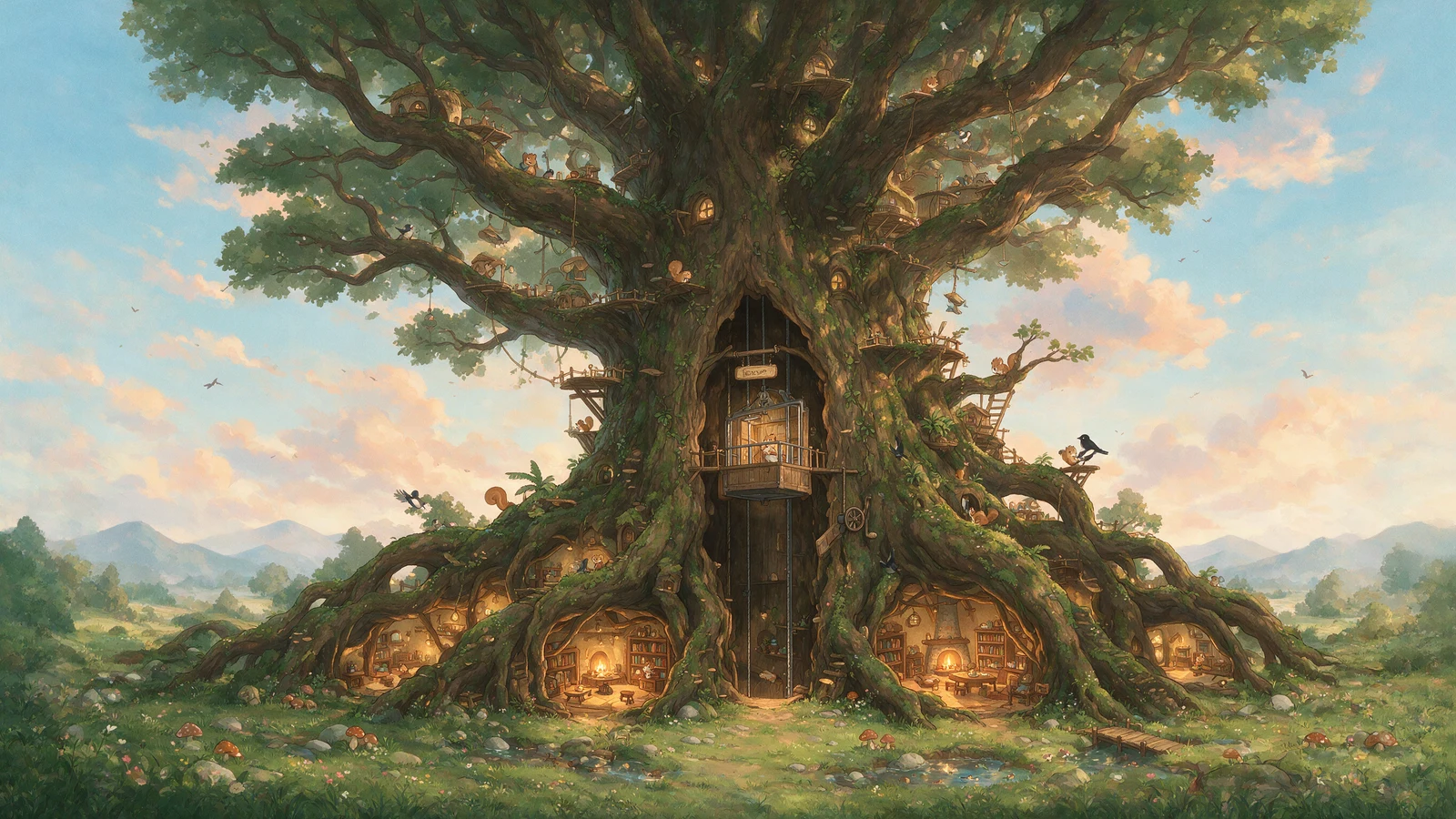
The tree was probably just standing there.
Nothing happened — it was simply present, and you were simply looking at it. That makes this dream hard to search for. You know it's a tree dream, but you don't know what question to ask about it.
The old catalog is surprisingly generous here. It breaks trees down into very fine categories, and the first question it asks is this.
Were you above the tree, or below it?
Table of contents
Climbing Earns You a Name; Standing Beneath Earns You ShadeBut Climbing Comes With a ConditionFive of the Korean Catalog's Six Plant Entries OverlapWithered Trees, Dying TreesThe Tree Broke or FellPlanting a Tree, Felling a TreeA Tree Growing on a House or a WellIf You Searched Here for a TaemongThe Most Honest AnswerFrequently Asked QuestionsClimbing Earns You a Name; Standing Beneath Earns You Shade
Split the tree entries of the Chinese Zhougong Jie Meng (Duke of Zhou dream manual tradition) into above and below, and they break down like this.
Above
- Climbing a large tree brings fame and profit into the open
Below
- Standing beneath a tree means benefiting from a powerful patron's protection
- Sitting or lying down in a forest cures illness
What stands out here is that both directions read favorably. It isn't a case of up being lucky and down being unlucky.
The type of good fortune differs instead. Climbing means being made visible; staying below means being protected.
And the illness-curing entry appears only on the below side. Recovery, it seems, was something you gained by sitting in the shade — not by climbing.
Lumi
"Were you looking up at it, or were you up in it?
The old entries call both favorable, but what you gain differs.
Up gets you a name; down gets you shade. Worth thinking about which one you actually need right now."
But Climbing Comes With a Condition
The same catalog also includes this entry.
Climbing a tree and having the branch suddenly break means injury or harm.
The plant-related branch of the Dreams entry of the Encyclopedia of Korean Culture (a major reference work on Korean history and culture) carries the same content: climbing a tree and having the branch break can mean death.
Climbing itself is favorable, but if the ground beneath you gives way after you've climbed, the reading reverses entirely.
This translates easily into today's terms. Climbing is fine — the problem is when whatever's holding you up fails.
Read in a modern light, a scene of the ground giving way beneath you at height is usually connected to whatever has been holding you up. One explanation ties an uptick in scenes like this to periods that feel like more than you can handle.
If the sensation of falling was strongest, see our falling dream guide.
Five of the Korean Catalog's Six Plant Entries Overlap
The encyclopedia's plant-related interpretation catalog lists six example entries.
- Sitting or lying down in a lush, deep-green grove cures illness
- Climbing a tree and having the branch break can mean death
- Felling and bringing home a massive tree brings great wealth
- Climbing a large tree brings widespread fame
- A mulberry tree growing over a well brings worry
- Passing through an area full of fruit trees brings a windfall
The Zhougong Jie Meng family states nearly the same things: sitting or lying in a forest cures illness, climbing a tree and breaking a branch causes harm, felling a large tree brings substantial wealth, climbing a large tree reveals fame and profit, and a mulberry tree over a well brings worry.
Five of the six entries overlap directly.
Our house dream guide found four overlapping house-related entries, and the bird dream guide found three. The tree category has the highest overlap rate of the three.
It's a natural conclusion that Korean folk plant interpretation inherited a substantial portion of this textual lineage. A tree was probably an easy subject to break into entries — up, down, branch, root, leaf, fruit. Its parts were already divided for you.
Withered Trees, Dying Trees
Lumi
"If you saw a withered tree, you probably braced for bad news.
But it says right there: new shoots sprouting from a withered tree means your descendants will flourish.
That ranks among the most favorable entries in the whole old catalog."
Traditional interpretation splits a withered tree into two readings.
Simply being withered is unlucky. A withering tree means misfortune for a person, and a tree dying of drought means an unsettled household.
But if it comes back to life, the reading flips entirely. New shoots on a withered tree mean your descendants will flourish, and so does a withered tree suddenly blooming.
A scene of something that looked dead coming back to life was ranked very highly. That makes intuitive sense — a tree already looks dead every winter and returns every spring.
Read in a modern light, an image of revival is usually connected to something you thought was already over. This is a symbolic reading, though, not a verified prediction.
The Tree Broke or Fell
A large tree suddenly snapped or toppled over. Many people remember the sound of it.
Traditional interpretation leans unlucky here. A large tree suddenly breaking is recorded as a violent, unlucky sign.
This differs from the withered-tree entry above. Withering allows for recovery, but breaking is sudden. The old catalog captured that distinction.
Read in a modern light, a sudden collapse is often read as an image of something that struck without warning — not a gradual decline, but a break that happened all at once.
The entry about a house's ridge beam breaking belongs to the same family. See our house dream guide for more.
Planting a Tree, Felling a Tree
Traditional interpretation reads both directions favorably.
Planting a tree is recorded as greatly auspicious and prosperous, and felling and bringing home a massive tree is recorded as bringing great wealth.
Planting is favorable, and felling is favorable. It's the same structure we saw in our rain dream guide, where both getting soaked and staying dry were read favorably.
The type of good fortune differs, though. Planting concerns something built to last; felling concerns something that arrives immediately. This preserves a sensibility from an era when trees themselves were treated as property.
Read in a modern light, one interpretation connects planting to beginnings and felling to closure. The feeling after the felling is what decides the reading — did it feel like relief, or like a loss?
A Tree Growing on a House or a Well
The tree was growing somewhere it shouldn't have been.
Traditional interpretation varies sharply depending on the location.
- A pine tree growing on a roof means rising to a high position
- Leaves from a large tree falling inside the house is favorable
- A tree growing on the wooden floor (maru) means worrying about your parents
- A mulberry tree growing over a well brings worry
The roof reads favorably; the floor and the well read unfavorably.
A pattern emerges. Growing overhead reads as favorable; blocking a space people actually use reads as unlucky. A well is where you draw water, and a maru is where people sit. A tree growing there means that space can no longer be used.
Read in a modern light, one interpretation reads something growing where it shouldn't as something taking up space it doesn't belong in. This article won't carry the old entries' fortune ratings over directly, though.
If You Searched Here for a Taemong
Traditional interpretation has a relevant entry. A tree growing deep in a forest is recorded as bringing a noble child, and a fruit tree heavy with ripe fruit is recorded as bringing peace to one's descendants.
The plant category in the encyclopedia's taemong entry list of conception-dream images is organized by sex, and most of its entries cluster around fruit rather than the tree itself.
If the fruit is what stayed with you, see our fruit dream guide.
Either way, no dream can reveal whether you're pregnant or your child's sex. Taemong stories are usually attached after the fact. Taemong dreams more broadly are covered in our baby dream guide.
The Most Honest Answer
Lumi
"Search 'large tree dream wealth' and you'll find plenty of claims.
There is an entry — but it applies when you felled it.
No entry reads a large tree simply standing there as wealth."
Traditional dream interpretation and modern psychology draw on different kinds of evidence.
What's confirmed in the old records is that trees were divided finely by position, condition, and location — above or below, alive or withered, where it was growing. That's not a prediction — it's a record of how people in that era read the world.
The encyclopedia itself, after laying out its interpretation catalog, states plainly that these readings formed naturally out of many people's lived experience rather than from any consistent theoretical foundation.
A few points should be stated clearly.
Simply seeing a large tree doesn't settle anything on its own. Even the old entries were built around what you did, not the tree itself.
A dream of a tree breaking doesn't predict an accident — not for you, and not for your family either.
A tree dream can't reveal pregnancy or a child's sex.
There's no verified connection between tree dreams and lottery numbers, either.
Frequently Asked Questions
Is a large-tree dream an auspicious dream (a good-omen dream)? An entry states that climbing a large tree brings widespread fame. No entry, though, addresses a tree simply standing there.
I was standing beneath the tree. The old entry reads this as benefiting from a powerful patron's protection. The entry about illness being cured by sitting or lying in a forest also belongs to the "below" category.
The tree was withered. Simply being withered reads as unlucky. A scene of new shoots or blossoms appearing, though, ranks among the most favorable entries in the old catalog.
A large tree fell over. A sudden break is recorded as unlucky. A modern reading treats it as an image of something that struck without warning.
I cut down a tree. The old entry reads this as wealth. What's worth reading is how you felt after the felling.
A tree was growing inside the house. This depends on the location. The roof was read favorably; the floor and the well were read as worry.
Tree dreams feel ambiguous because nothing actually happens. Trees don't move.
But the old catalog changed the question at exactly that point. It didn't ask what the tree did — it asked where you were.
Today's task comes down to three lines.
- Were you above or below
- Was the tree alive or withered
- Where the tree was standing
Those three lines cover every question the old catalog actually asked.

An eventless dream is easy to let slide, since there seems to be nothing to write down.
Two lines about position and condition are enough, though. Track it for a few weeks, and it starts to read as where your mind was during that stretch.
Dream Talisman looks at the dream scene you record together with your day stem (ilgan) in the Five Elements system, and creates a color and phone wallpaper for the day. It's less an app that interprets your dream for you than one that gets you to write it down before it fades.
→ Record your dream in Dream Talisman
References
- Dreams — Encyclopedia of Korean Culture · The plant-related branch of the folk-belief interpretation catalog, the two contrasting attitudes toward dream interpretation
- Taemong — Encyclopedia of Korean Culture · The plant category within the taemong-image classification
- Zhougong Jie Meng, Geography/Rocks/Trees chapter · Tree-related passages, rendered from widely circulated quoted passages; the original edition was not cross-checked. A Chinese traditional dream-interpretation text with a different lineage from Korean folk records
- General research in modern sleep and dream psychology